

This action works with built-in product fields. To set your own custom attributes, use Set Attribute Value instead.
Set a field value
1
Select products
Check the products you want to update, or use filters and select all matching results.
2
Open Bulk Edit and choose Set Field Value
Click Bulk Editing, then search for “Set Field” or find it under Attributes & Custom Fields.
3
Choose the field
Pick the field to set. Fields are grouped by type: text, identifiers, numeric, enum, and boolean.
4
Enter the value
Set the value. Text and identifier fields also accept formula variables in the
{{scope.key}} syntax.5
Set options and apply
Turn on Only if empty if needed, then click Apply.
Options
Available fields
Text fields
Text fields
Product Name, Reviewed Name, Description, Enriched Description, Short Description, Enriched Short Description, SEO Title, SEO Description, SEO Keywords, Brand, Supplier.
Identifier fields
Identifier fields
SKU, EAN, UPC, MPN (Manufacturer Part Number), HS Code, Country of Origin.
Numeric fields
Numeric fields
Price, Special Price, Cost, Weight, Length, Width, Height, Stock Quantity, Low Stock Threshold.
Enum fields
Enum fields
Status (Active/Inactive/Pending/Archived), Review Status (Unreviewed/Reviewed), Stock Status (In Stock/Out of Stock/On Backorder), Product Type (Simple/Configurable/Virtual/Bundle/Grouped), Dimension Unit (mm/cm/m/in/ft), Weight Unit (g/kg/oz/lb).
Boolean fields
Boolean fields
Manage Stock, Requires Shipping, Backorders Allowed, Is Dangerous Good, Is Visible.
Use formulas in text fields
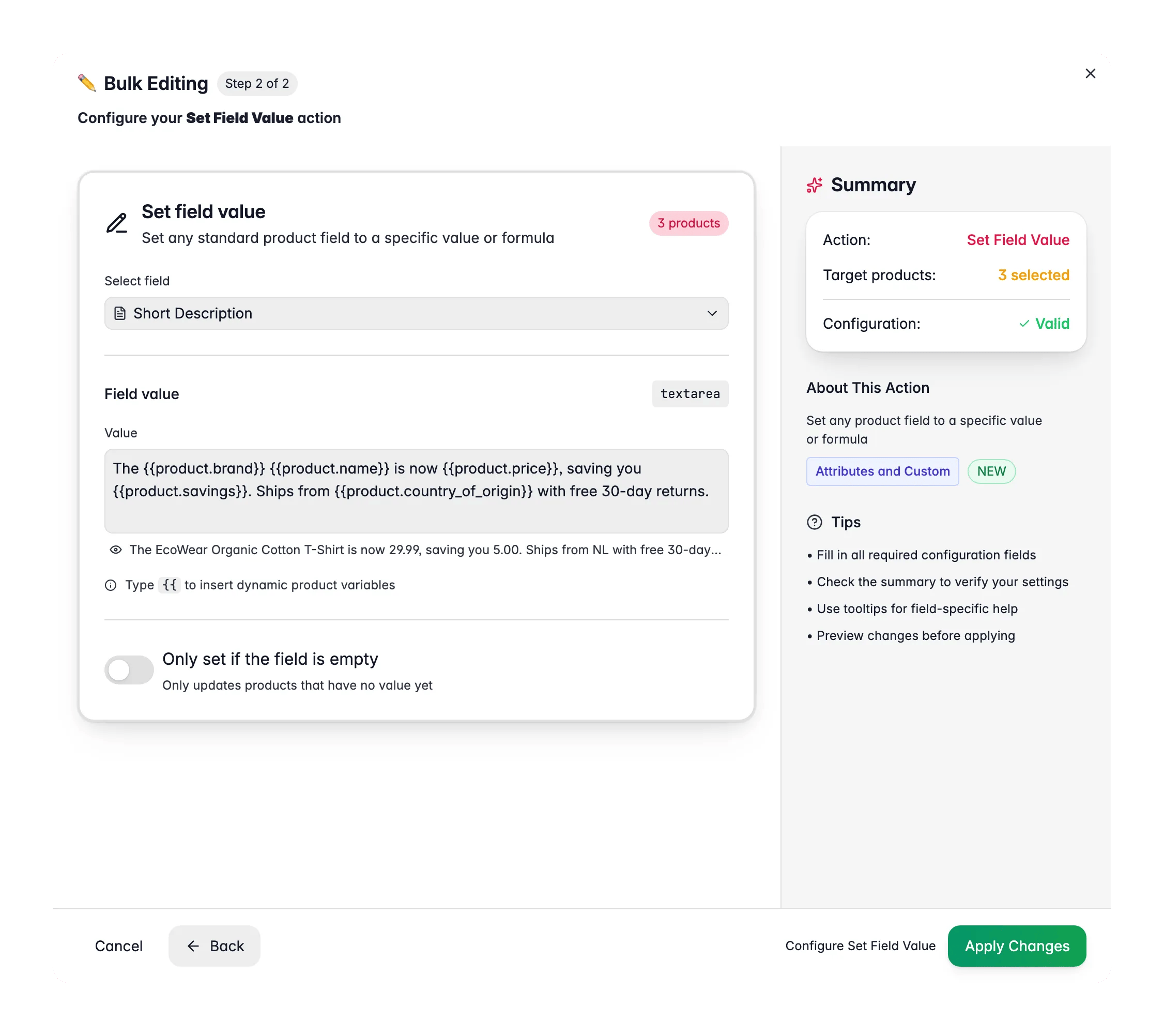
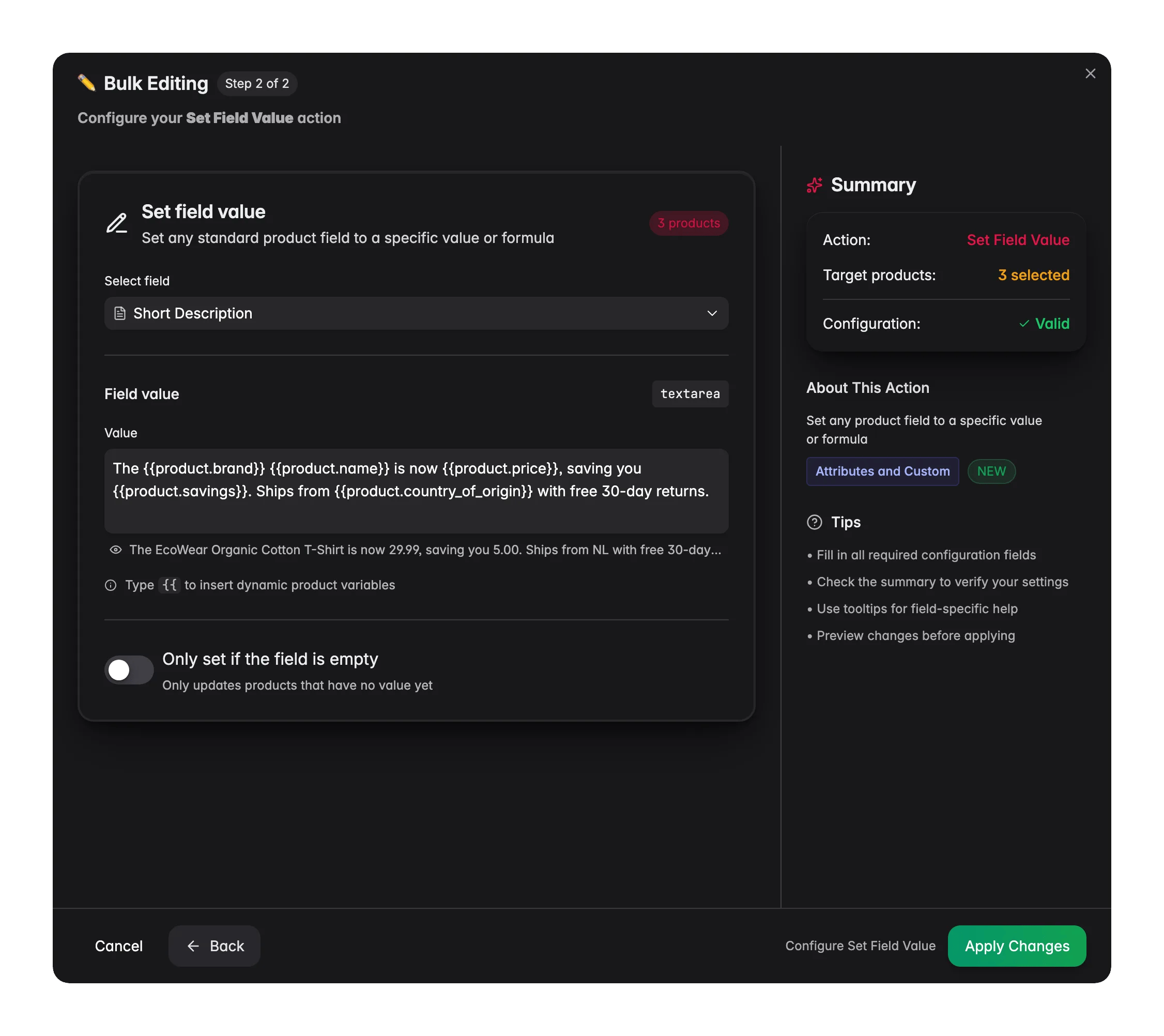
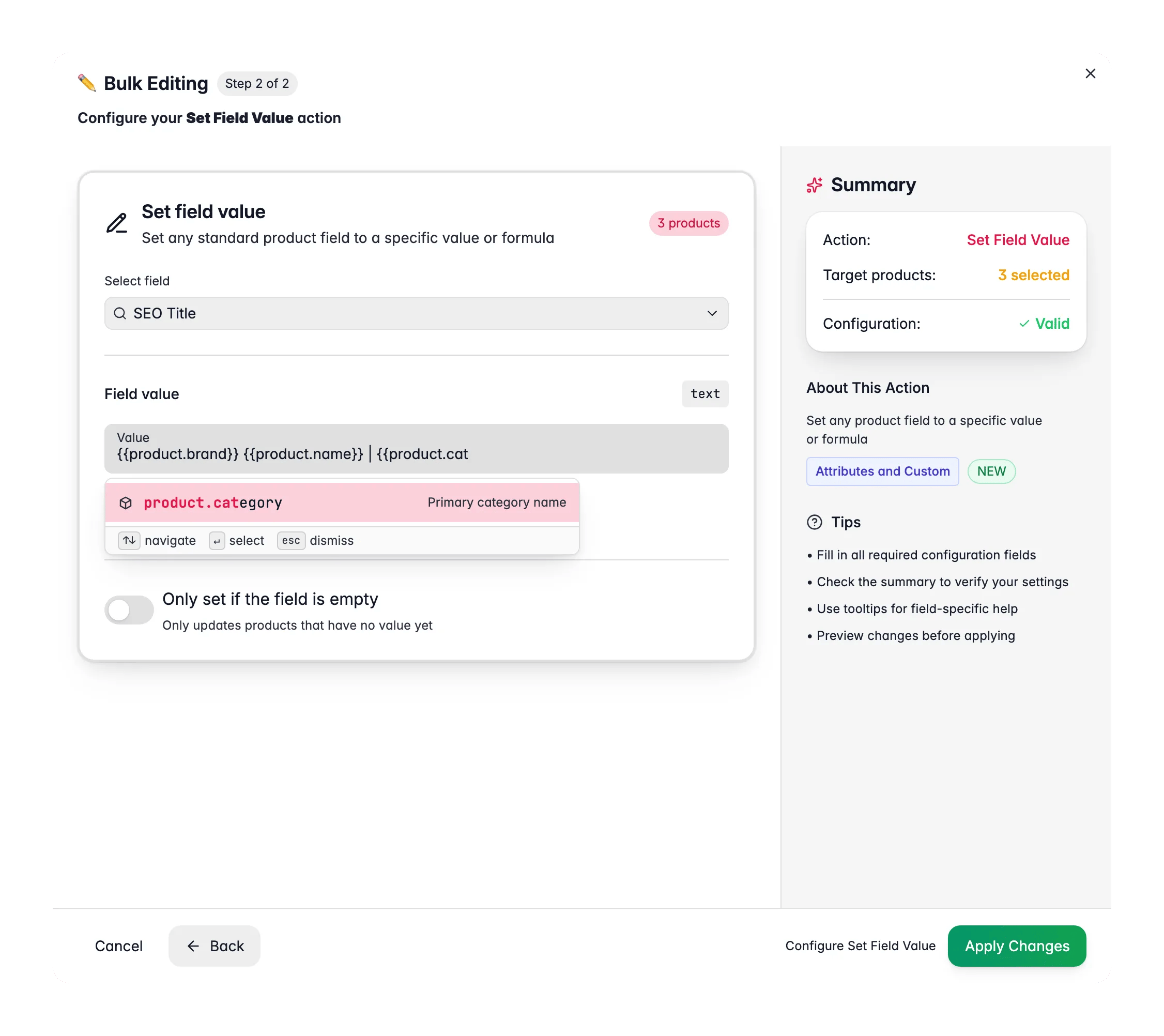
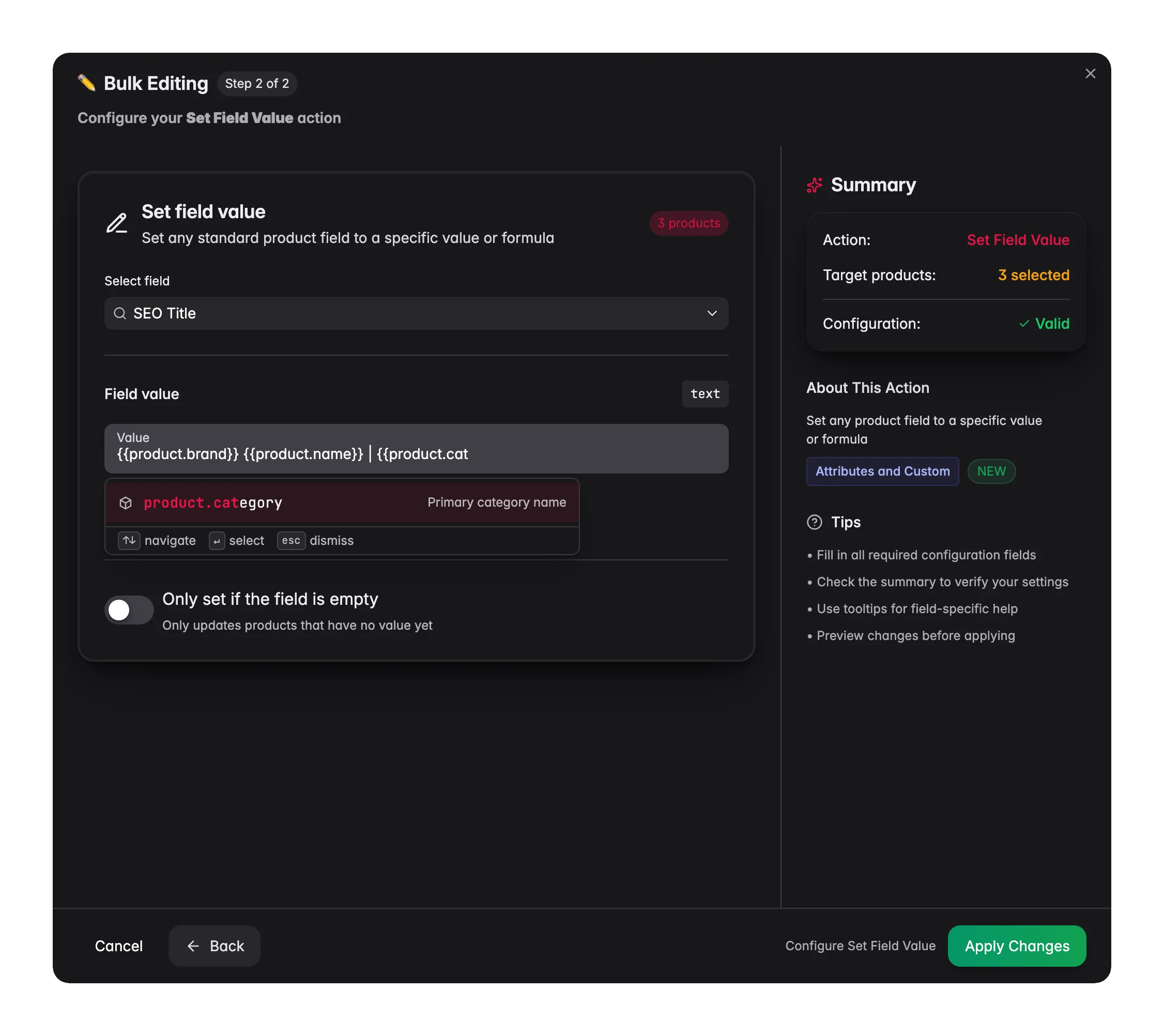
{{scope.key}} syntax. Type {{ to open the autocomplete dropdown. It lists every variable across all scopes. A preview below the input shows which variables it detected.
Fields that accept formulas: Product Name, Reviewed Name, Description, Enriched Description, Short Description, Enriched Short Description, SEO Title, SEO Description, SEO Keywords, Brand, Supplier, SKU, EAN, UPC, MPN, HS Code, Country of Origin.
Examples
SEO and storefront copy
SEO and storefront copy
Generate SEO titles from product data
- Field: SEO Title
- Value:
{{product.name}} | {{product.brand}} | Buy Online
“Air Max 90 | Nike | Buy Online”. Each product gets a unique, keyword-rich title.Build structured short descriptions
- Field: Short Description
- Value:
{{product.name}} by {{product.brand}}. {{category.short_intro}} Shop now at {{global.website_url}}.
“Air Max 90 by Nike. Premium running shoes for everyday performance. Shop now at shop.example.com.”Set SEO descriptions with pricing and brand context
- Field: SEO Description
- Value:
Buy {{product.name}} for only €{{product.price}}. {{brand.tagline}}. Free shipping on orders over €50.
“Buy Air Max 90 for only €129.99. Just Do It. Free shipping on orders over €50.”Bulk-set meta keywords with dynamic values
- Field: SEO Keywords
- Value:
{{product.name}}, {{product.brand}}, {{product.sku}}, {{category.name}}
“Air Max 90, Nike, NK-AM90, Running Shoes”
B2B catalogs and data sheets
B2B catalogs and data sheets
Standardized short descriptions with technical specs
- Field: Short Description
- Value:
{{product.name}} ({{product.sku}}) | {{category.material}} | {{product.weight}} {{product.weight_unit}} | {{product.dimensions_l}}×{{product.dimensions_w}}×{{product.dimensions_h}} {{product.dimension_unit}}
“Stainless Steel Hex Bolt M10x50 (SS-HB-M1050) | AISI 304 | 0.085 kg | 50×17×17 mm”. Every product gets a consistent, spec-first format that purchasing teams can scan quickly.Generate B2B product titles with manufacturer part number
- Field: Product Name
- Value:
{{product.name}} | {{product.manufacturer_part_number}} | {{product.brand}}
“Industrial Ball Bearing 6205-2RS | 6205-2RS-SKF | SKF”. Standardizes naming so buyers can search by MPN or brand.Structured descriptions for product data sheets
- Field: Description
- Value:
{{product.name}} by {{product.brand}}.\n\nSpecifications:\n- Material: {{category.material}}\n- Weight: {{product.weight}} {{product.weight_unit}}\n- Dimensions: {{product.dimensions_l}} × {{product.dimensions_w}} × {{product.dimensions_h}} {{product.dimension_unit}}\n- HS Code: {{product.hs_code}}\n- Country of Origin: {{product.country_of_origin}}\n\n{{brand.compliance_text}}\n\nMinimum order: {{category.moq}} units. {{global.lead_time_text}}
Creates a complete, standardized description with specs, compliance info, MOQ, and lead times, all pulled from product, brand, and category variables.SEO descriptions targeting B2B search queries
- Field: SEO Description
- Value:
Order {{product.name}} ({{product.sku}}) from {{global.company_name}}. {{category.short_intro}} MOQ: {{category.moq}} units. {{global.lead_time_text}}.
“Order Stainless Steel Hex Bolt M10x50 (SS-HB-M1050) from Industrial Supplies BV. High-grade fasteners for structural applications. MOQ: 100 units. Ships within 3-5 business days.”
Tips
- Use Only if empty to fill missing SEO fields with formula content without overwriting copy you wrote by hand.
- Combine scopes in one formula, for example product data plus brand messaging plus global store info.
- Numeric fields use a fitting step size (€0.01 for prices, whole numbers for stock). Formulas are not available for numeric, enum, or boolean fields.
Related
Set Attribute Value
Set your own custom attributes in bulk.
Content Logic
Define the variables you use in formulas.