
Workflows must be enabled before you can use them. Go to Settings > Workflows to turn them on.
When to use a workflow
Audit your catalog
Find every product with missing or low-quality data, then work through the list until it is clean.
Prepare a launch
Make sure new products meet your standards before they go live on your sales channels.
Improve quality
Raise quality scores across the catalog by fixing descriptions, images, SEO, and more.
Move products forward
Push products through your lifecycle stages as they get ready to publish.
How a workflow is built
Every workflow has three parts:- Pre-filter (optional): scopes the whole workflow to a subset of products, like one category.
- Stages: group related tasks together. You complete one stage before moving to the next.
- Tasks: each task uses a filter to find products that need attention, such as a missing description.
Create a workflow
The Workflow Builder is a visual editor. Open it from Create Workflow on the workflows page, or by editing an existing workflow.1
Open the builder
Go to Workflows and click Create Workflow. You can also add one from Settings > Workflows.
2
Name your workflow
Give it a clear name, like “Q1 Launch Prep”, and a short description of its purpose.
3
Set a pre-filter (optional)
Click Add Pre-filter to limit the workflow to a set of products, like only “Electronics”. This filter applies to every stage and task.
4
Configure stages
Your workflow starts with one stage. Rename it, add a description, and set an optional stage filter to narrow products further. Click Add Stage to add more.
5
Add tasks
Click Add Task inside a stage to open the task picker. Choose ready-made presets, or build a custom task with your own filter conditions.
6
Save
Click Save in the top-right corner. Drafts save automatically as you work, so you will not lose progress.
How the three filters work together
Filters stack from broad to narrow, so each level cuts the product list down further:- Pre-filter scopes the whole workflow (for example, only “Clothing”).
- Stage filter narrows that down inside one stage (for example, only products missing images).
- Task filter finds the exact products to fix (for example, products with no description).
Every filter level supports AND/OR logic. For example: quality score is below 50% AND description is empty.
Task presets
The task picker comes with ready-made presets, grouped by category. Pick as many as you like, or add your own custom task.Quick Fixes
Quick Fixes
Low quality score, unreviewed products, missing main image.
Content
Content
Missing description, short description under 100 characters, missing reviewed name.
SEO
SEO
Missing meta title, short meta description, no meta keywords.
Commerce
Commerce
Missing price, no SKU, zero price, missing brand.
Inventory
Inventory
Out of stock, low stock, no stock info.
Media
Media
No images, missing image URL.
Quality
Quality
Critical quality below 25%, incomplete below 50%.
Translation
Translation
Not translated, partially translated.
Run a workflow
Click Start Workflow from the workflows page to open the task view.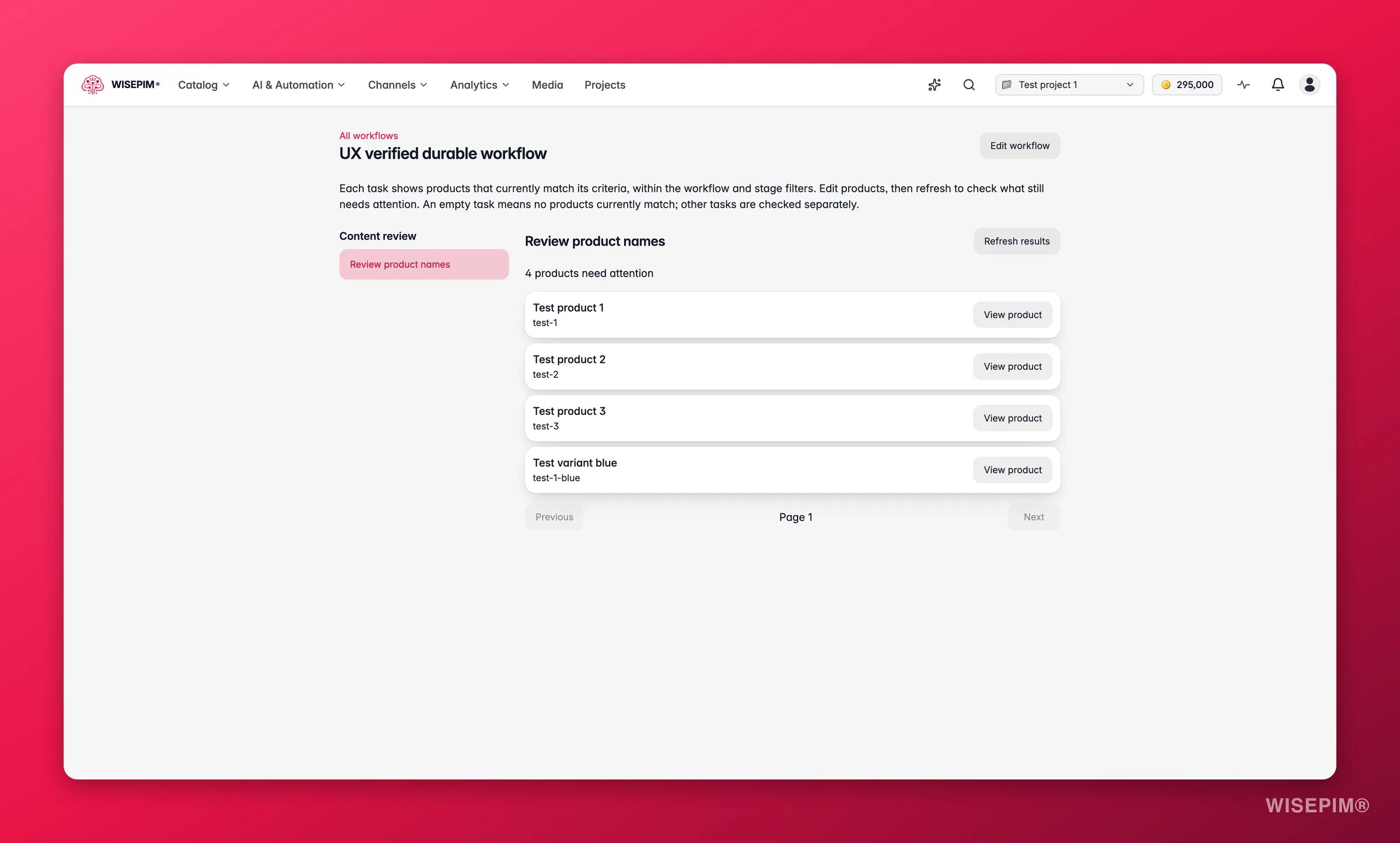
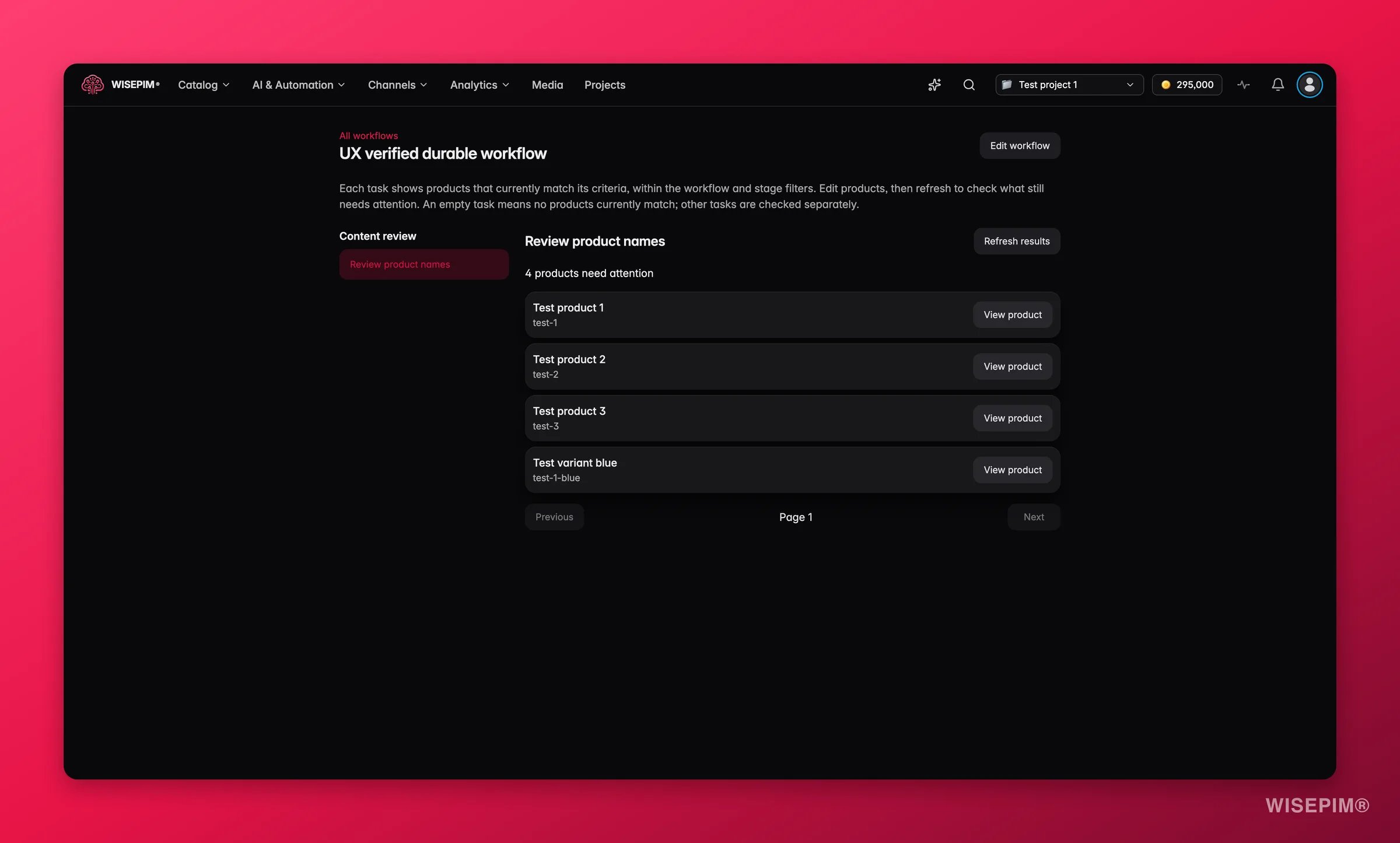
- The heading counts what is left, as “12 products need attention”.
- Every match is listed by name and SKU, and View product opens it for editing.
- Long lists page with Previous and Next.
- Refresh results re-runs the filter, so the count catches up with what you just fixed.
Counts move when you refresh, not on their own. That is deliberate: the list holds still while you work through it, instead of shifting under you.
Find your workflows
On the Workflows page, each workflow appears as a card showing:- The name and description.
- The from and to lifecycle stages, as colored chips.
- How many stages it has.
- A Start Workflow button.
Manage workflows
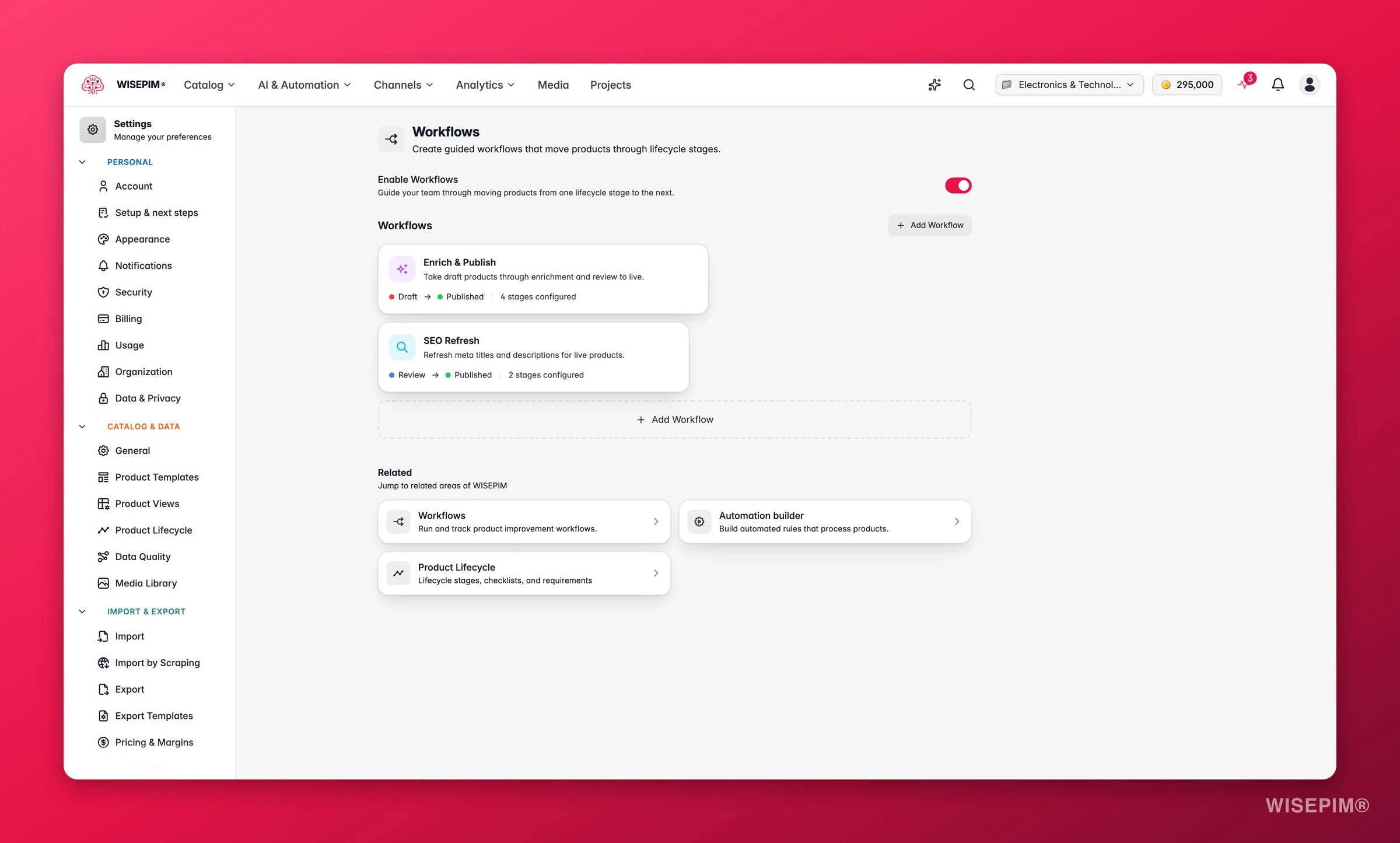
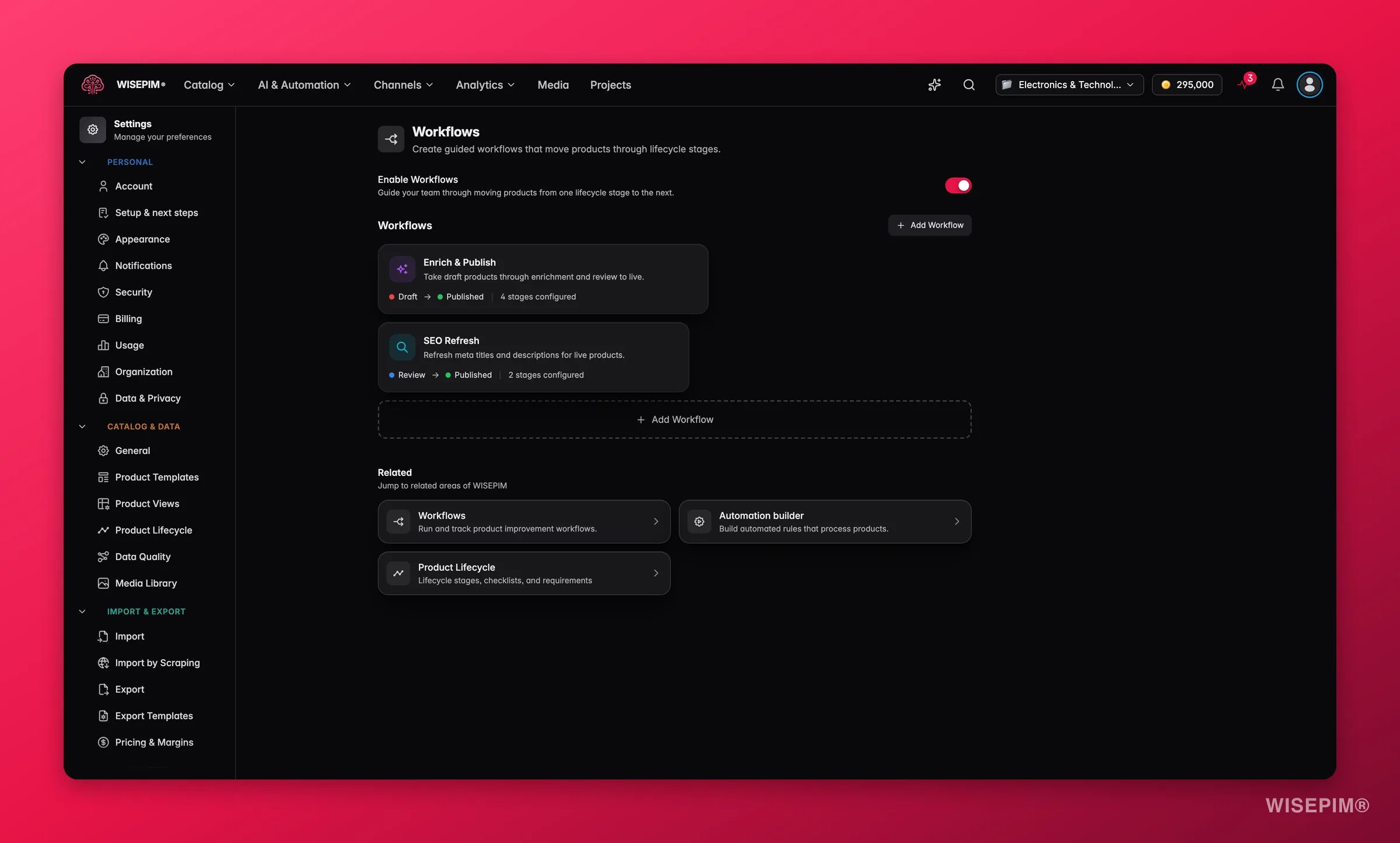
- Enable or disable workflows for your project.
- Create new workflows or edit existing ones.
- Delete workflows you no longer need.
- Start from a template instead of a blank workflow.
Related
Product Lifecycle
Define the stages products move through, and connect them to your workflows.
Automations
Set up actions that run on their own when conditions are met.
Workflow Settings
Turn workflows on and manage them for your project.