

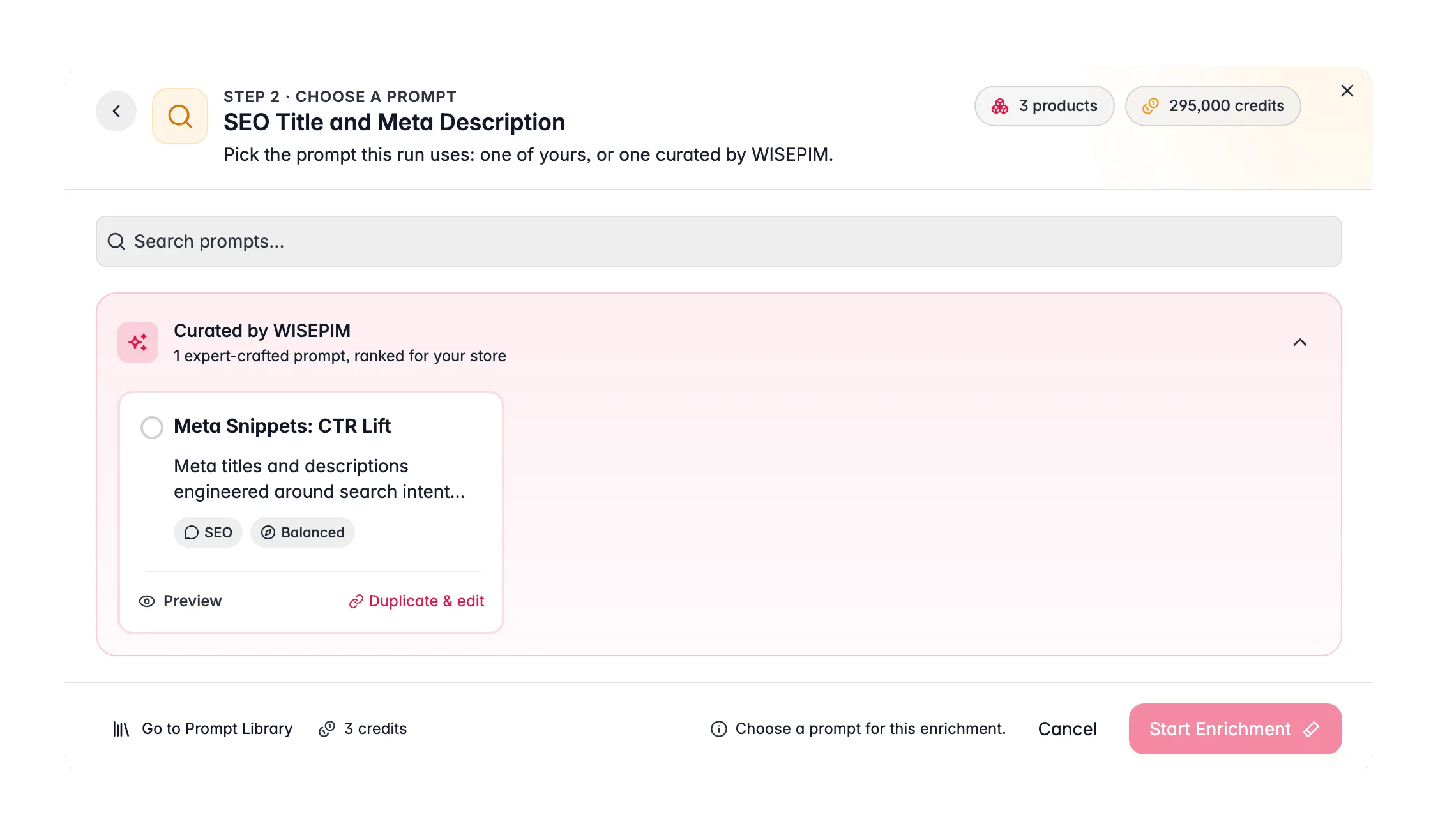
SEO enrichment costs 1 credit per product. It writes to the Meta Title and Meta Description fields (and meta keywords where used). These are separate from your on-page title and description, so enriching SEO meta does not change your storefront copy.
When to use it
- Meta fields are empty, so Google is guessing your snippet from page content.
- Meta titles are duplicated across variants, which dilutes their SEO value.
- Snippets are getting truncated in search results because they are too long.
- As part of Auto-Fill, which fills missing SEO meta using your default SEO prompt.
How to run it
1
Select products
Check products individually, or filter and select all matching results.
2
Open the Enrich modal
Click Enrich with AI in the toolbar.
3
Choose SEO Title and Meta Description
Pick SEO Title and Meta Description as the enrichment type.
4
Select a prompt
Choose an SEO prompt from your Prompt Library. Defaults from Settings → Enrich Prompts are pre-selected.No prompt of your own yet? Open the Curated Prompts tab. These are written by WISEPIM and ranked for your industry, so the best fit is near the top. Use Set as default on the one you pick and it is pre-selected for every SEO run from then on.
5
Start Enrichment
Click Start Enrichment and track it in the Process Tracker. If a run stops early, use Resume there to finish only the products that were not processed yet, at no extra credit cost.
What a great SEO prompt produces
Search snippets live or die by length and relevance. Encode the rules in your prompt:- Meta title: 50–60 characters. Longer titles get cut off with an ellipsis in results. Front-load the primary keyword and brand.
- Meta description: 140–160 characters. Write a compelling one-or-two-sentence pitch that includes the keyword naturally and gives a reason to click (benefit, range, or differentiator).
- One primary keyword per product. Match the term shoppers actually search, then support it with the product’s distinguishing detail.
- Each snippet unique. Duplicate meta tags compete with each other. Use Content Logic variables so every product’s snippet is built from its own data.
- Lead with value, not boilerplate. “Free shipping” at the end is fine, but the first words should be about the product.
Act on what you find
Snippets are truncated in Google
Snippets are truncated in Google
New runs already stay within 50–60 characters for titles and 140–160 for descriptions. Re-run the affected products to replace older, longer meta copy. Outcome: full snippets display without being cut off.
Meta titles are too similar across variants
Meta titles are too similar across variants
Add the distinguishing attribute (size, color, model) to the title formula using a Content Logic variable. Outcome: unique, non-competing snippets for every variant.
You're not sure which keyword to target
You're not sure which keyword to target
Connect Google Search Console and check the SEO and Search & Discovery reports to see which queries already drive impressions, then target those keywords in your SEO prompt. Outcome: meta copy aligned to real search demand.
Measure the impact
Meta changes show up as click-through-rate movement before they show up in revenue. After enriching, watch the SEO report for impressions and CTR on the enriched products, then Enrichment Impact for the downstream revenue lift.Related
SEO Analytics
Track impressions, clicks, and CTR for your products.
Search Intent
Rewrite content using real search queries.
Prompt Library
Build and organize your SEO prompts.
Enrichment Impact
Measure the revenue lift from better search snippets.