
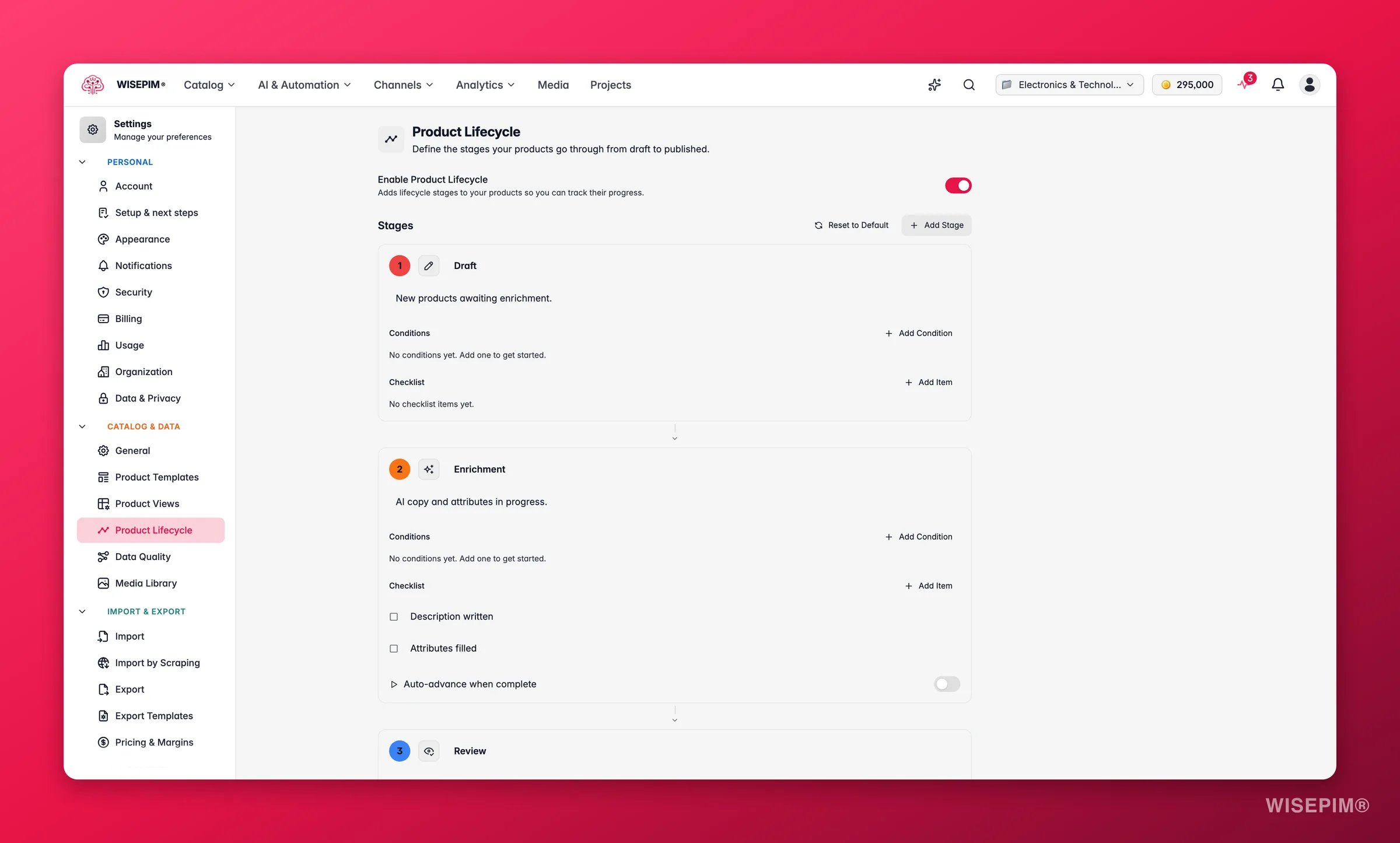
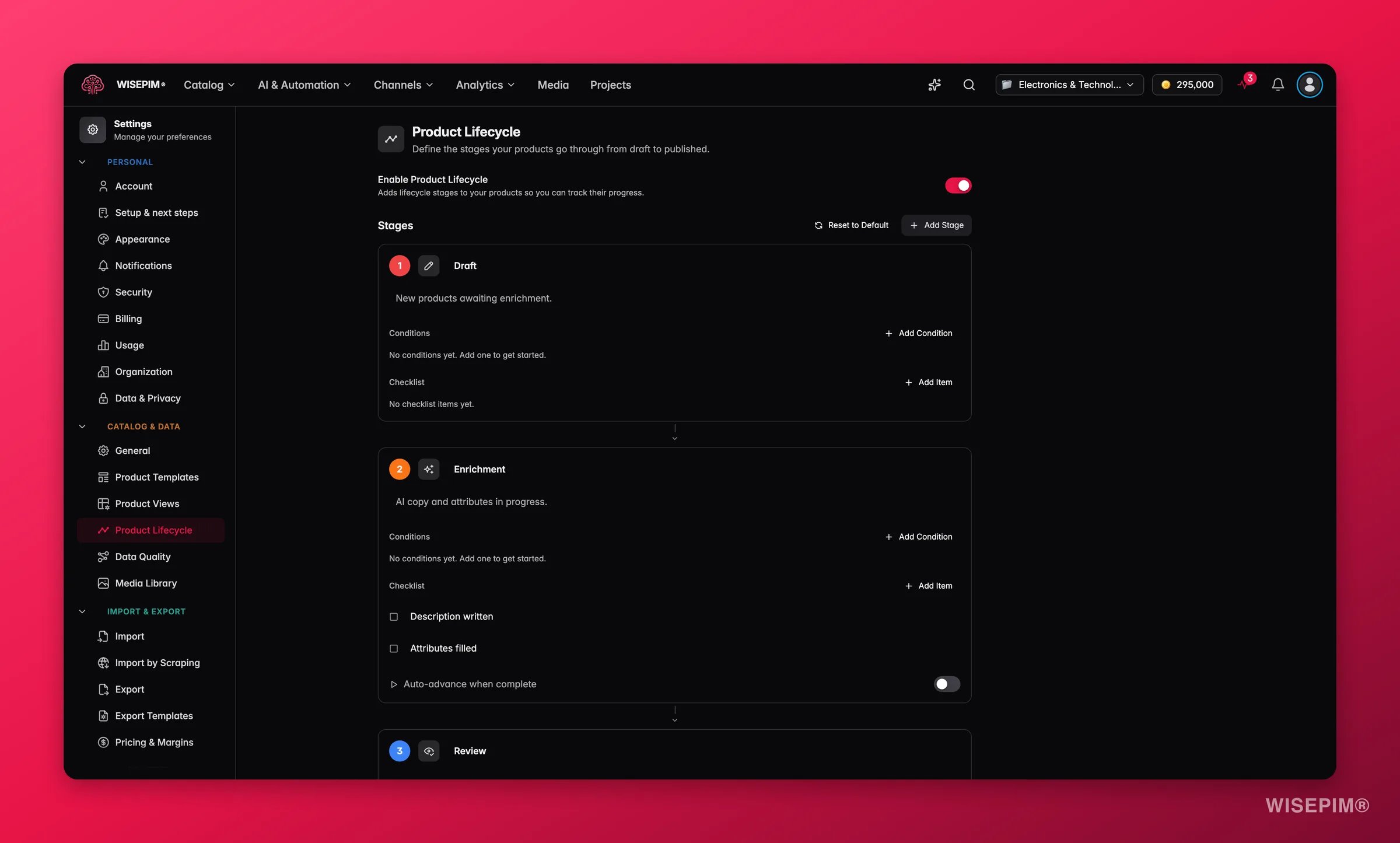
The lifecycle is set up per project. Go to Settings > Product Lifecycle to configure your stages.
Why use lifecycle stages
See status at a glance
Know instantly which products are drafts, in review, approved, or published. No guessing.
Follow one process
Every product follows the same repeatable steps, so nothing gets published before it is ready.
Set quality gates
Add requirements and checklists per stage. Products cannot advance until they pass.
Drive your workflows
Stages connect to Workflows, so guided processes can move products forward.
Enable the lifecycle
1
Open the settings
Go to Settings > Product Lifecycle. Make sure a project is selected in the project switcher.
2
Turn it on
Flip the Enable Product Lifecycle switch at the top of the page.
3
Configure stages
The stage editor appears. Here you add, edit, reorder, and remove stages.
Customize these or replace them with your own. Click Reset to Default anytime to restore the originals.
Build your stages
Add a stage
Click Add Stage, at the top of the stage list or the bottom of the pipeline. A new stage appears with default settings you can edit right away.Edit a stage
Each stage card lets you set:- Name: a clear label, like “Draft”, “Content Review”, or “Ready to Publish”.
- Color: one of eight options (blue, green, yellow, purple, red, orange, cyan, pink) to tell stages apart.
- Icon: one of 28 icons, grouped into five categories: Content & Creation (7), Review & Approval (6), Product Data (4), Publishing & Sales (7), and Maintenance (3).
- Description: an optional note on what happens in this stage.
Reorder stages
The order of your stages is the order of your pipeline. Hover over a stage card and use the up and down arrows to move it.Delete a stage
Hover over a stage card and click the trash icon. Any products in that stage will need to be moved to another one.Set quality gates
Quality gates stop a product from advancing until it is ready. You build them from automatic requirements and manual checklists.Add requirements
Requirements are conditions a product must meet to enter or stay in a stage. Find the requirements section inside each stage card.1
Add a condition
Click Add Condition in the stage’s requirements area.
2
Pick a field
Choose which product attribute to check. The list covers every attribute in your project: built-in fields like description, price, and EAN, plus any custom attributes from Settings > Product Attributes.
3
Choose an operator
Pick how to evaluate the field:
4
Set a value
Enter the value to compare against. Operators like “is empty” need no value.
5
Set the logic
With more than one condition, choose whether all must pass (AND) or any one is enough (OR).
- Ready to Publish requires: description is not empty AND quality score is greater than 75 AND main image exists.
- Content Review requires: description is not empty OR short description is not empty.
Add a checklist
Some checks need a human eye, like confirming photo quality or supplier pricing. Each stage can hold a manual checklist for these.1
Add an item
Click Add Item in the stage’s checklist section.
2
Describe the task
Write a clear, actionable item, like “Verify all images are at least 1000x1000px”.
3
Add more as needed
Repeat for every manual check that belongs in this stage.
Advance products automatically
When a stage has requirements or checklist items, you can turn on auto-advance. Products that meet every requirement then move to the next stage on their own, with no manual step. To enable it:- Make sure the stage has at least one requirement or checklist item.
- Flip the Auto-advance when complete switch at the bottom of the stage card.
Auto-advance only appears once a stage has a quality gate. This stops products from skipping ahead in stages with no checks.
Example setups
Not sure how to structure your pipeline? Start from one of these.Simple two-stage review
Simple two-stage review
Best for small teams that just need a basic review step.
- Not Reviewed (Red): awaiting initial review.
- Reviewed (Green): checked and approved.
E-commerce publishing pipeline
E-commerce publishing pipeline
For teams preparing products for online stores.
- Draft (Blue): raw data, just imported or created.
- Content Enrichment (Yellow): descriptions and attributes being written or AI-enriched.
- SEO Review (Orange): meta titles, descriptions, and keywords being optimized.
- Quality Check (Purple): final review against your quality standards.
- Ready to Publish (Green): approved and ready to export to your webshop.
- Published (Cyan): live on your sales channels.
Multi-market launch
Multi-market launch
For teams launching products across several markets.
- Data Collection (Blue): gathering specs and images.
- Content Creation (Yellow): writing descriptions in the primary language.
- Translation (Purple): translating to all target languages.
- Legal Review (Orange): compliance and regulatory checks.
- Approved (Green): ready for all markets.
- Archived (Red): discontinued or seasonal products.
Save your changes
WISEPIM tracks every change you make: adding stages, editing names, reordering, deleting, and toggling the feature. A save bar appears at the bottom of the page whenever you have unsaved changes.- Click Save to store your whole configuration at once.
- Click Undo to revert all changes since your last save, restoring the server’s exact state.
- A loading indicator shows while the save runs.
Undo reverts everything at once. There is no partial undo. To keep some changes and drop others, save first, then make more edits.
Use stages on products
Once your stages are set up, they appear in the Products table. Each row shows a lifecycle stage selector with the product’s current stage, icon, and color. To change a product’s stage:- Find the product in the table.
- Click its lifecycle stage indicator.
- Pick the new stage from the dropdown. Each option shows the name, icon, and color.
- The stage updates right away.
Related
Workflows
Run guided processes that find, fix, and move products through your stages.
Product Attributes
Define the fields your stage requirements can check against.