
Someone else built this catalog and they are not around to explain it. Product names are capitalised four different ways, half the descriptions carry links to a site you do not own, thousands of products sit in “Uncategorized”, and nobody can tell you which numbers are trustworthy. You do not need to read every product. You need an order of operations that fixes the cheap, catalog-wide problems first and leaves you with a floor the catalog cannot fall below again. This is that order. Budget about half a day of hands-on work, spread across your first two weeks. If you imported this catalog yourself and it is only days old, part 3 of the first-catalog series is the shorter version - this guide assumes a catalog you did not build and cannot ask anyone about.
Before you start: your products need to be imported already, so Data Quality has something to measure. If data is still arriving, finish importing first and work through the Import Cleanup Wizard it opens for you.
What you’ll get: a measured before-and-after quality score, a catalog with consistent text, real categories, and grouped variants, plus two or three Quality Guard rules that keep it from regressing.

Take a baseline before you touch anything

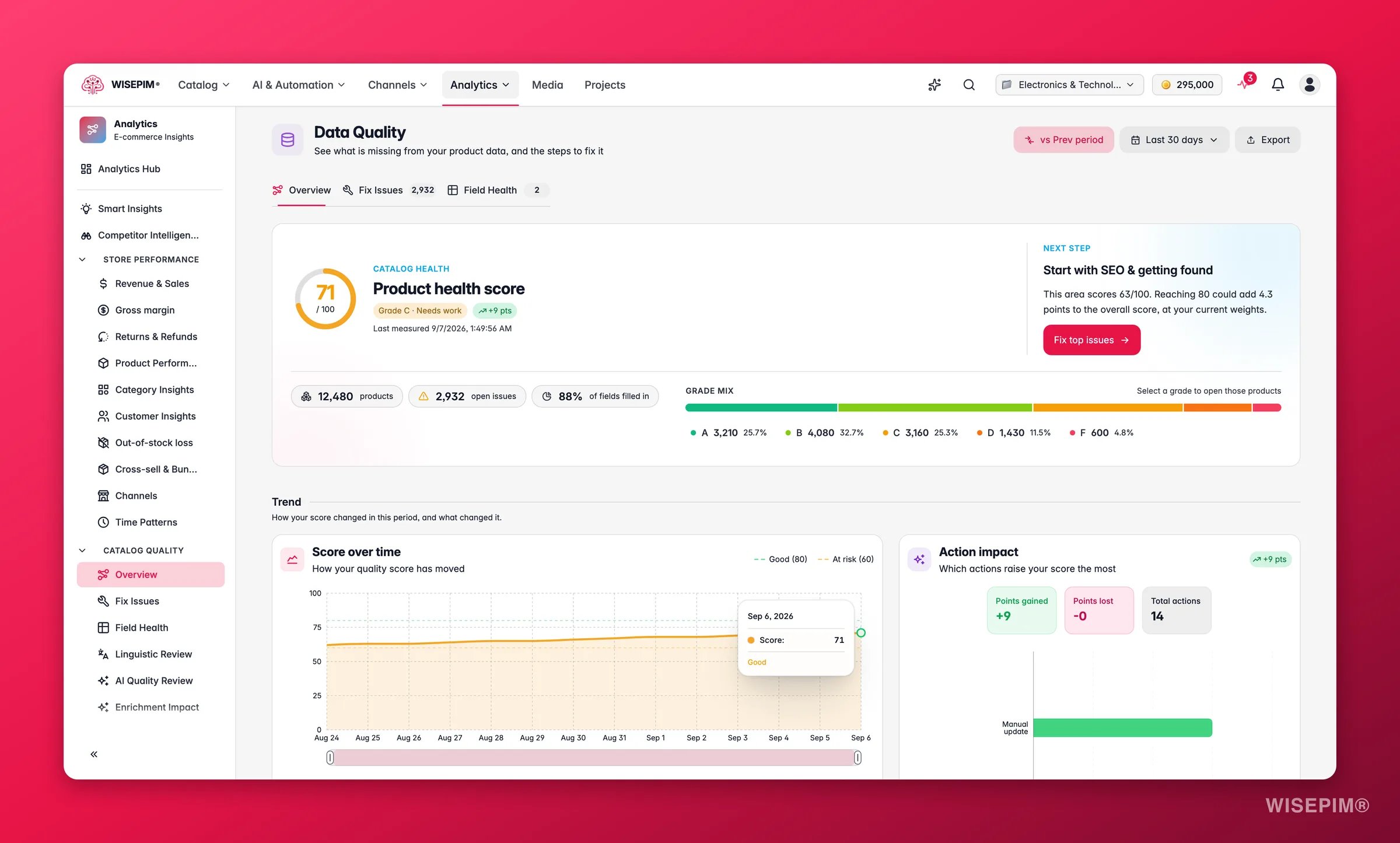
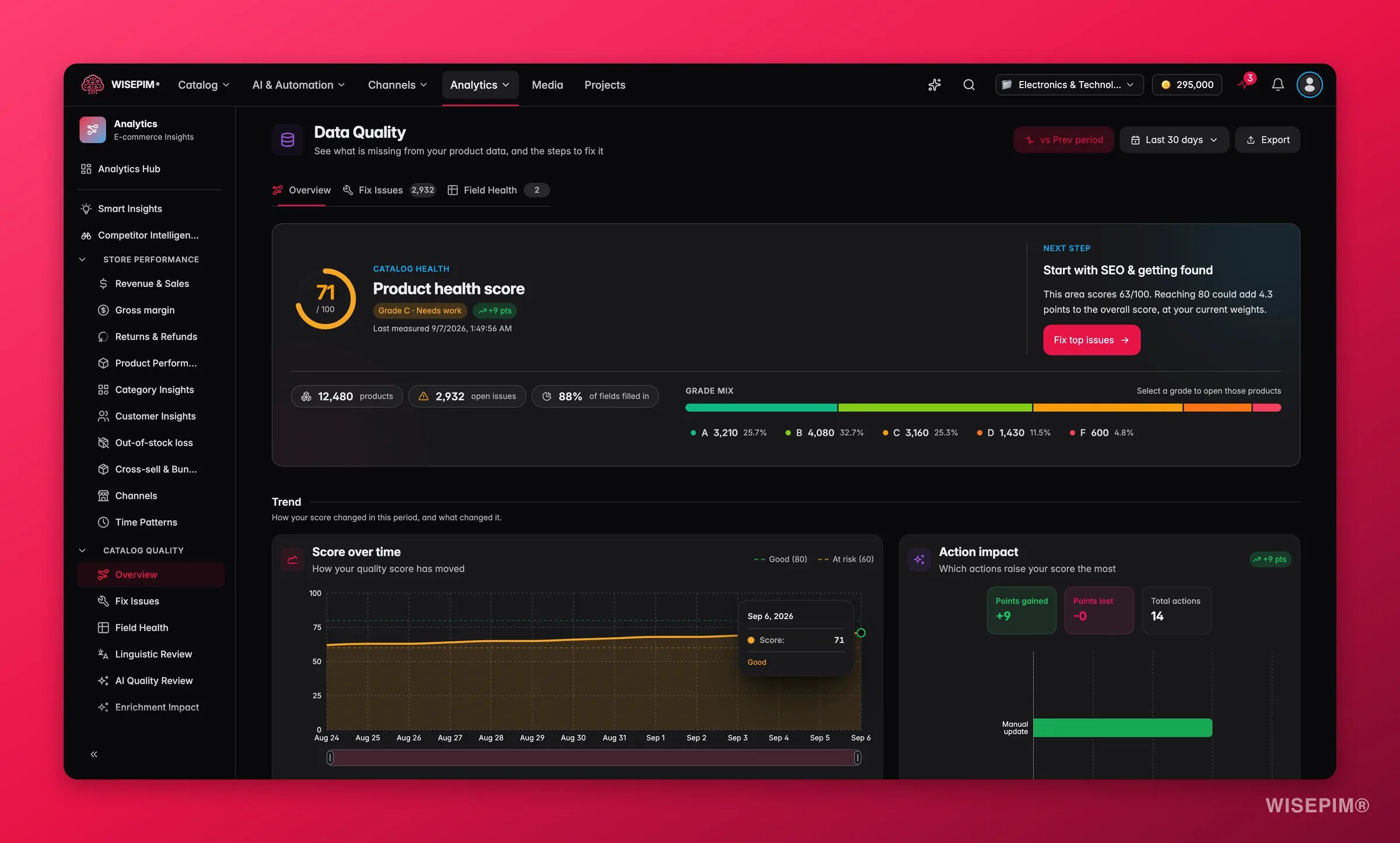
Do this first. Once you start bulk-editing you lose the ability to prove the cleanup was worth doing, and you lose the map of what was actually broken. WISEPIM data quality dashboard with score, trends and field health
1

Write down your score and your worst grades

Open Data Quality and stay on the Overview tab. Note the overall score, the letter grade, and how many products sit in D and F on the grade distribution, then screenshot it. This is the number you compare against at the end, and the D/F pile is your working set.
2

Read the action queue on the Overview

The Overview - the screen you land on after logging in - ranks the most worthwhile fixes by how many products they touch and how much they move your score, and each row opens Products already filtered to them. Working top-down tells you what the previous owner neglected without you auditing anything by hand.
3

Count the damage with preset filters

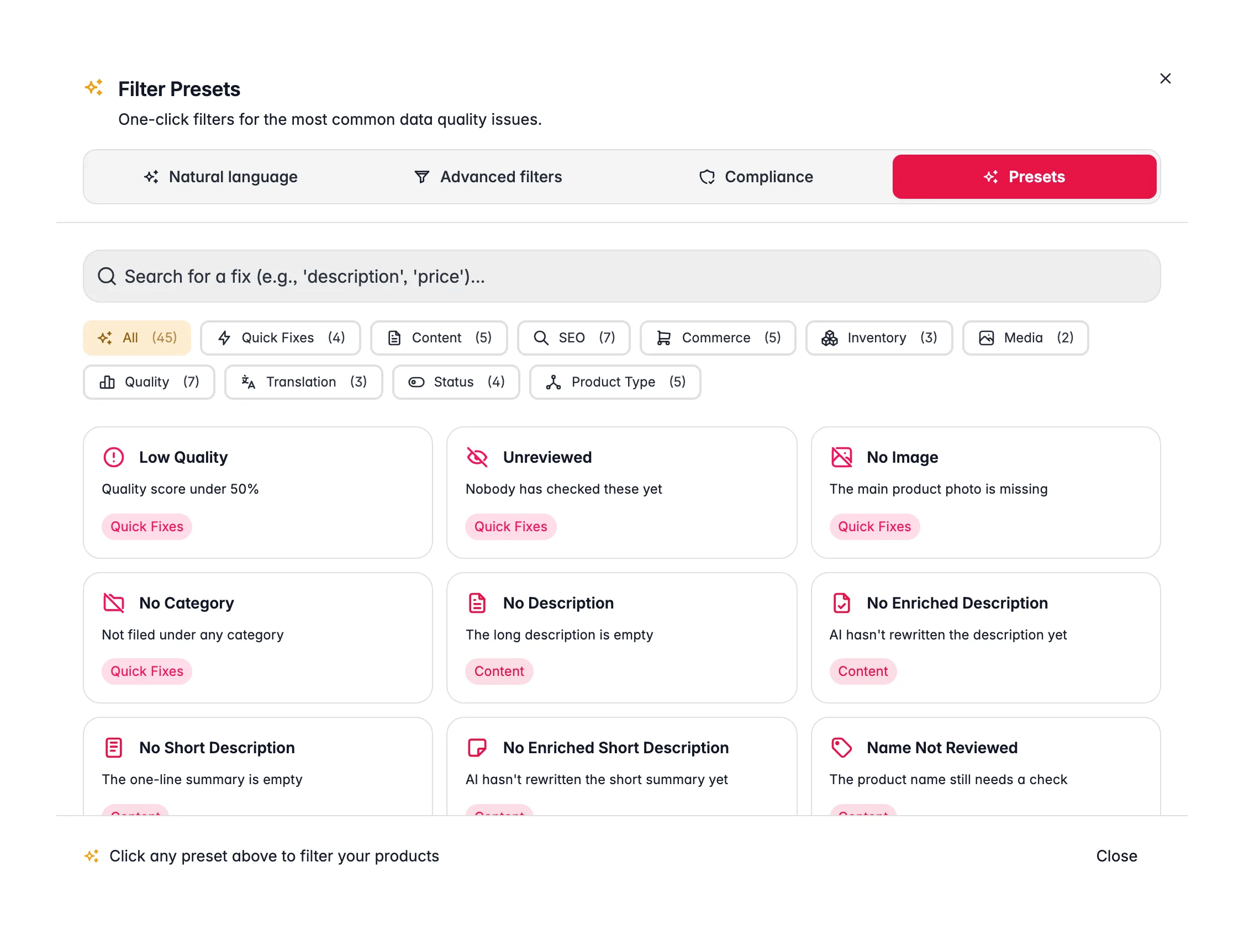
On the Products page, click Filters next to the search bar and open the Presets tab. Each of the 46 presets shows how many products have that issue right now. Note the biggest counts: they are your cleanup backlog in priority order.One-click preset filters for common data issues in WISEPIM
4

Find the duplicates now, not later

Switch to the Advanced filters tab and use the is duplicate operator on SKU, then again on EAN. Do this before any text cleanup: cleaning makes near-identical rows look even more alike, and a repeated SKU is sometimes two genuinely different products from two suppliers, so you want to judge them while they still read differently. See filtering products for the operator list.
5

Save the filters you will re-run

Name each filter in the Save filter set box and save it. You will run these same queries after every pass to watch the counts drop, and saved sets live on your account rather than in your browser.

Clean the text, in this exact order

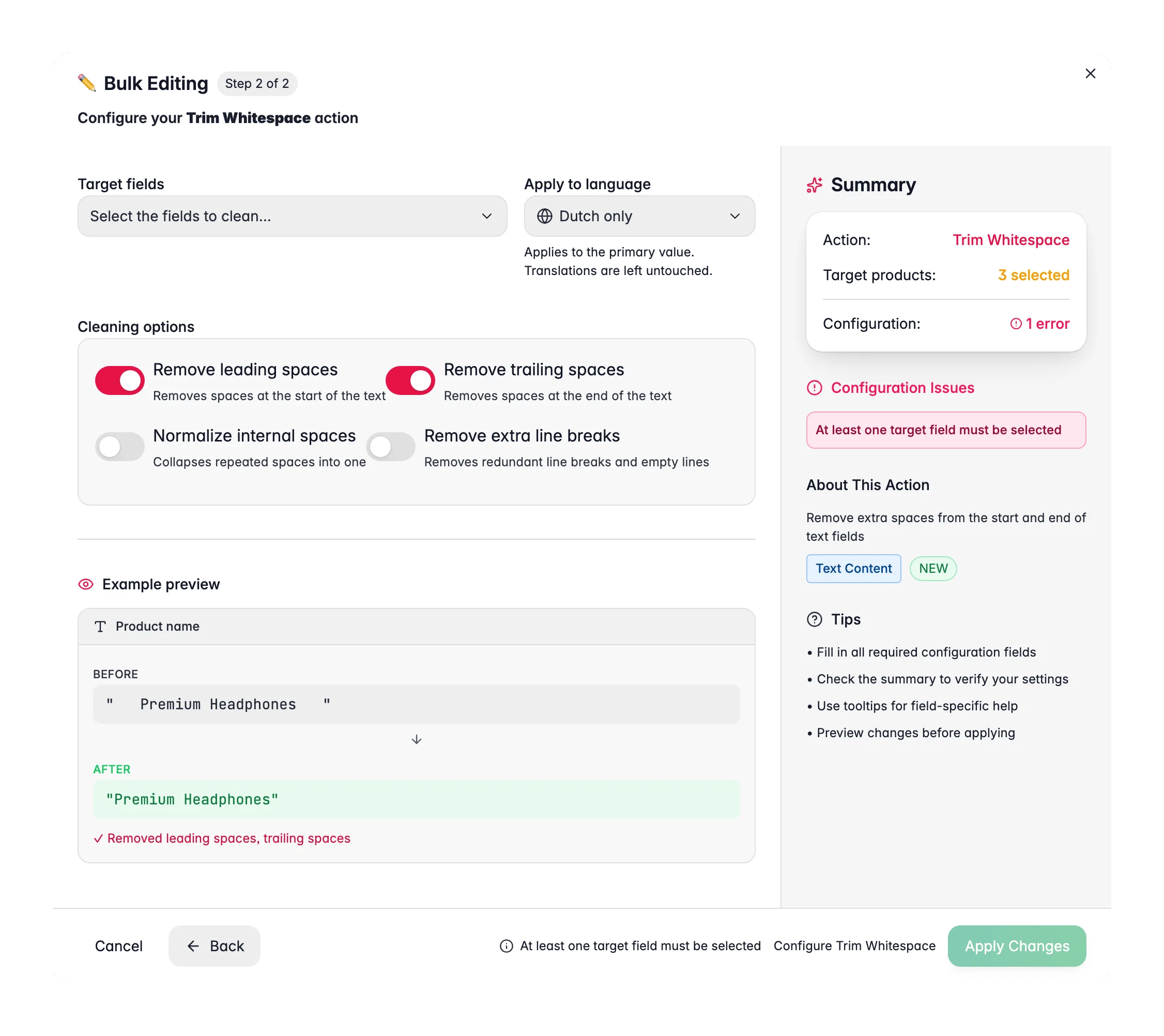
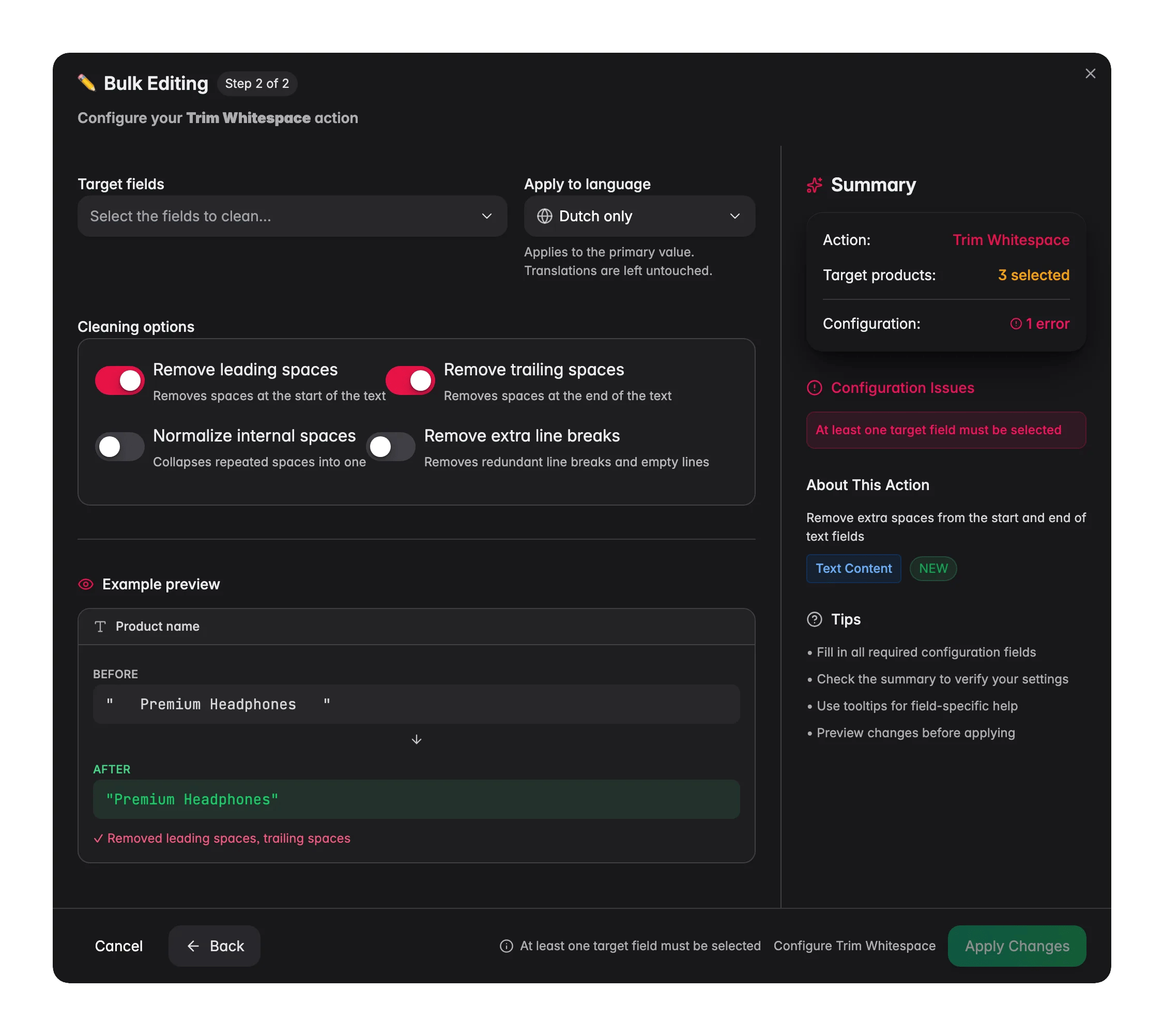
Each of these is a bulk action: filter to a set, select it, click Bulk Edit in the Products toolbar, and search the action by name. The order matters more than the actions do - each step makes the next one’s matching more reliable, and running them the other way round means redoing work. Bulk editing, Trim Whitespace across many products at once in WISEPIM
1

Trim whitespace first

Trim Whitespace is the safe opener: stray leading, trailing, and doubled spaces never carry meaning, so nothing can go wrong. Do it before anything else, because invisible spaces are what make find-and-replace and case rules miss products they should have matched. Turn on Normalize internal spaces when data came from several sources.
2

Standardize case second

Standardize Text Case gives names and titles one style instead of four. Run it after trimming so the case rule sees clean word boundaries. Check the live before/after preview: fields holding brand names with deliberate styling should not be swept into a uniform case.
3

Find and replace third

Now that spacing and case are predictable, Find and Replace actually finds things. Use it here for the one-off junk your predecessor left behind: dead promo lines, a former owner’s name, placeholder text. Leave the replacement empty to delete a phrase outright. Brand and term variants are a bigger job than a single replacement - that is make terminology consistent, and it is worth doing right after this pass.
4

Remove the links that point somewhere else

Inherited descriptions are full of hyperlinks to the old storefront, a supplier’s site, or a blog that no longer exists. Remove Links strips them in bulk, and you choose whether the linked words stay. Internal versus external is decided against this project’s sitemap, so if your sitemap is empty, remove all links instead.
5

Normalize the numbers and the units

Feeds leave prices like 19.9900 and weights recorded in grams where the rest of the catalog uses kilograms. Convert Numbers rounds and rescales built-in numeric fields; Change Unit of Measure switches units with the conversion factor worked out for you, or relabels without converting when an import set the wrong unit. Both show a preview, use it.

Give the catalog a structure again

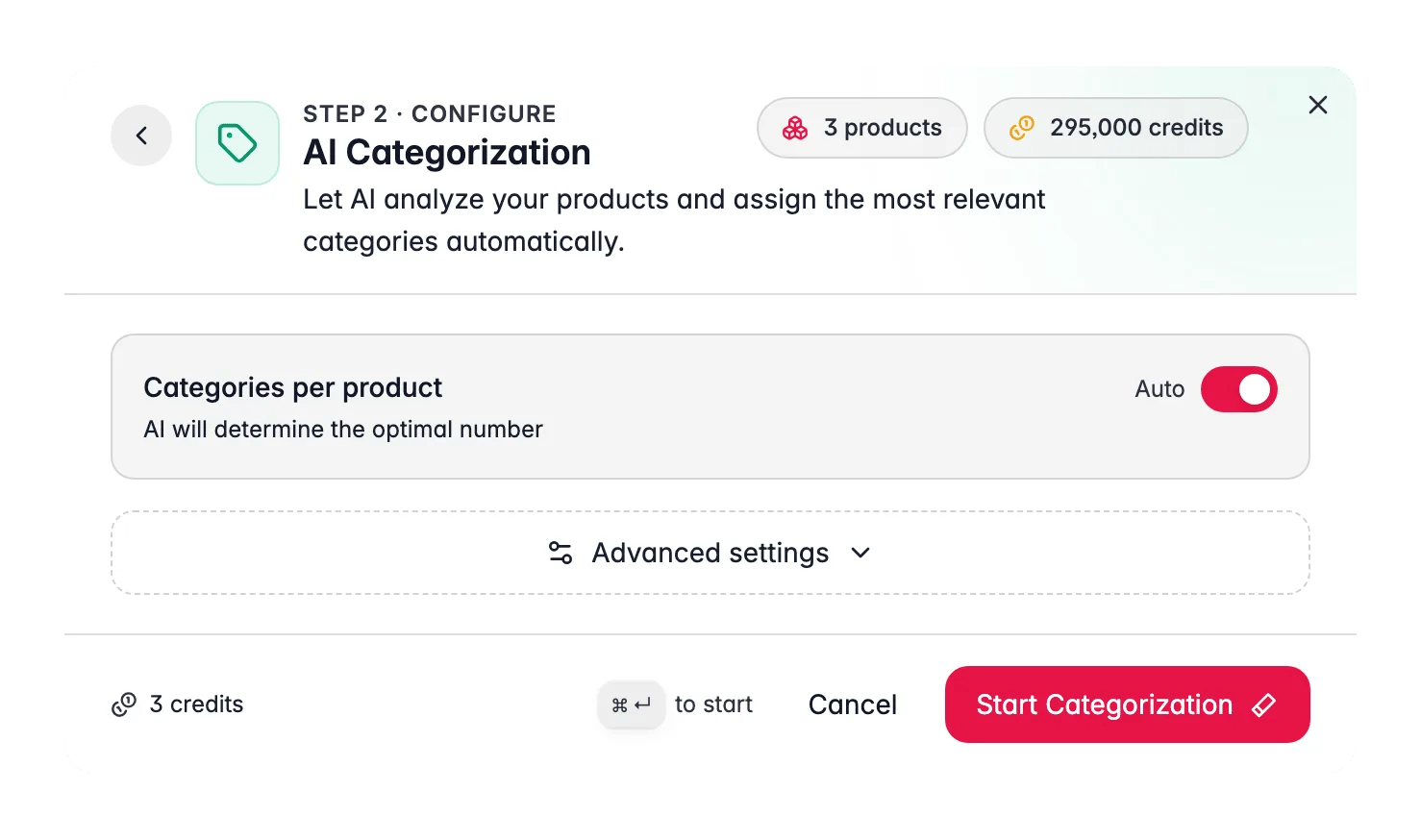
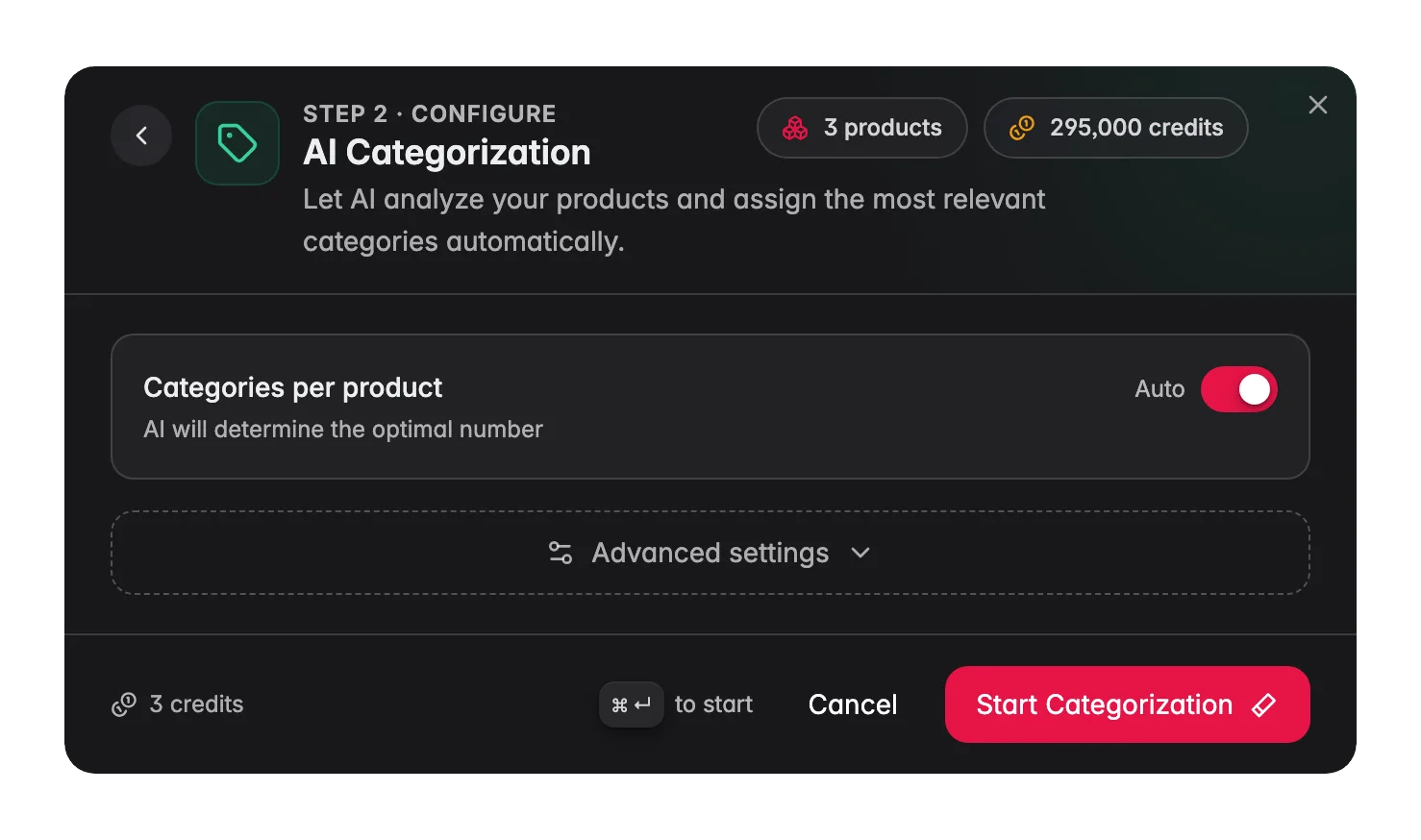
Clean text on unstructured products still browses badly. Two jobs here: empty the uncategorized bucket, and turn look-alike rows back into single products. Enriching products with AI, categorization in WISEPIM
1

Categorize confidently first

Filter to uncategorized products, select all matching results, click Enrich with AI in the toolbar and pick AI Categorization at the default 75% confidence. Run it now rather than before the text cleanup: it reads each product’s own content, so it places better on text you have already normalized. It only uses the category tree you already have and never invents new ones, which is what makes a default-threshold pass safe to accept in bulk.
2

Run a second, looser pass on what is left

Re-filter to whatever is still uncategorized and run it again at 60–65%. You get the confident assignments committed first and only review the genuinely ambiguous remainder, instead of reviewing everything at a low threshold.
3

Fix products that landed nowhere

If a lot of products stayed uncategorized, the cause is usually thin content rather than a bad threshold. Enrich the title and description first, then re-categorize. Place the last stragglers by hand.
4

Set the primary category

Products in several categories need one designated primary, because most platforms build breadcrumbs and canonical URLs from it. Filter by category, then run Set Primary Category from Bulk Edit on that selection - after categorization, so it has the full set of assignments to choose from.
5

Group the flat variant rows

Inherited imports arrive flat: every size and colour is its own product. Select the ones that belong together on a single page and run Group as Variants from Bulk Edit to attach them to one parent. It refuses a select-all-across-pages selection and caps at 500 products per run, so plan on working through it in batches.

Measure it, then put a floor under it

Do this last, and do it in one sitting: the score only tells a story once every bulk action has landed, and rules written now are shaped by the problems you actually found rather than the ones you expected.
1

Recalculate the quality scores

Bulk actions do not always refresh quality metrics straight away. Select your catalog and run Recalculate Data Quality from Bulk Edit, otherwise you will compare today’s data against yesterday’s score and conclude nothing happened.
2

Compare against your baseline

Reopen Data Quality and put it next to the screenshot you took on day one: overall score, grade distribution, content coverage funnel. This is the number you report to whoever handed you the catalog.
3

Write two or three Quality Guard rules
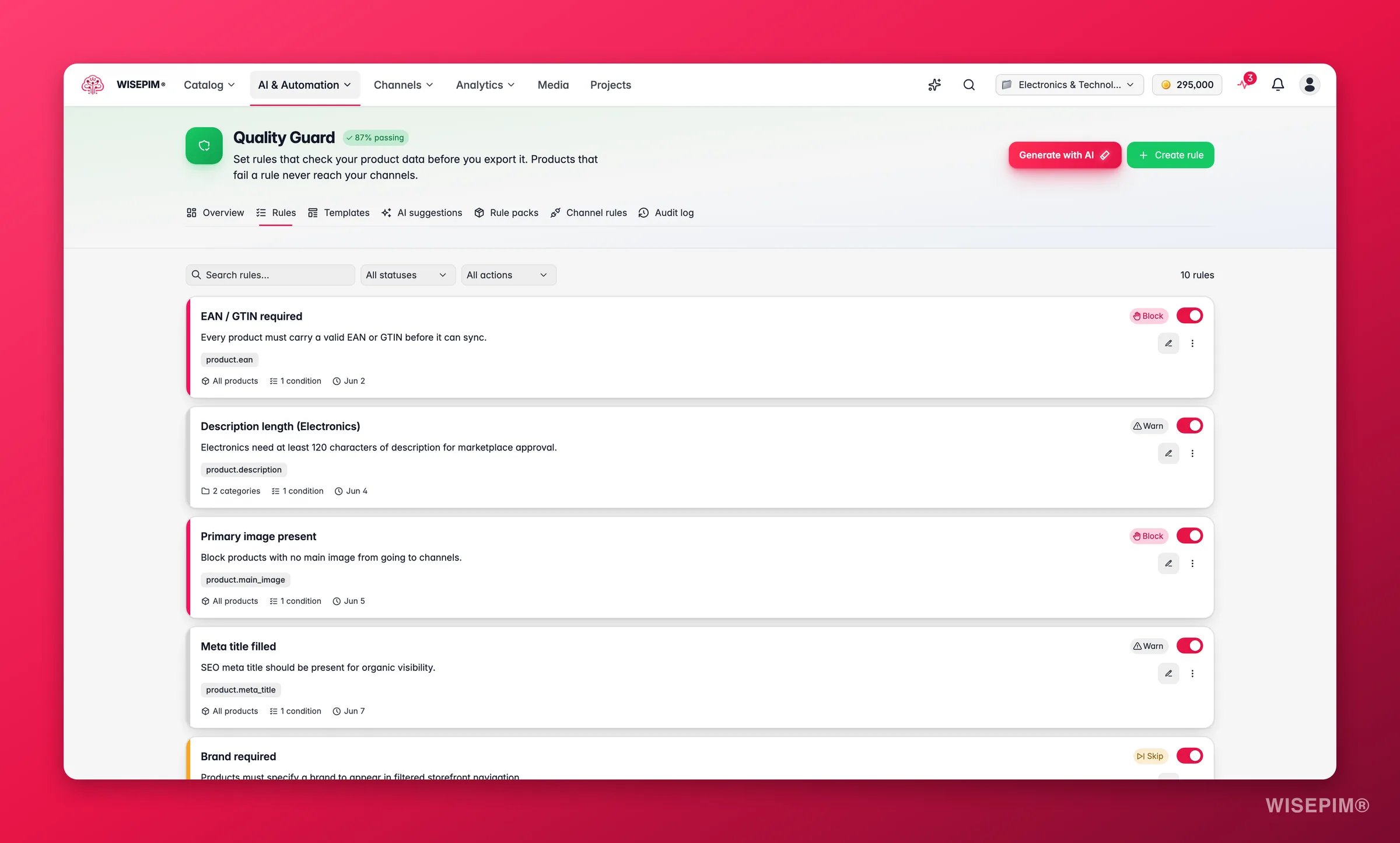
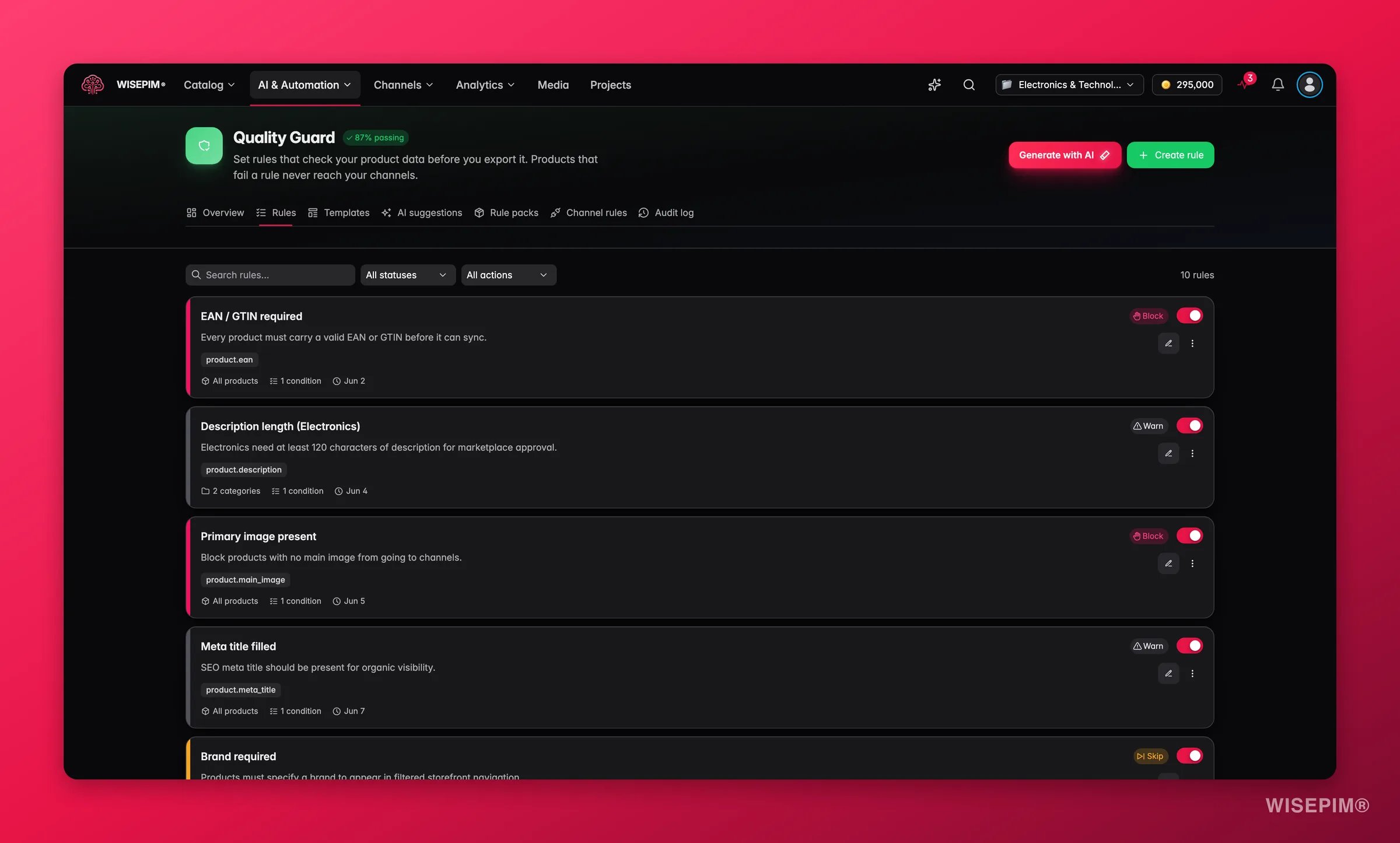
A cleanup without rules decays. In Quality Guard, open the Rule Templates tab and start from a ready-made check rather than Create Rule on a blank one. Pick the problems you just spent a day fixing: typically a required identifier, a minimum description length, and a minimum image count.WISEPIM Quality Guard rules list with severity and scope
4

Set them to Warn, not Block

Keep the severity on Warn for the first weeks. Warned products still export and the failure is logged, so you learn how often each rule actually fires before it can stop a sync. The rule builder’s live impact preview tells you how many products would fail before you save.

How to tell it worked

Give the trend charts a week before you read them as a trend: a single recalculation moves the score at once, but the historical chart needs days of data to show direction. For a target, Data Quality documents a B (80+) as the baseline worth holding, and the thresholds themselves are configurable if your team’s standards differ.

When it doesn’t work

Quality scores refresh on their own when you edit a single product, but bulk actions may not refresh them right away. Run Recalculate Data Quality across the affected products, then re-read the dashboard.
Either the threshold is too high for this catalog or your category names are ambiguous. Lower it and re-run on the remainder, and clarify vague category names. If products keep failing to place, the real cause is usually thin product content, enrich first and categorize after. See AI Categorization.
The action deliberately refuses a select-all-across-pages selection, so a stray filter cannot build a 2,000-variant product, and it caps at 500 products per run. Products that cannot become variants are skipped and reported in the toast. Details on Group as Variants.
Check the Action Impact chart on the Data Quality Overview. A sharp drop nearly always traces to a specific event, an import, a batch delete, or an automated update, rather than to your cleanup. Identify the event first, then fix the products it touched.

Data Quality

The score, the grade distribution, and the fix workspace you measure against.

All bulk actions

Every bulk edit used in this guide, with its full option list.

Consistent terminology

Collapse the brand-name and wording variants this cleanup will surface.

Weekly routine

Keep the catalog clean once the one-off cleanup is done.