Your feed keeps getting disapproved. Sequence channel readiness, rule packs, bulk fixes and feed validation into one clean launch instead of four.
Someone in the business has decided you’re selling on Google Shopping, Kaufland, or Meta next month. You export a feed, the channel eats it, and half your catalog comes back disapproved - missing GTIN, missing brand, title too long. Then you fix a few products, resubmit, and wait another day to find out what else is wrong.The fix is to stop discovering requirements one rejection at a time. WISEPIM can tell you what a channel wants before you send anything, and this guide puts those checks in the order that avoids rework. Budget half a day for your first channel, and about an hour for each one after that.
Before you start: connect the channel (or at least know which one you’re targeting) under Integrations, and have a catalog with products in it. Marketplace-specific credentials are covered on the Kaufland and Mirakl pages.
What you’ll get: a feed the channel accepts on the first submission, and a compliance number you can watch instead of waiting for a rejection email.
Four surfaces shape what a channel receives, and mixing them up is the main reason a launch takes three attempts. Read this table once and the rest of the guide is just execution.
Surface
The question it answers
Where it sits
Channel Readiness
Across my whole catalog, how much is listable on this channel, and which field is the gap?
That table is also the order. Readiness tells you what to fix, rules keep it fixed, the feed gets built on data that is already clean, and quarantine is the last gate you clear before the first sync. Build the feed first and you will rebuild it after every data fix.
Do this before you touch a single product. Readiness gives you today’s snapshot; a rule pack turns the same requirements into checks that keep running after you stop looking.
1
Open Channel Readiness and pick your target channel
On the Channel Readiness page, pick the channels you sell on. Each one gets a card: a percentage ready for that channel, coverage bars per required field, and chips counting the products missing each one. Write the percentage down - it is your before number.
2
Find the single field blocking the most products
The coverage bars rank themselves for you. One field is almost always responsible for most of the gap - usually GTIN or brand. Each card carries a Fix button that opens the AI fix drawer with exactly those products preloaded, so the biggest gap in your launch is one pass rather than a project.
3
Install the channel's rule pack in Quality Guard
A readiness percentage is a snapshot that goes stale. Open the Rule Packs tab in Quality Guard and install the pre-built bundle for your channel: its requirements land as channel-scoped rules in one click and re-run on every export from then on. The Google Shopping pack covers GTIN, brand, product category, image requirements, and title formatting.
4
Start the pack on Warn severity
Severity decides what happens on failure: Block quarantines the product, Skip silently leaves it out, Warn lets it through and logs it. Start on Warn so you can measure the real size of the problem without holding up an export you still need today. You switch to Block in the last section, once the data is clean.
5
Note today's compliance rate on Channel Rules
Channel Rules is a filtered view of the same rules, grouped by destination. Find your channel - if it’s still listed under Unconfigured Channels, click Add Rules, and write down its compliance rate. Green means 80% or more of covered products pass, amber 60–79%, red below 60%. This is the one number you’ll watch for the rest of the launch.
You now know which rule fails and how often. Never fix these product by product - filter to the violators and act on the whole set at once.
1
Filter to the products that violate one rule
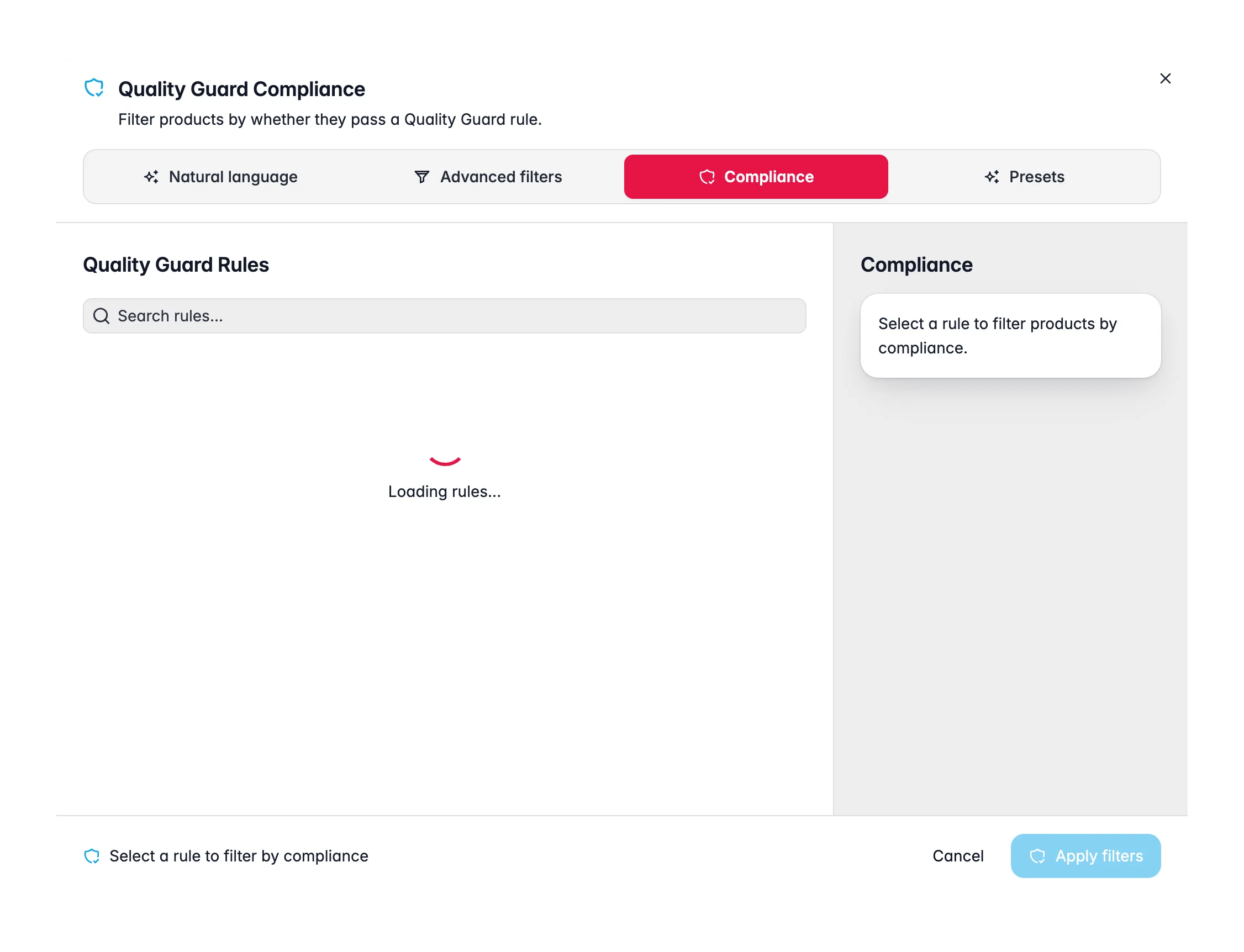
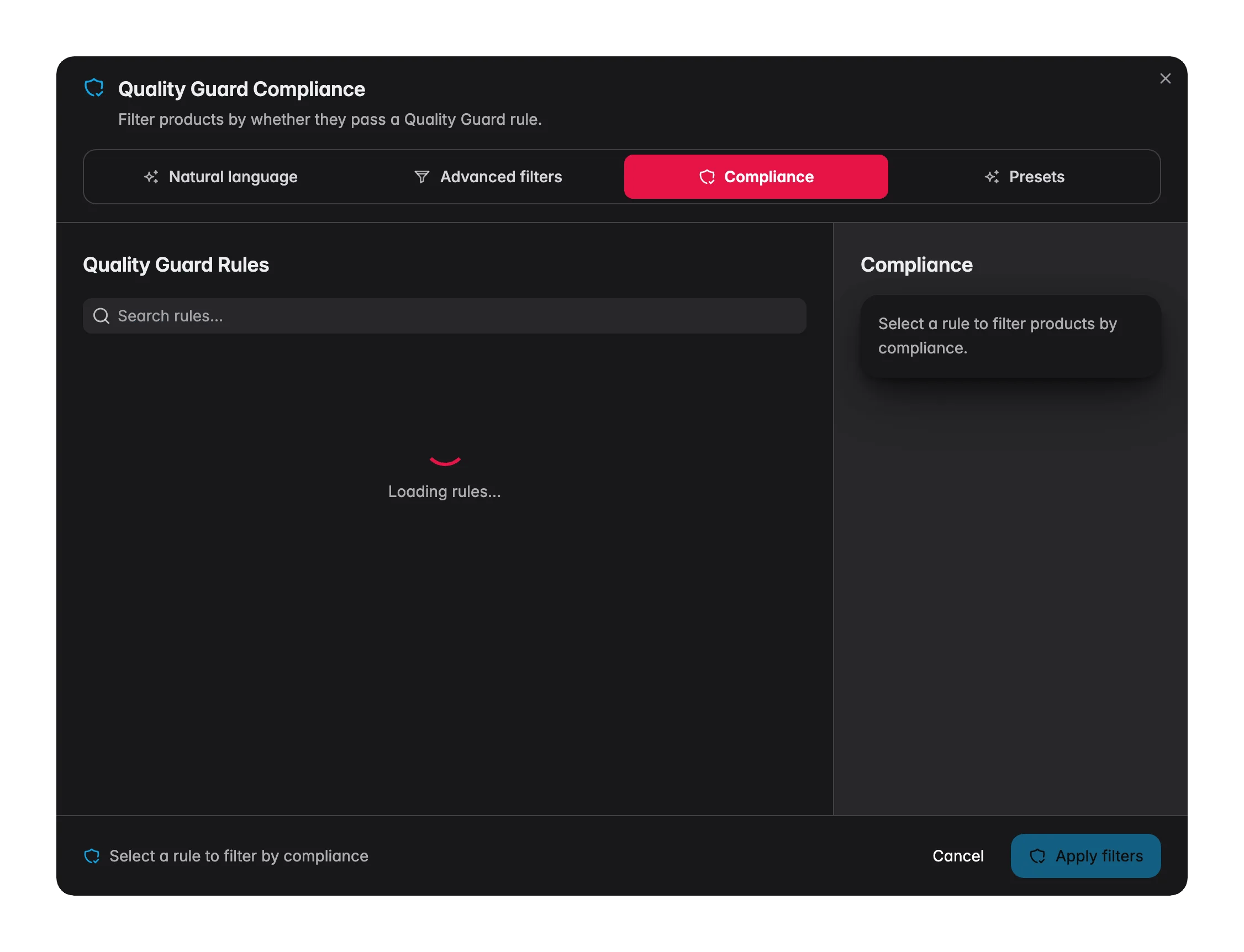
On the Products page, open the filter modal and switch to the Compliance tab. Pick the failing rule and choose Violates. The rule’s own scope is applied automatically, so you get exactly the products it targets, with a live count before you commit.
2
Fix flat, factual fields with a bulk edit
Anything that’s a known value - a brand you can set per supplier, a category assignment, a stock status - belongs in bulk editing rather than in AI. It’s instant and it costs no credits.
3
Extract missing specs from text you already have
When a channel wants colour, material, or size and the information is buried in your descriptions, run AI attribute extraction on the filtered set. It only fills attributes that already exist on the product’s family, so nothing unexpected appears in your structure.
4
Fill missing identifiers with Web Research
GTIN, UPC, MPN, and model number can’t be written - they have to be found. Run Web Research on the filtered set and switch on the identifiers you need under Identifiers to discover. Identifiers follow stricter rules than anything else research writes: they only ever go into empty fields, every value is checksum-validated, and a value that conflicts with yours is flagged rather than written over it.
5
Re-check the same filter
Run the Compliance filter again with the same rule. The count should have dropped. Work down the rules in order of how many products they fail, and stop when the remaining ones are genuine exceptions rather than data gaps.
Only now is it worth creating the feed, because a feed is a snapshot of data you have already cleaned. Everything from here happens in Feed Hub.
1
Create the feed from the channel preset
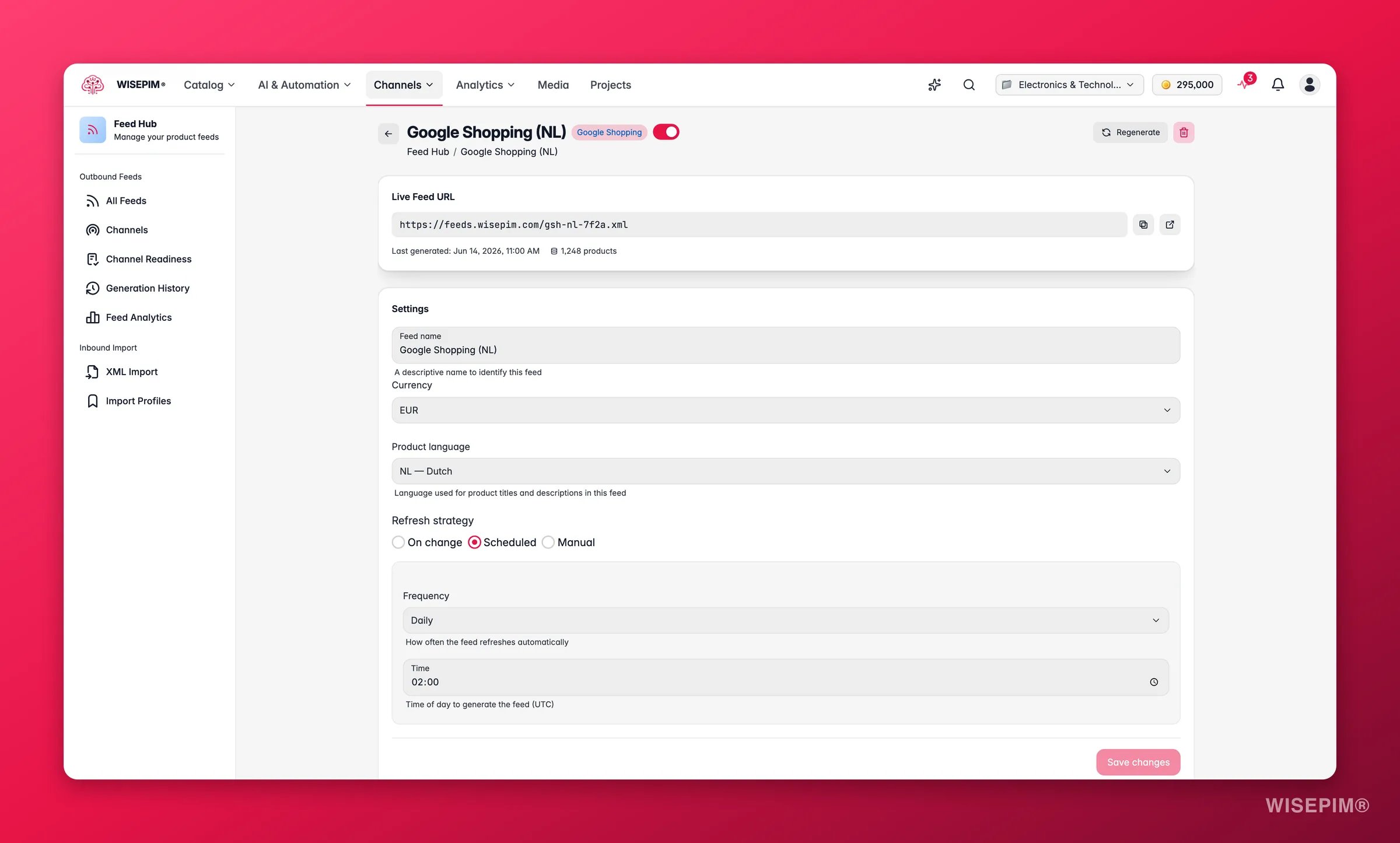
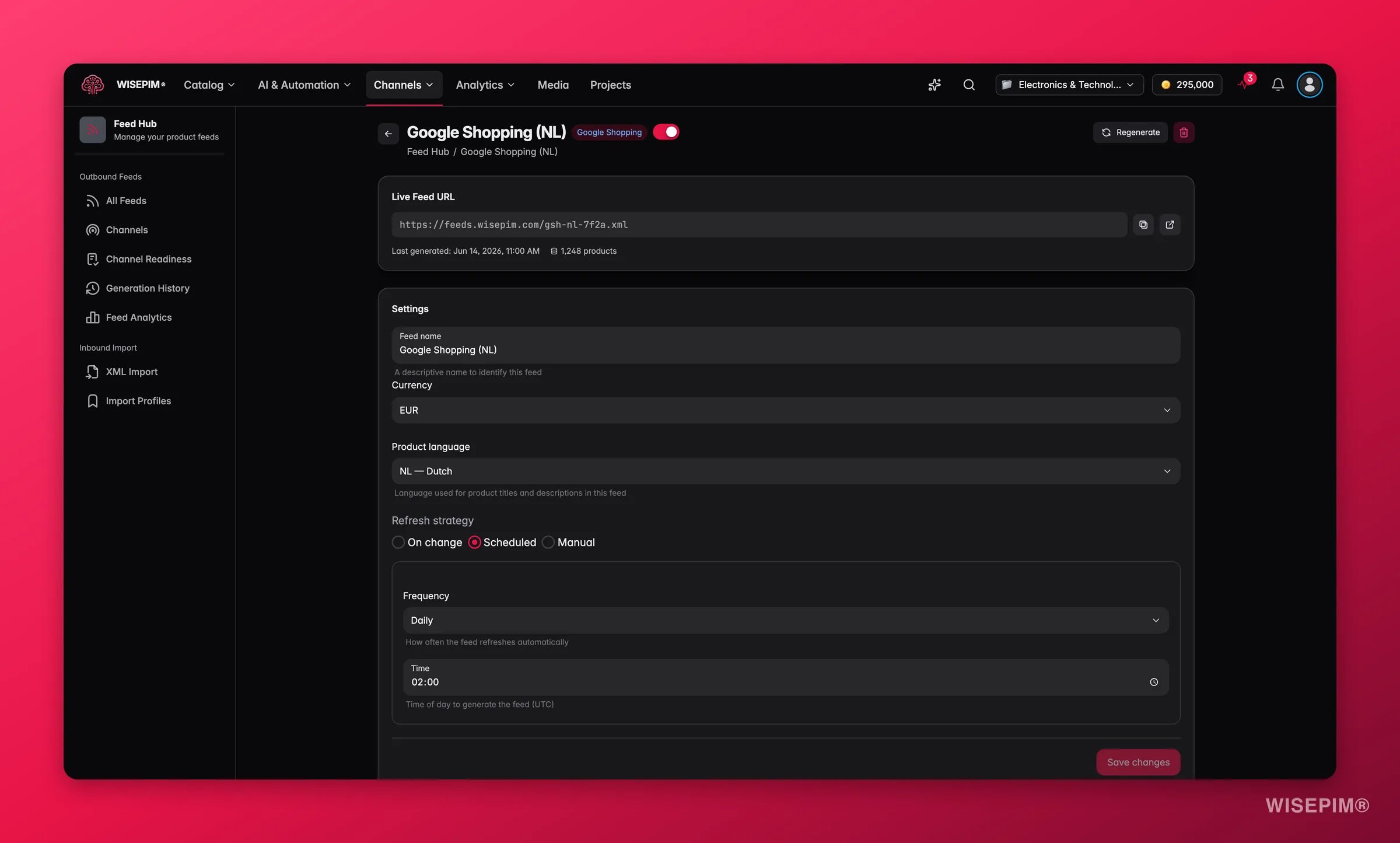
Click Create Feed on the Feed Hub overview and pick your channel in the two-step wizard. The preset sets sensible defaults; you set the name, product language, currency, and refresh strategy. Selling in more than one language? One feed per language - most channels expect a separate URL per market.
2
Let AI map the fields, then check the required ones
On the feed’s Field Mappings, Auto-map matches on field names and AI Auto-map handles the cases where your names and the channel’s don’t line up. Review the required fields yourself afterwards, and add a fallback value on any field where your primary source is sometimes empty.
3
Narrow the scope, then filter out the weak products
Two different controls, in this order. Product Scope decides who is eligible at all - categories, product families, whether out-of-stock counts. Filter rules then drop the products that would embarrass you: no price, no image, quality score below a threshold. Hit Preview to see how many each rule removes before you save, because this is where a feed silently loses half its catalog.
4
Run Feed Validation and read the feed quality score
Validate checks each individual product against the channel’s field requirements and lists errors and warnings per product - that is your rejection list, written before the channel writes it. The Feed Quality panel scores the feed itself across six dimensions, including GTIN/EAN coverage and title quality. Fix, regenerate, then Recalculate.
Only now do the rules become blocking. Flip severity first, empty the queue that flip creates, and give the channel its URL last - in the other order you hand a platform a feed that quarantine is quietly shrinking.
1
Switch your channel rules from Warn to Block
Now that the data is clean, Block severity is protection rather than an obstacle. From here, a product that breaks a channel requirement is held instead of shipped.
2
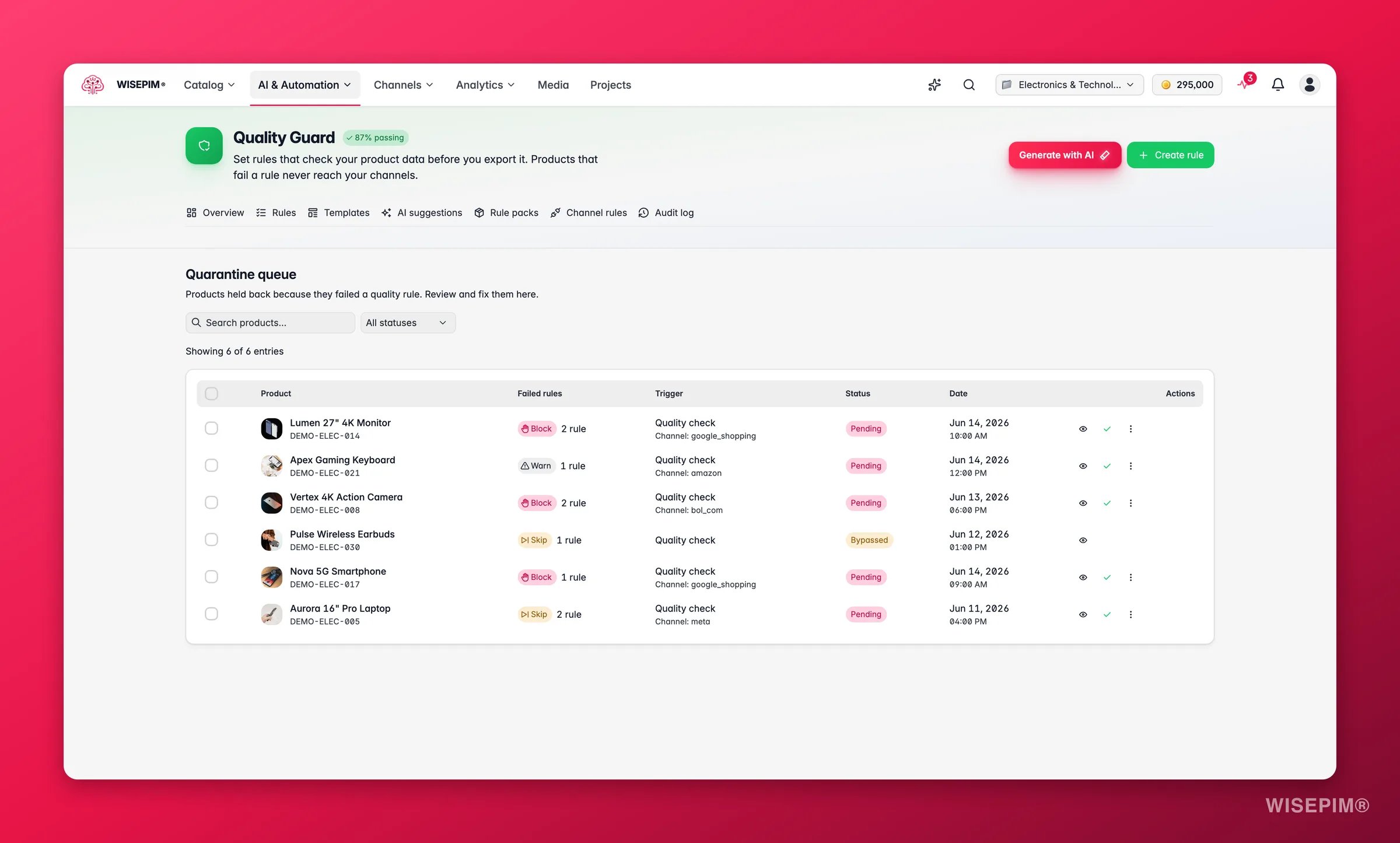
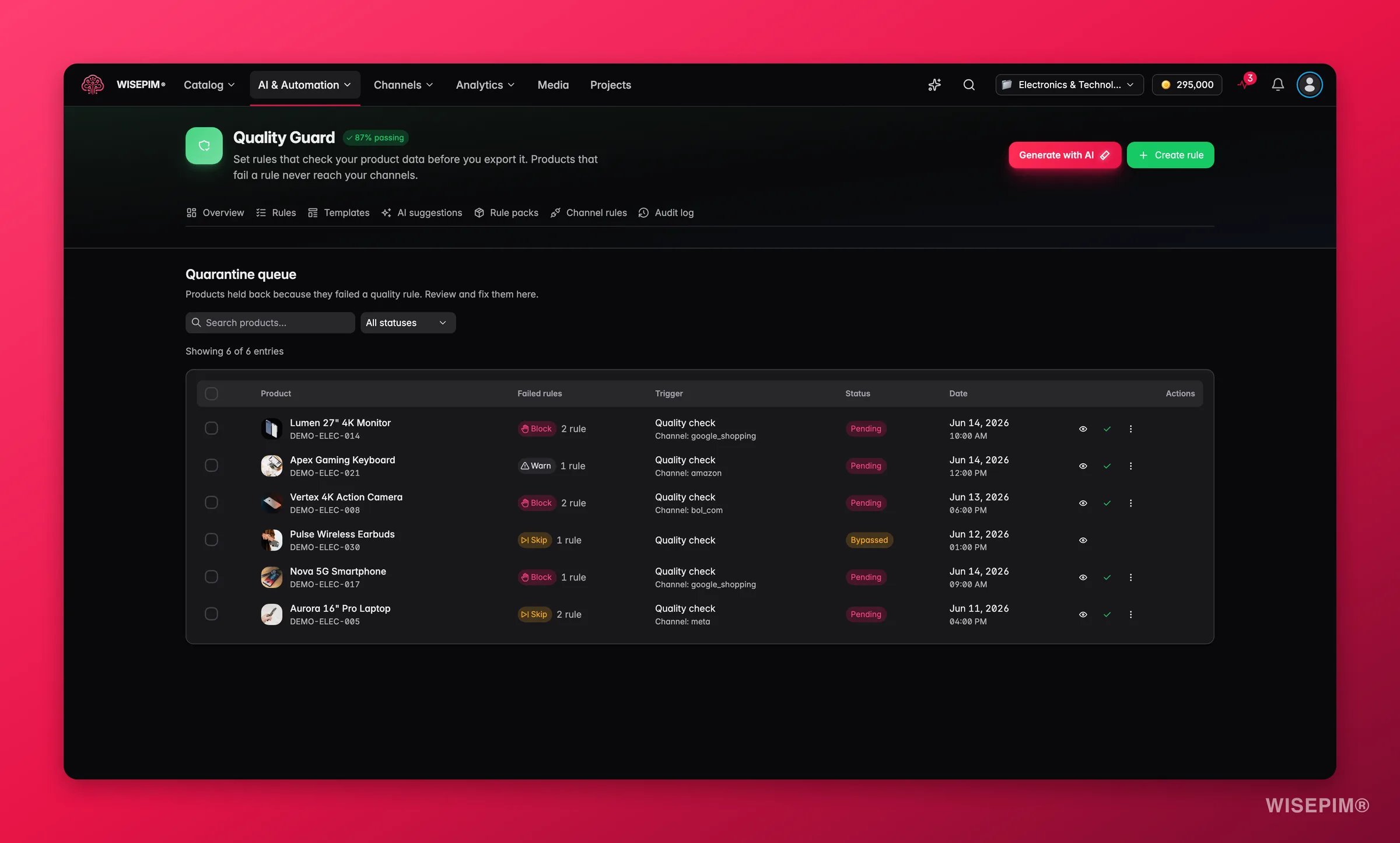
Empty the quarantine queue
This is the step people miss. Nothing in quarantine can be exported, synced, or published - so if products vanish from a launch with no error anywhere, quarantine is the first place to look. Open an entry to see the exact field, operator, expected value, and actual value, fix the data, then Bulk Resolve the entries you fixed together. For a genuine exception the channel will accept anyway, Bypass it with a reason instead; the reason goes to the audit log under your name.
3
Check the price you're about to send
Marketplace fees change what a healthy price looks like. If this channel takes a commission, set up the markup before the first sync rather than after the first invoice - see Send a different price per channel.
4
Submit the feed URL and pick a refresh strategy
Each feed has its own hosted URL that the channel fetches on its own. Choose Scheduled or On change so you’re not regenerating by hand, and give the platform its first fetch.
5
Watch the first week
Integration Health tells you whether the sync itself is reliable; Channel Analytics tells you whether the channel is earning. Check the first before you judge the second.
The feed generated fine but the channel received far fewer products than I expected
Three silent shrinkers, in the order worth checking. Quarantine holds every product a Block-severity rule caught, and nothing held there can be exported, synced, or published. Your feed’s Filter rules may be removing more than you intended - hit Preview to see the real number per rule. And Product Scope may never have included them: an out-of-stock toggle or a category selection narrows the feed before any rule runs. Feed Hub’s Generation History settles it - compare the last two versions and read the product count.
Compliance went red the moment I installed the rule pack
Red means below 60%, and it is the pack telling you the truth about data you already had. Keep the rules on Warn, open the Quality Guard dashboard’s Top Failing Rules list, and work it from the top using the Compliance filter - one rule at a time, in bulk. Switch to Block only when the rate is where you want it. Installing a pack straight onto Block on a large catalog can hold up your next export.
Feed validation passes but the channel still rejects listings
Readiness and validation are scored on the required fields WISEPIM tracks for that channel - required fields it doesn’t track are flagged rather than guessed. For marketplaces, the remaining gap is usually platform-side setup: category mapping, shipping attributes, or account configuration. See Kaufland or Mirakl for what that channel needs on its own side.
Web Research didn't find a GTIN for a chunk of my products
The identifier you searched with was the wrong key. If EAN returns nothing, switch the picker to Brand + Name or Model Number - technical products are far better indexed by model. Some products genuinely have no public barcode; for those the identifier has to come from your supplier. A wrong barcode is worse than an empty one, which is why conflicts are flagged rather than written.
It synced once, then went stale
Open Integration Health and read the Last error column - it names the cause without you logging into the platform. A failure rate that climbs gradually past 3% is the classic signature of a rotated API key or an expired token: re-test the connection from Integrations. A burst of validation failures instead means the channel is rejecting products for a missing field, and the error usually names it - that field belongs in your channel rules, not in a retry.