AI wrote thousands of descriptions and they all sound the same. Give it your brand context in the right order, then re-run the catalog and hear the difference.
You enriched 5,000 products and the copy is technically fine and completely forgettable. Every description opens the same way, nothing sounds like your brand, and half of it uses words your style guide bans. The instinct is to blame the AI, but the usual cause is that nobody told it who you are, so it wrote the only thing it could: average.The fix is an order of operations, not a setting. Budget about two hours for the setup and a short review after each run.
Before you start: pick a project in the project switcher, because Knowledge Library, Keywords, and prompt defaults are all project-scoped. If this is a brand-new project, do 1. Set up first - this guide is the deeper pass for a catalog that is already enriched and sounds generic.
What you’ll get: brand context the AI reads on every run, one proven prompt per content type set as your project default, and a re-enriched catalog that sounds like your team wrote it.
Do this before you touch a prompt. Every AI feature in WISEPIM reads from the Knowledge Library, so filling it once improves everything downstream at the same time - and a prompt tuned against an empty library is tuned against the wrong baseline, which means tuning it twice.
1
Open Brand identity and go deep, not wide
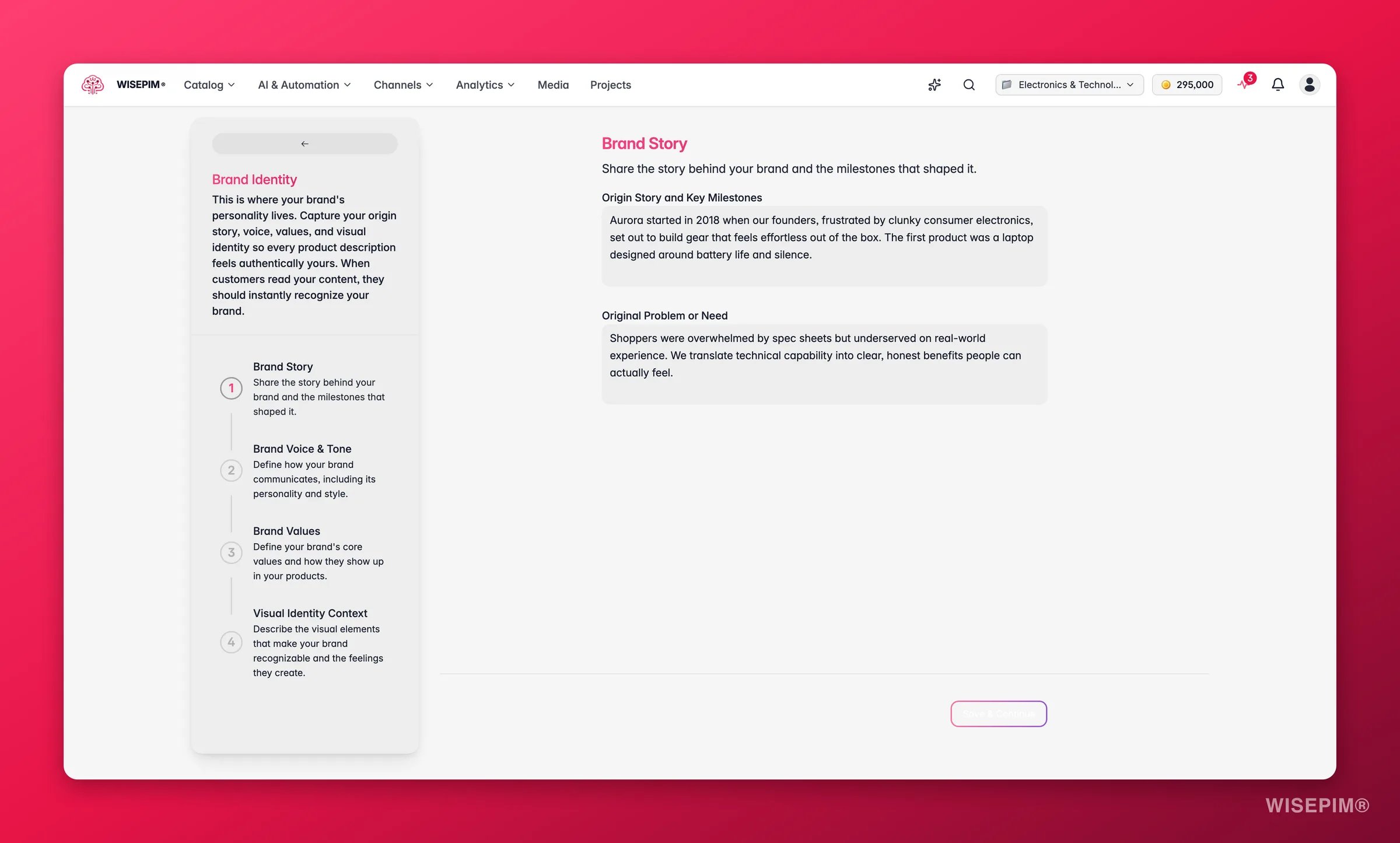
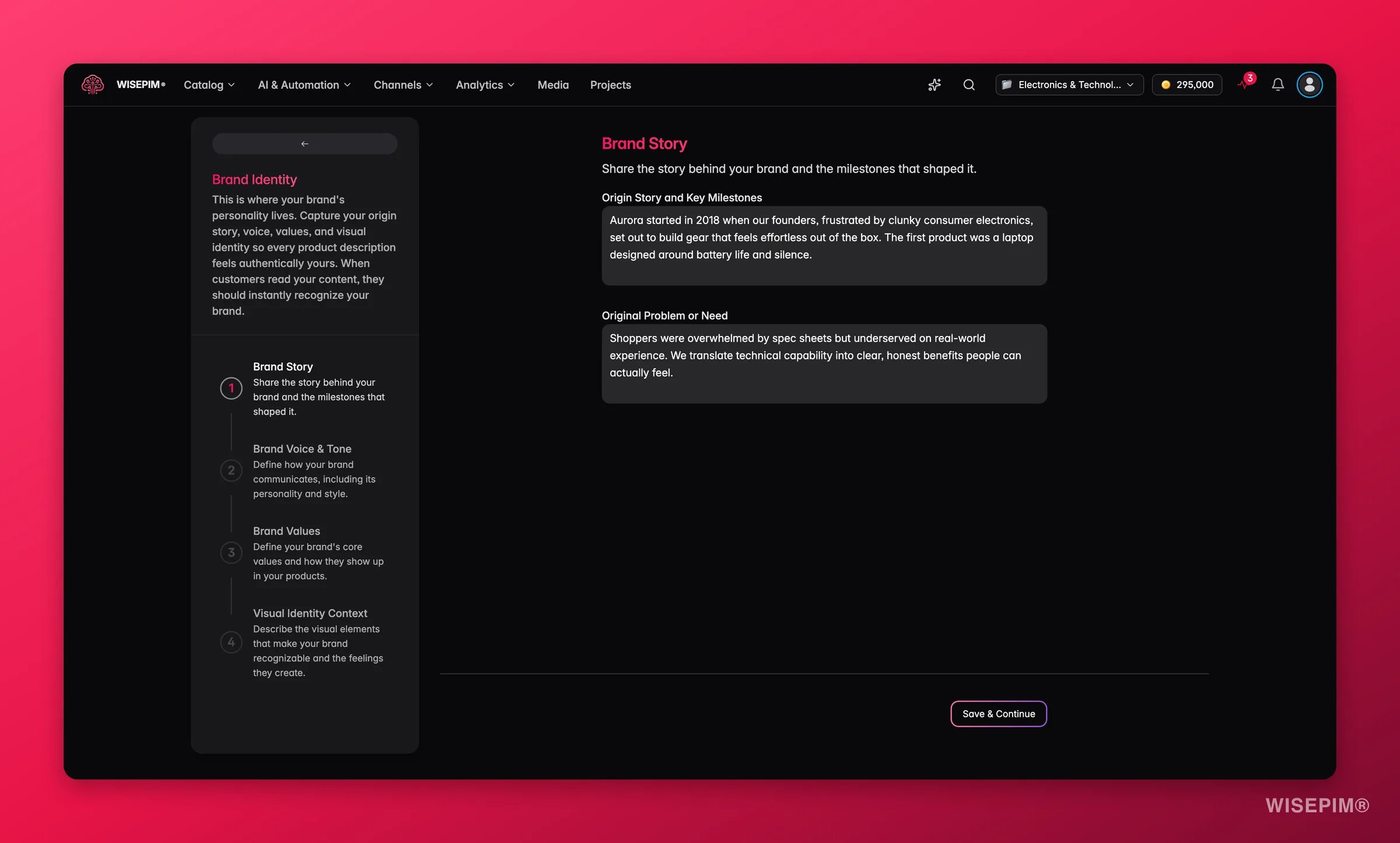
Open the Knowledge Library from the main menu and start with the Brand identity card: brand story, voice, and values. It is the foundation the other categories build on, and the first place to look whenever output feels off-brand later.
2
Paste from what you already have
Copy from existing brand guidelines, a tone-of-voice doc, or customer research. Writing it from scratch in the form is the slow route and usually produces vaguer input. Progress saves as you type.
3
Work one card at a time
Move on to Brand voice, Target audience, Value proposition, and Content requirements. Finishing a card before starting the next keeps your context coherent rather than half-answered everywhere, and the overview’s completion percentages show you which one to open next.
4
Be concrete, and write in the voice you want copied
Name tone adjectives, quote phrases your brand actually uses, and use the exact terms your industry uses. Vague input gives vague output, which is the whole problem you are here to solve.
5
Ban and mandate specific words
In Keywords, put off-brand wording and competitor names on the Negative tab so AI keeps them out, and your must-use terms on the Positive tab at High priority so they carry more weight. Scope them by locale and target field so they only appear where they belong.
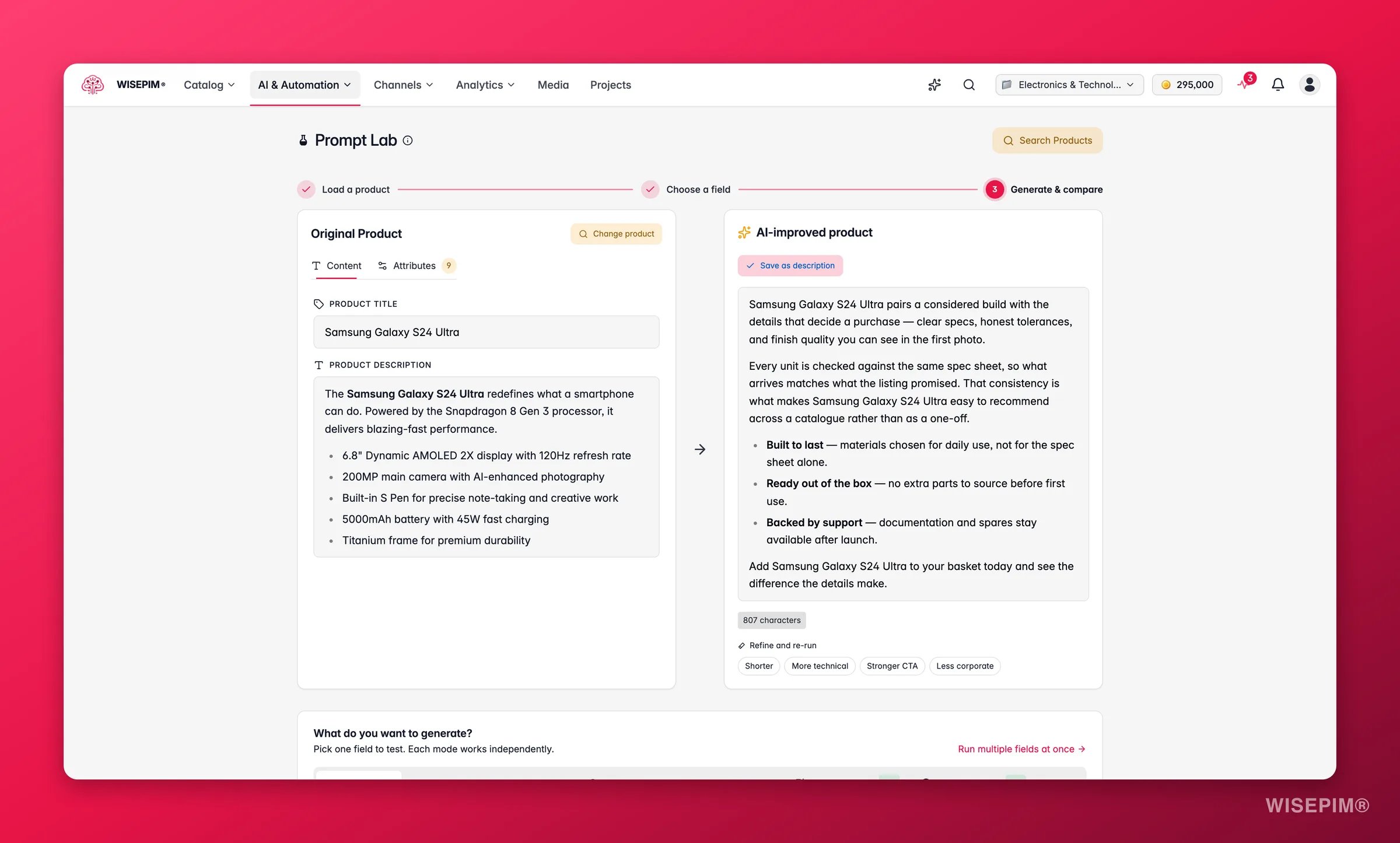
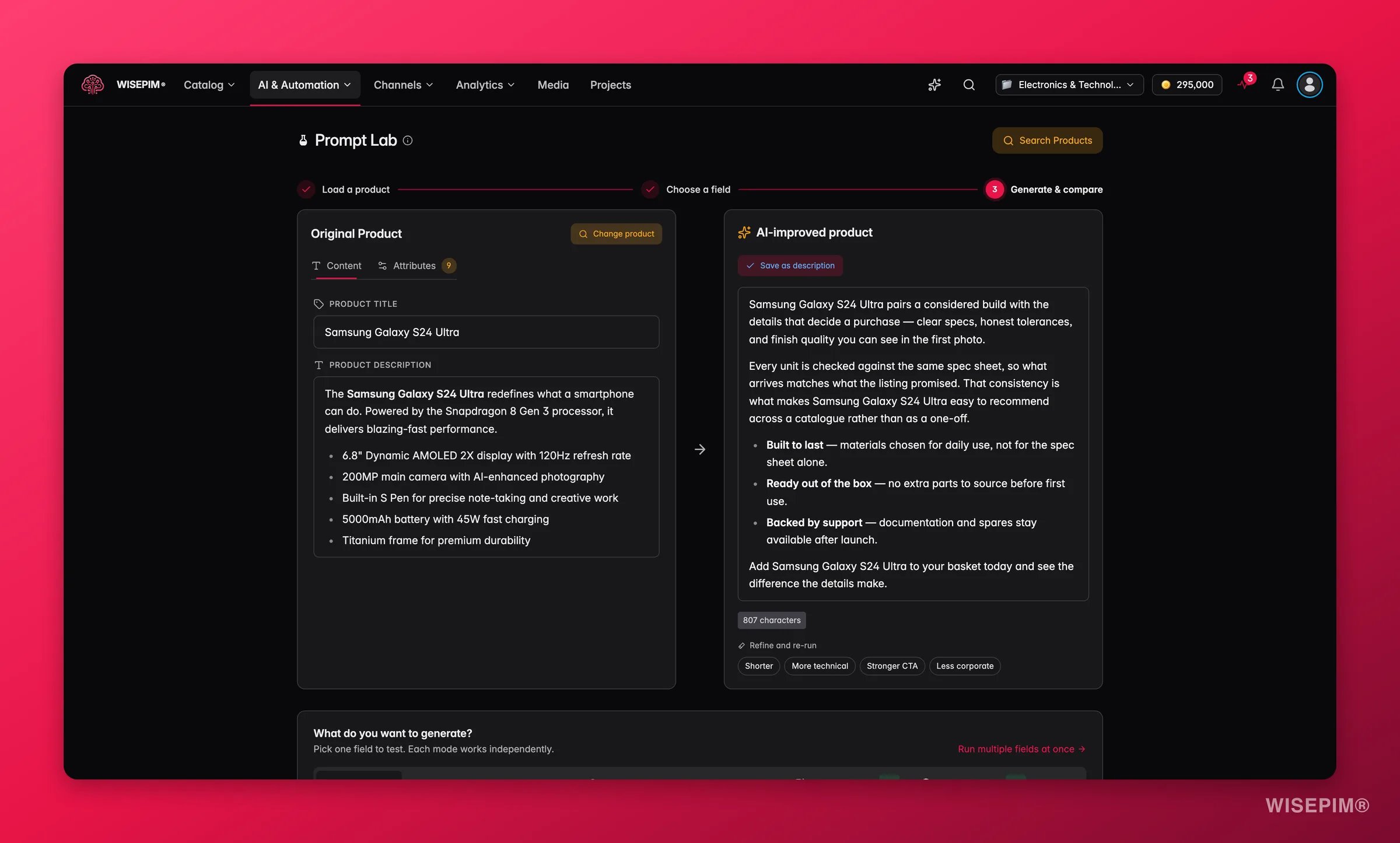
Now, and only now, work on prompts. Prompt Lab runs a prompt against a real product and shows the result beside the original, with nothing written to your catalog, so it is where you find out whether the brand context alone already fixed things.
1
Load a product that already has a description
Click Load Product and pull in a SKU from your current project. An existing description gives you a real before-and-after instead of a comparison against nothing.
2
Test once to get a baseline
Hit Test Prompt and read the output. This is what your brand context alone produces, and it is often already better than what you had. Each test takes roughly 30 to 60 seconds, which is why the next step matters.
3
Change one setting at a time
In the prompt configuration panel, adjust industry, purpose, tone of voice, or point of view, then test again. Changing several at once tells you the result improved but not which change did it.
4
Re-test on awkward products
Run the winning prompt across a few products from each category, including ones with minimal data. A prompt that only works on your best-documented product will disappoint at catalog scale - and that is the failure you cannot undo once it has run on 5,000 products.
5
Save it, then make it the default
Save the winner into your Prompt Library, then open Enrich Prompts settings and assign a default per content type. Nothing applies until you hit Save changes. Defaults mean your whole team enriches with the same voice without remembering which prompt to pick.
Bulk Enrich regenerates the fields you choose across every selected product, using those defaults. It is the right tool here precisely because you want the old, off-brand copy gone, which also means there is no undo. Run it last, and only once the checks below all pass.
Before you start the bulk run
How you confirm it
Brand identity is filled in, not stubbed
Story, voice, and values each hold real sentences you would defend in a meeting
The cards that carry your voice are done
Completion percentages on the Knowledge Library overview for brand voice, audience, value proposition, and content requirements. You do not need every field, just no empty card
Banned words are on the list
The Negative tab in Keywords holds your competitor names and off-brand wording
A Prompt Lab test on a thin product still reads on-brand
1
Start with one category, not the catalog
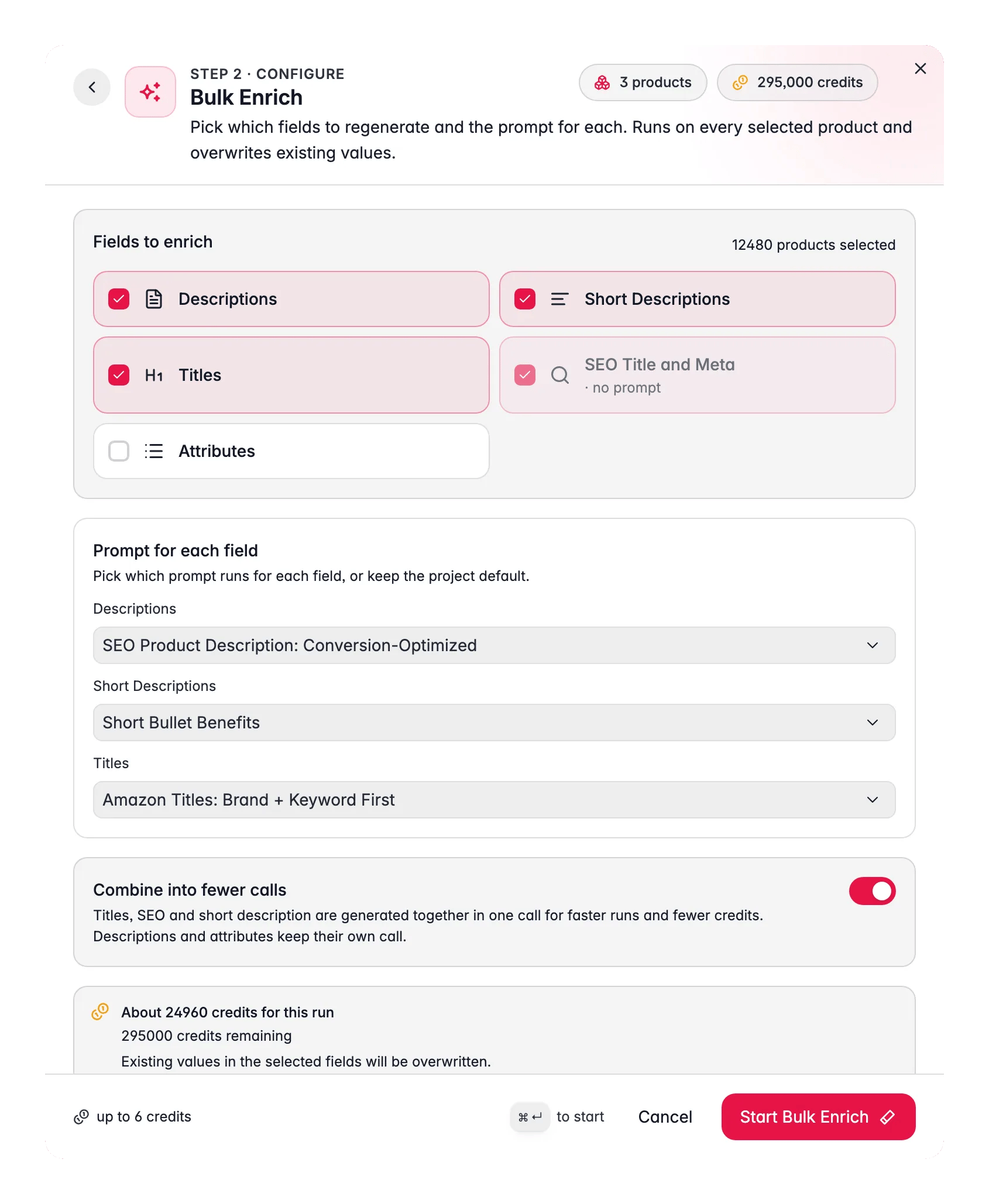
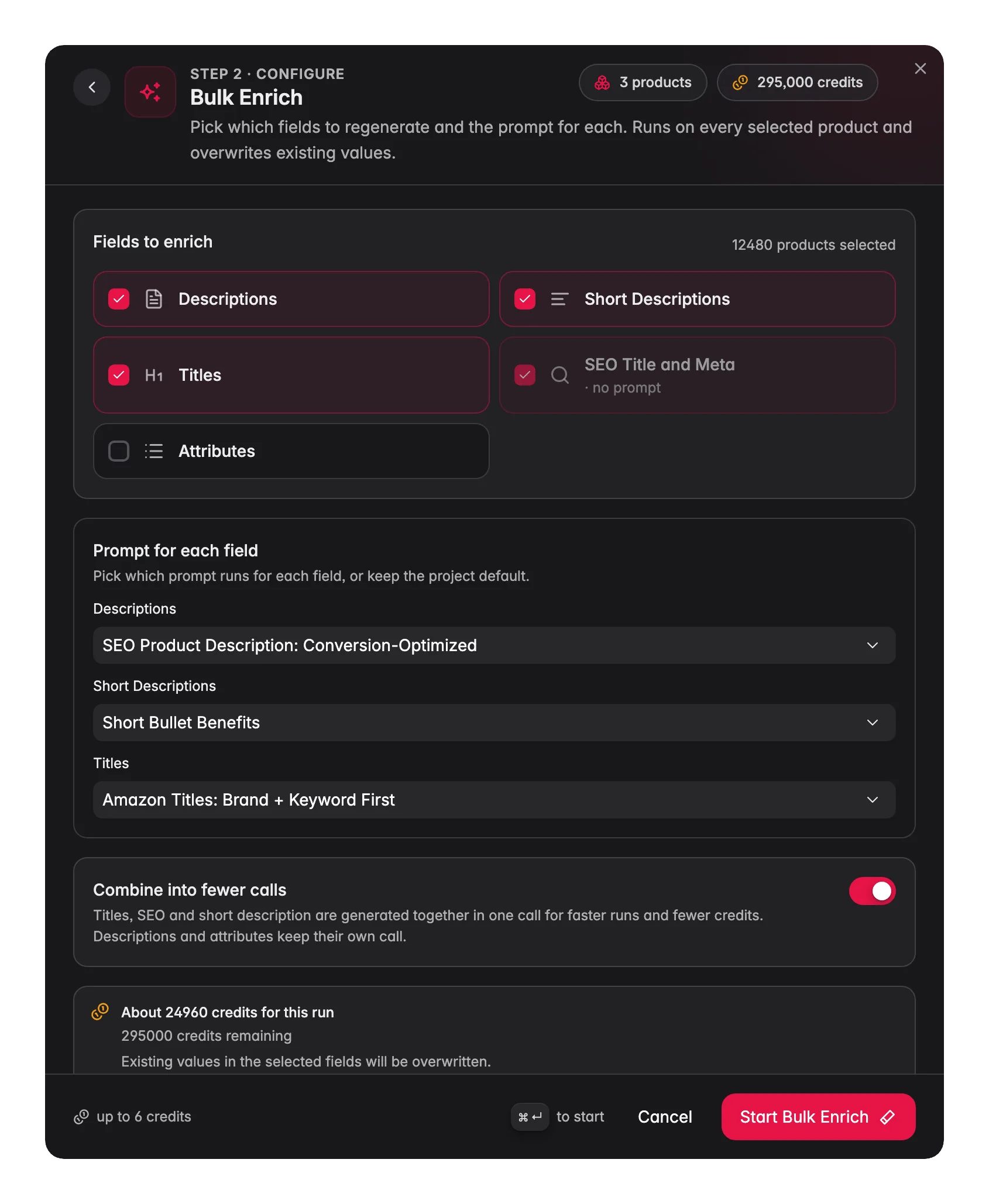
On the Products page, filter to a single category, click Enrich with AI in the toolbar, and open Bulk Enrich - the first card in the Start here shelf. A category is large enough to be representative and small enough to abandon.
2
Pick your fields and watch the credit estimate
Everything is pre-selected except attributes, which are opt-in because re-deriving them in bulk is rarely what you want. The Combine into fewer calls switch changes what you pay: combined, two or more fields cost less per product than running each field separately. Then Start Bulk Enrich.
3
Read ten of them out loud
Do they sound like your brand? Are the banned words gone? Do the must-use terms appear naturally rather than bolted on? If not, go back to the Knowledge Library card that covers the gap before you run anything else.
4
Roll out to the rest
Once a batch reads right, select the remaining products and run the same configuration. Track it in the Process Tracker; if a run stops early, Resume finishes the untouched products without charging for them again.
5
Optionally centralize shared boilerplate
Content that repeats across many products - warranty wording, shipping promises, brand taglines - is better held once as a Content Logic variable than retyped into every prompt. Change it in one place and every prompt that uses it follows.
Bulk Enrich always overwrites the fields you select. Check the product count in the modal header before starting, especially when you are running on all matching products rather than a ticked selection.
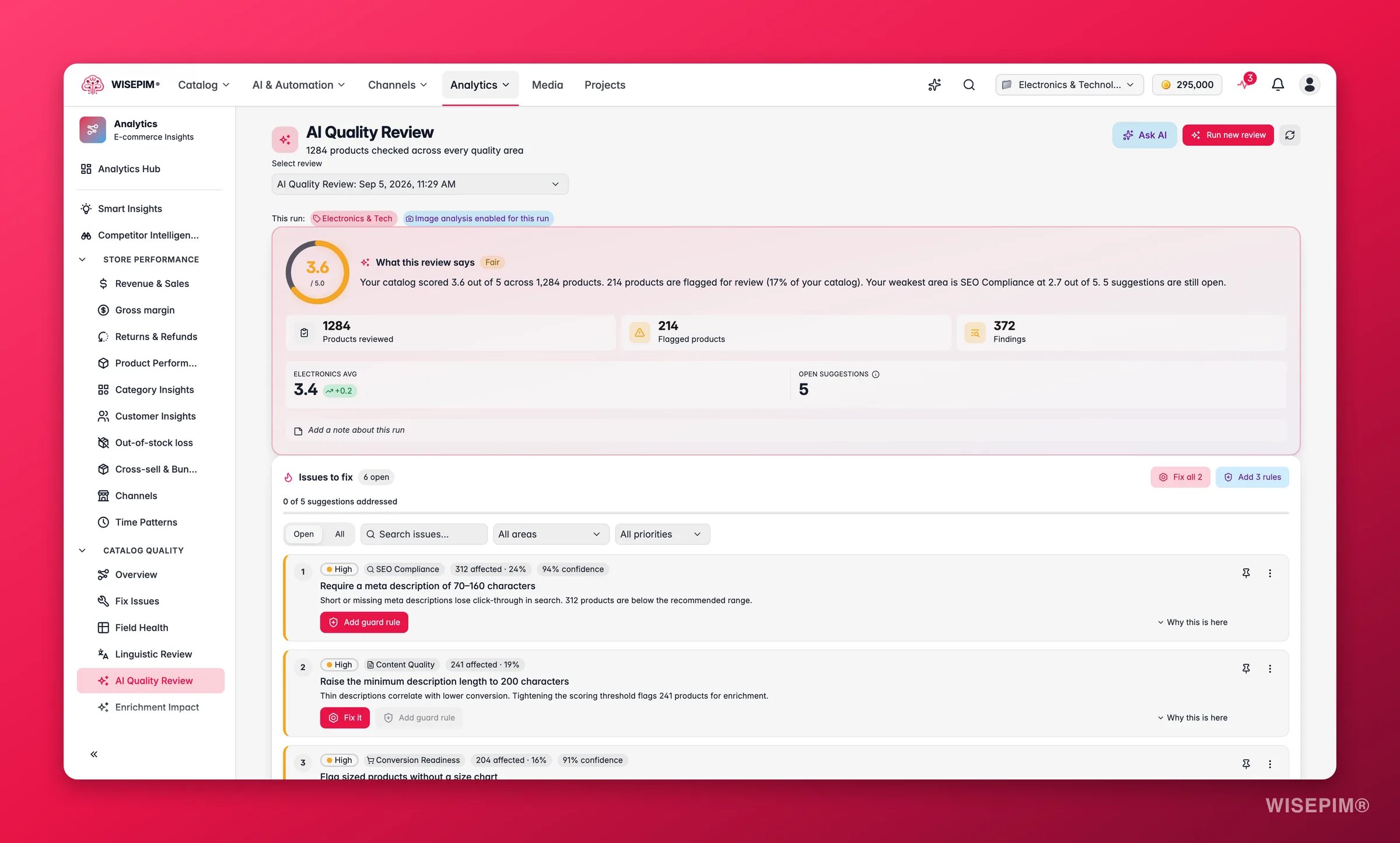
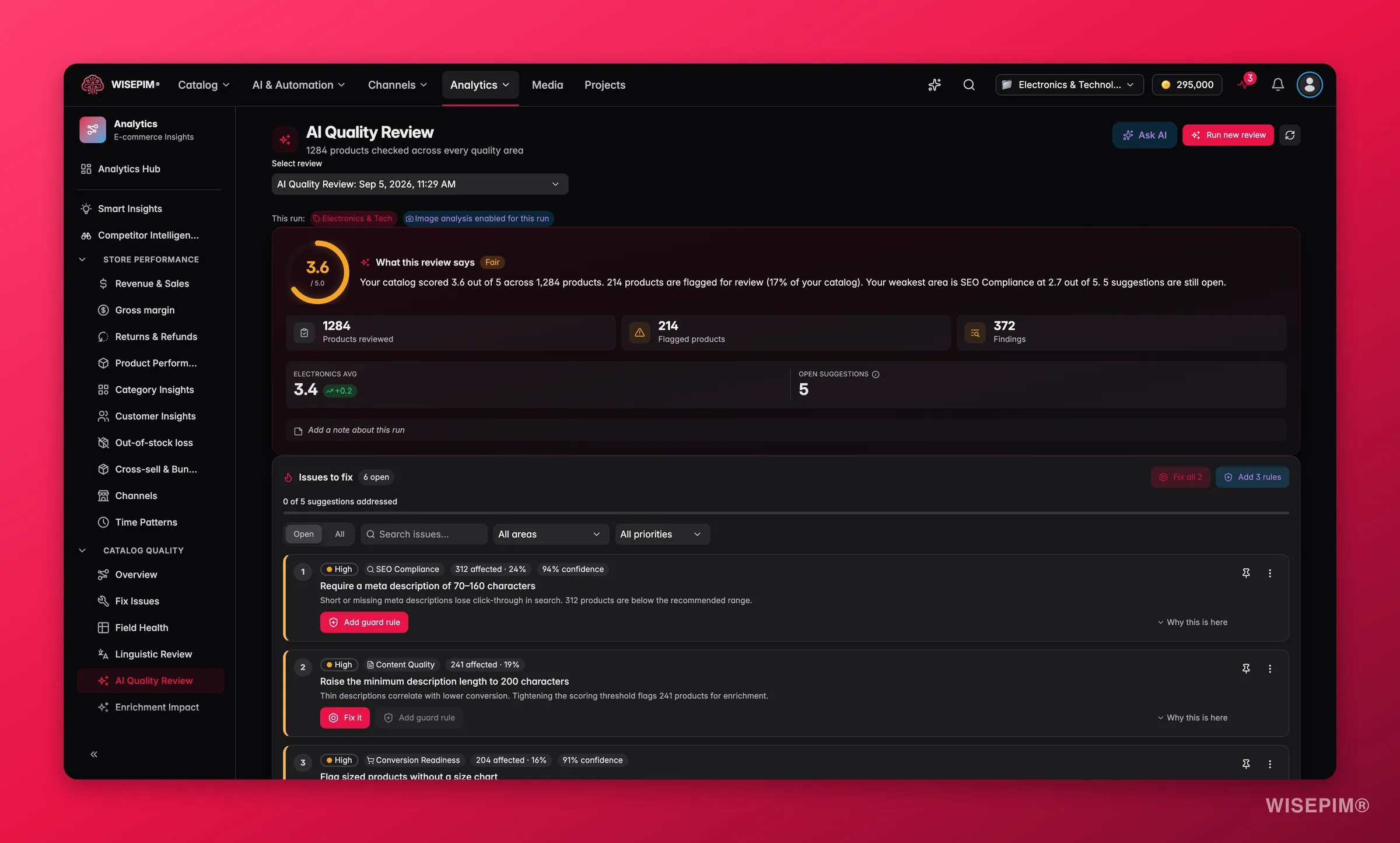
Reading a handful of products tells you whether the voice landed. AI Quality Review tells you whether it landed across the catalog, because it reads content the way a demanding customer would rather than just checking that fields are filled. Find it in the Analytics sidebar under the quality section, or start it straight from a product selection.
Same run. This is the one that catches “all sounds the same” the other way round
Overall score above 4.0
AI Quality Review dashboard
4.0–5.0 reads as good, below 3.0 as needs work. The dashboard also projects the score you would reach by applying the open suggestions
Banned words gone
Spot-check ten products in the products table
Immediately after the Bulk Enrich run
Knowledge Library completion
Per-card progress on the Knowledge Library overview
Live as you type, before you enrich anything
Run the review with the Prelaunch or Conversion intent preset for house-style work. Those presets select the text dimensions, so you are not paying vision credits for image checks that say nothing about tone.
Brand voice and brand identity are almost certainly thin - vague input gives vague output. Add concrete tone adjectives and example phrases your brand actually uses, then re-test the same product in Prompt Lab before re-running a batch. No prompt tuning compensates for an empty library.
The copy is on-brand but says nothing specific
Generic output is usually missing selling points, not missing tone. Fill in Value proposition and Content requirements in the Knowledge Library - your specific benefits, and the must-have details every description should carry - then re-run one category.
The prompt was great in the lab and disappointing in bulk
You tuned against one well-documented product. Re-test the prompt on products from each category, including ones with sparse data, and save the version that survives all of them. If the weak results all come from thin source records, fix the source data first - AI writes from what is in the product.
A field is dimmed with 'no prompt' in the enrich modal
That content type has no default prompt assigned, so it is excluded from the run. Assign one per type in Enrich Prompts settings and save, or pick a prompt for that field in the modal for this run only. The field becomes selectable either way.
The same issue keeps reappearing after every run
Turn the finding into a standing check instead of re-fixing it. AI Quality Review offers Add guard rule on an issue, which drafts a Quality Guard rule for you - it arrives inactive, so review it and switch it on.
Bulk Enrich rewrote copy I wanted to keep
Bulk Enrich overwrites by design. When you only want to fill gaps and leave hand-written copy alone, use Auto-Fill instead - same fields and same prompts, but it only touches empty fields unless you deliberately raise its overwrite threshold, and a low threshold upgrades your weakest content without touching the good stuff.