Your catalog needs to be in German by next quarter. Go from one locale to a reviewed, published market language without shipping raw machine output.
Someone has decided you are selling in Germany next quarter. You have a few thousand products in one language, no German speaker on the team, and a launch date. The fear is not that machine translation is bad - it is that you will not know whether it is bad until a German customer tells you.This guide is the order of operations that makes that risk manageable: fix the source first, prove the quality on a sample, review the whole locale like an editor would, and only then wire up the market. Budget half a day of hands-on work; the AI runs happen in the background.
Before you start: pick a project in the project switcher, because languages, translation rules, and keywords are all project-scoped. Your primary-language content should already be enriched - translation reads it as its source.
What you’ll get: a target locale scored and fixed in Linguistic Review, with its own keywords, its own product feed, and hreflang tags pointing search engines at the right version.
Every step below assumes the one before it, which is why the sample sits between the settings and the catalog:
This is the part everyone skips and everyone regrets. Translation quality is capped by source quality, and settings only affect future runs - so both are far cheaper to fix now than across 3,000 translated products later.
1
Add the locale to your project
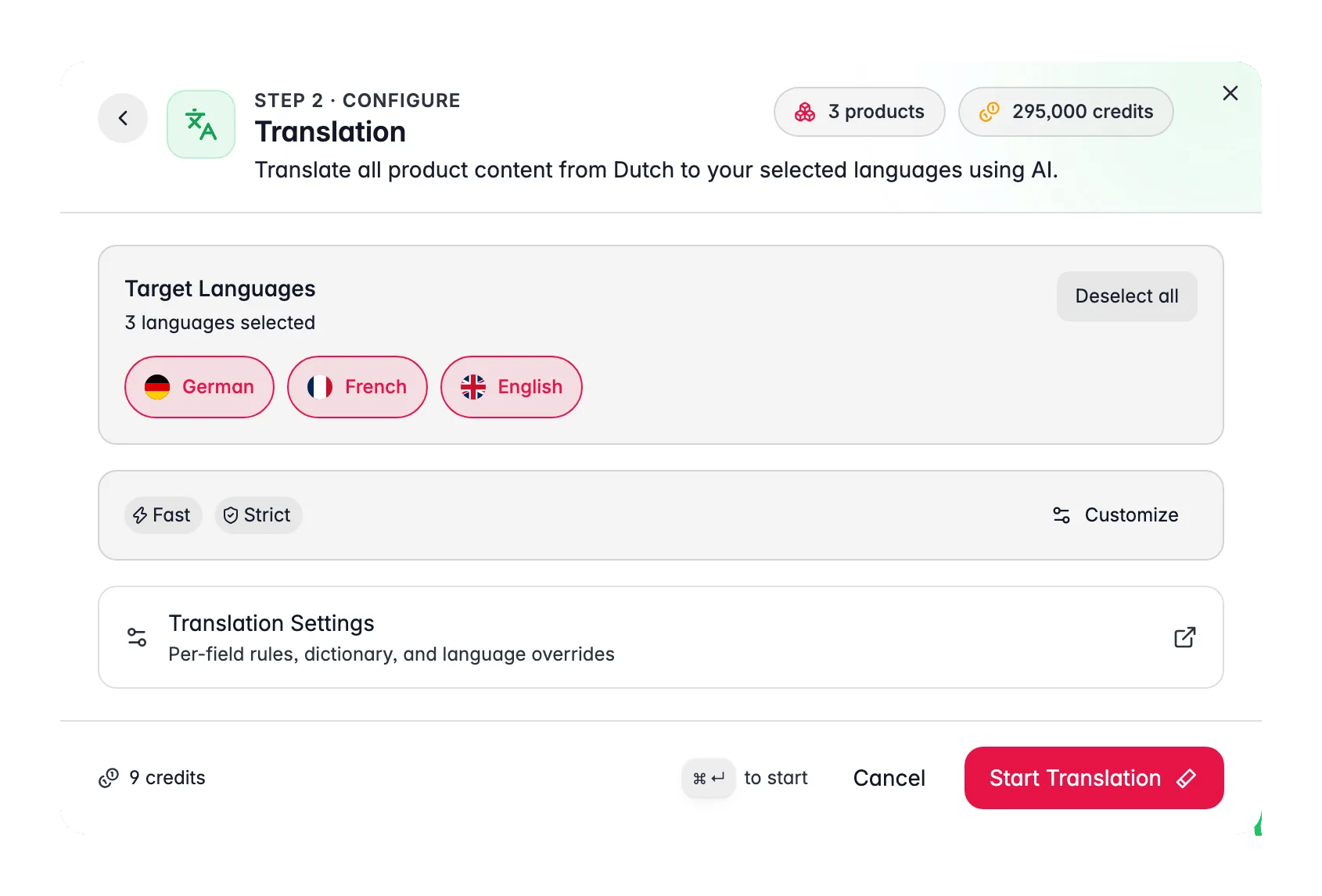
In General settings, add German under Additional languages and save. Nothing else in this guide is available until the locale exists - the Translation action does not even appear in the enrich modal without a second language.
2
Enrich the source language first
Run enrichment on your primary language before you translate a single product. When a field has enriched or reviewed content, translation uses that as its source automatically - so a thin English description becomes a thin German description, and you pay credits for the privilege.
3
Lock your terminology in the dictionary
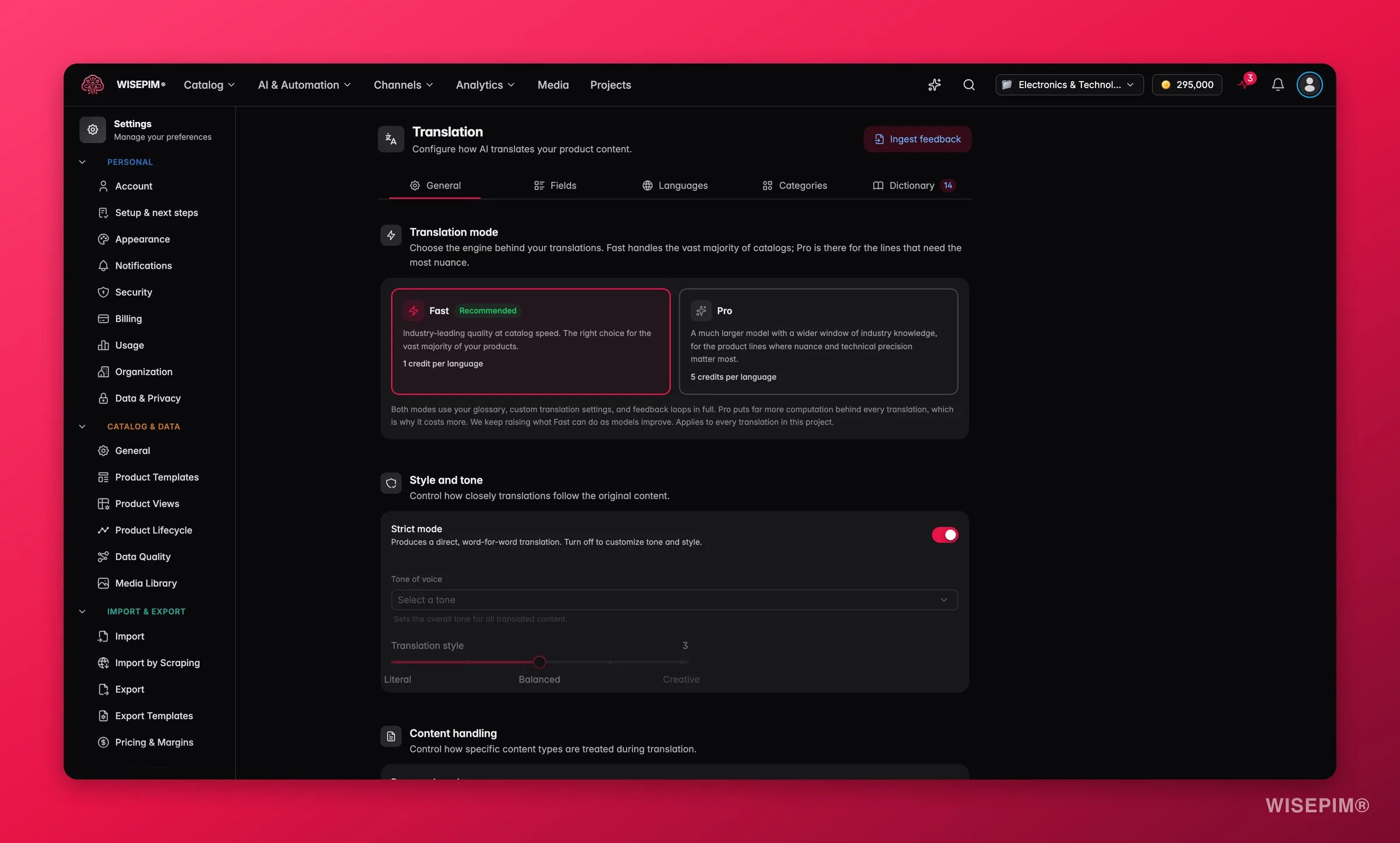
On the Dictionary tab of Translation settings, add the terms you cannot afford to get wrong. Brand names, model codes, and product lines go in as Keep as-is so they are never translated by accident. Doing this before the first run is the difference between one entry and 3,000 corrections.
4
Pick strict mode, or pick a tone
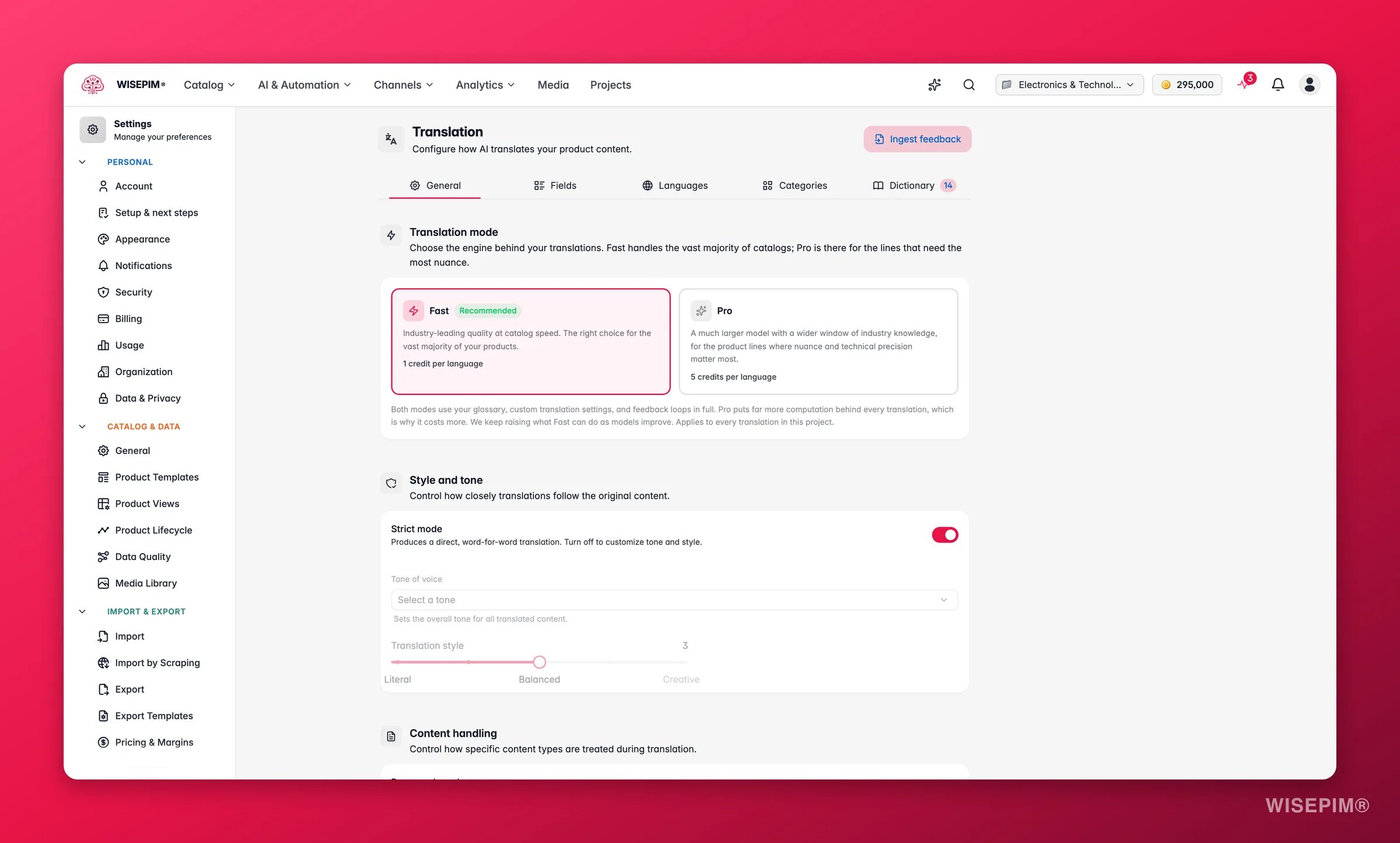
On the General tab, strict mode translates word for word with no style changes, and it is on by default. That is the right call for technical, regulated, or spec-heavy catalogs. Turn it off only if your copy sells on voice - that unlocks tone of voice and the Translation style slider from literal to creative.
5
Set formality for the language
German, like many languages, forces a choice between formal and informal address. Add a language override on the Languages tab and set Formality explicitly rather than letting each run guess.
6
Decide how units should behave
Unit handling on the General tab decides whether measurements stay as written, convert to the target locale’s standard, or show both. Get this wrong and your German pages quote inches.
AI translates six fields: product name, description, short description, meta title, meta description, and meta keywords. Custom attributes are not translated, so spec values and codes stay exactly as they are - plan that as a separate data job.
Do not run 3,000 products on your first attempt. The sample exists to catch a settings mistake while it is still worth ten credits instead of three thousand, and to answer the only real cost question in this guide.
Mode
Cost
Choose it when
Fast
1 credit per product, per language
The recommended default. Handles normal product copy well, and it is what your whole catalog should run on unless the sample proves otherwise.
Pro
5 credits per product, per language
A much larger model that reasons before it writes. Worth it where wording carries real nuance: flagship products, luxury copy, regulated wording - not the whole catalog.
1
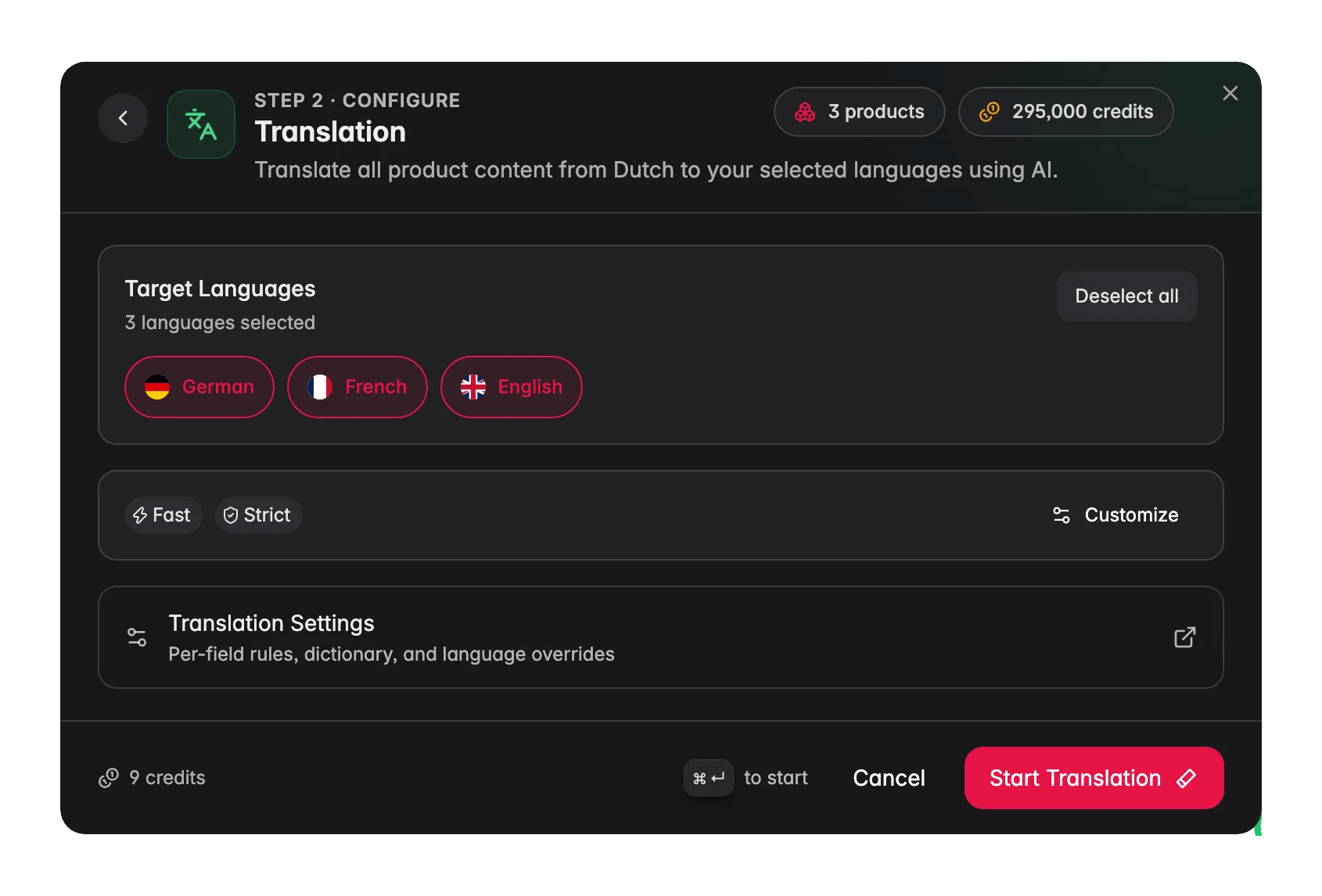
Translate 5 to 10 products on Fast
On the Products page, tick a handful of products that represent your range, click Enrich with AI in the toolbar, choose Translation, leave the mode on Fast, and click Start Enrichment.
2
Read the result in the target language
Switch the language selector on the Products page to German and read the output properly. You are looking for tone, terminology, and whether brand names survived - not for typos.
3
Only now decide about Pro
Reach for Pro only on the products where the sample showed Fast genuinely falling short. On a catalog of any size, that choice is the difference between hundreds and thousands of credits, so make it product by product rather than catalog-wide.
4
Run the catalog by category
Filter by category and translate in batches rather than firing the whole catalog at once. Each batch stays internally consistent, and review is far easier when you are reading one product type at a time.
5
Let a stopped run resume
If a run stops early, open it from the indicator in the header in the Process Tracker and choose Resume - it finishes only the untouched products at no extra credit cost, where Restart re-runs everything and is charged as a fresh run. Failed translations are refunded automatically.
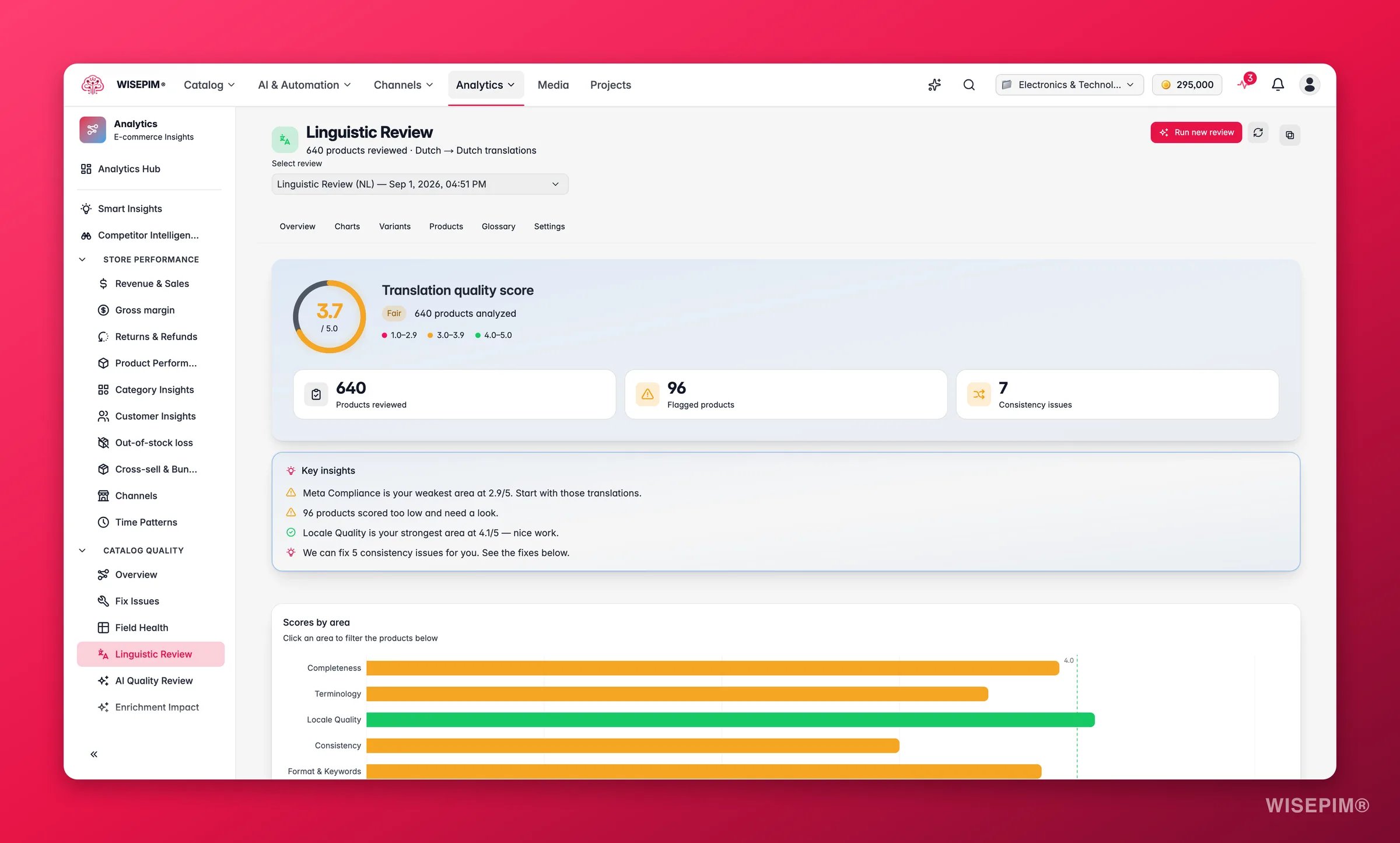
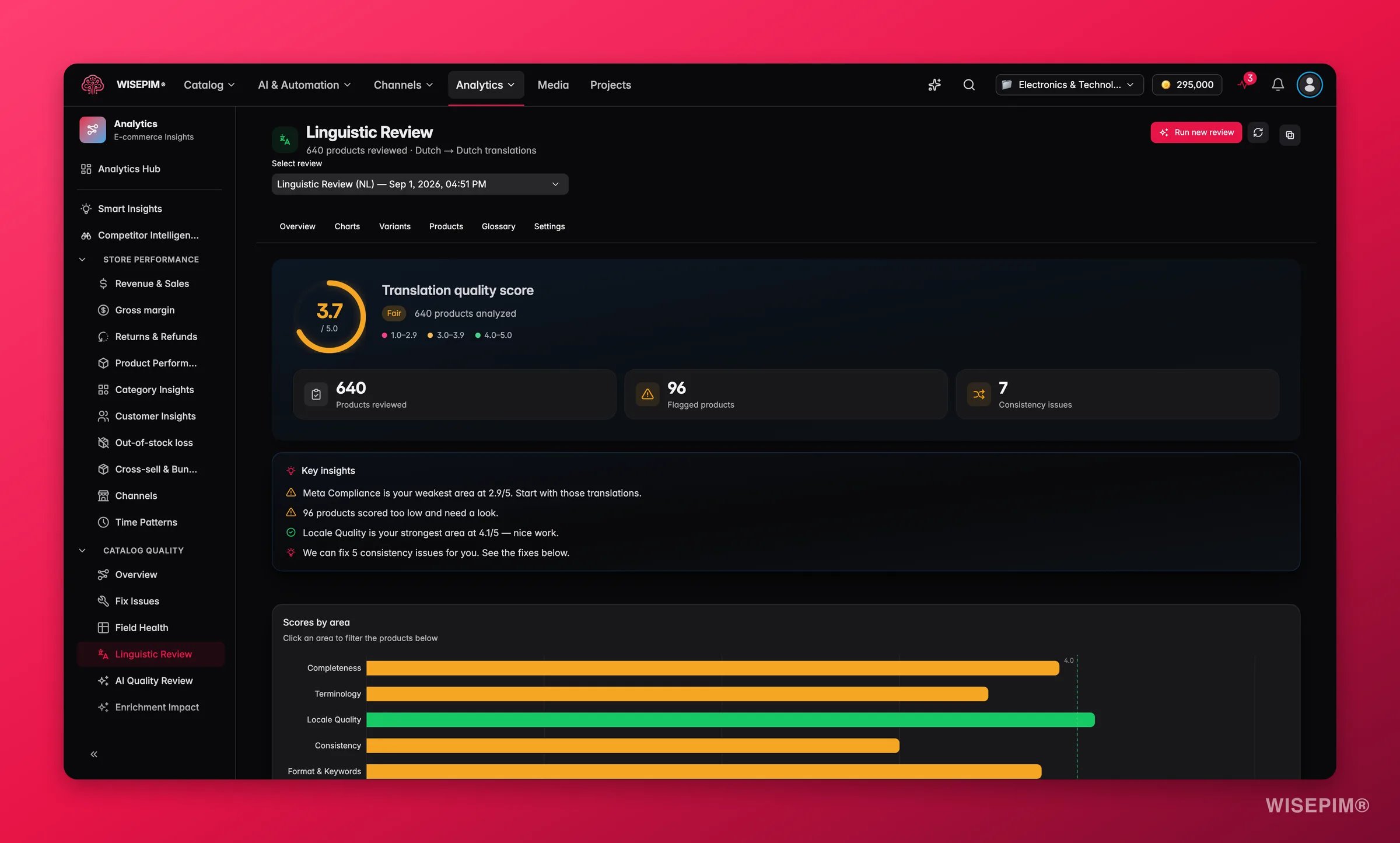
Machine translation drifts. The same term comes out three ways, meta descriptions blow past their limits, and the tone reads slightly foreign. Linguistic Review is the gate that catches it before a customer does - run it after the catalog batches, not between them, because it scores one target locale at a time across everything you have translated.
1
Run a review on the full catalog for the locale
Open Linguistic Review from the Analytics sidebar and click Run review. The button stays disabled until at least one target locale exists. Results are ready in a few minutes.
2
Read the six criteria, not just the headline score
Completeness, Terminology, Locale Quality, Consistency, Format & Keywords, and Meta Compliance each describe a different failure. The overall score is their average, so a healthy-looking 4.1 can still hide one criterion sitting below 3.
3
Apply the one-click consistency fixes
Open Term Variants, pick the recommended translation for each inconsistent term, and toggle Add to dictionary as you apply it. That fixes the products you have and stops the drift returning on the next run. Fix All applies every auto-fixable issue at once.
4
Confirm the score before you publish
Fix the flagged products and the consistency issues, then confirm the overall score is comfortably above 4 - the band that reads as ready to publish. Below 3 means fix it before the locale goes live. Treat that as your launch gate.
A translated catalog is not a market. These are the wiring jobs that turn German copy into German traffic, and they come last because each one assumes reviewed content already exists.
1
Scope keywords to the locale
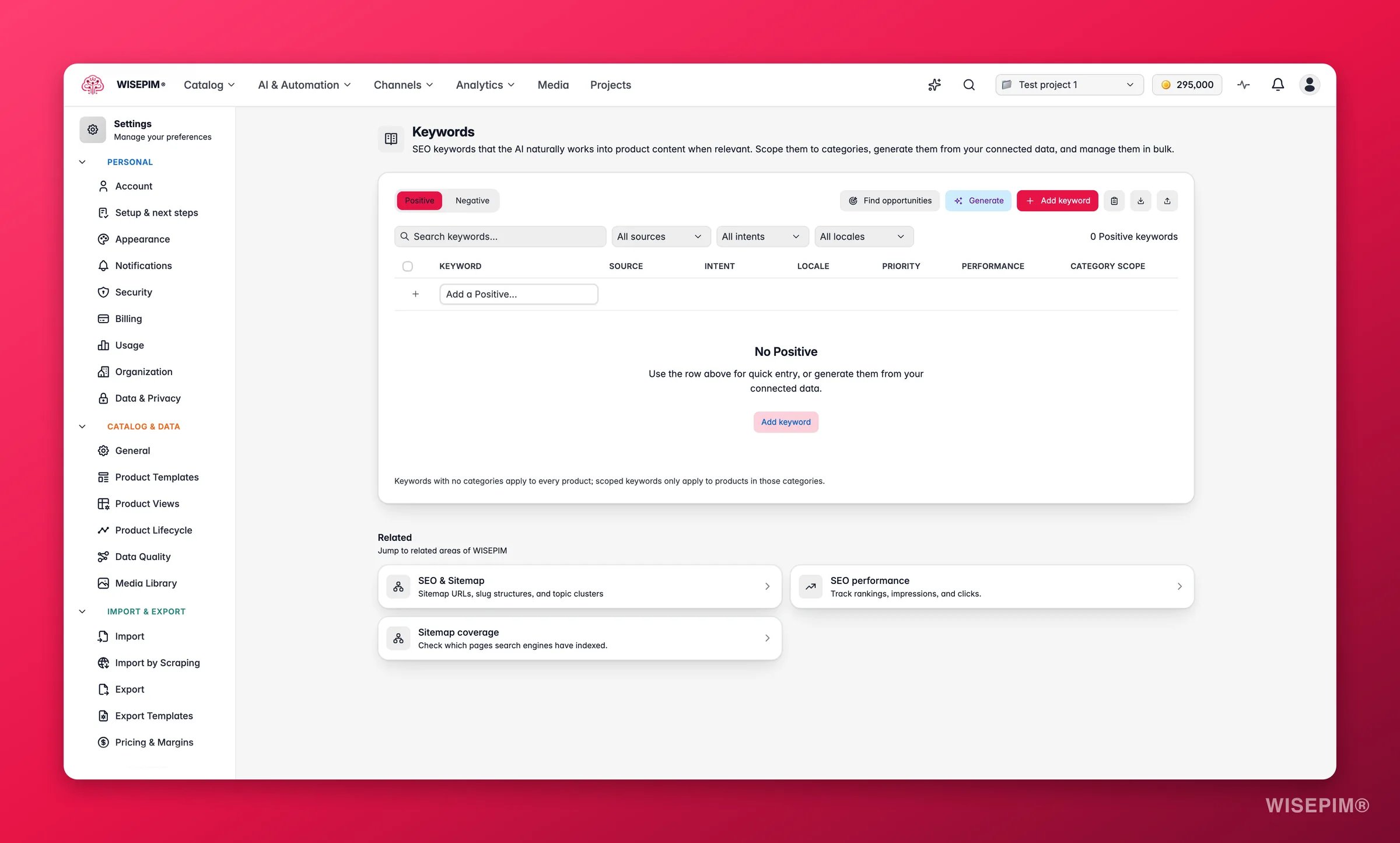
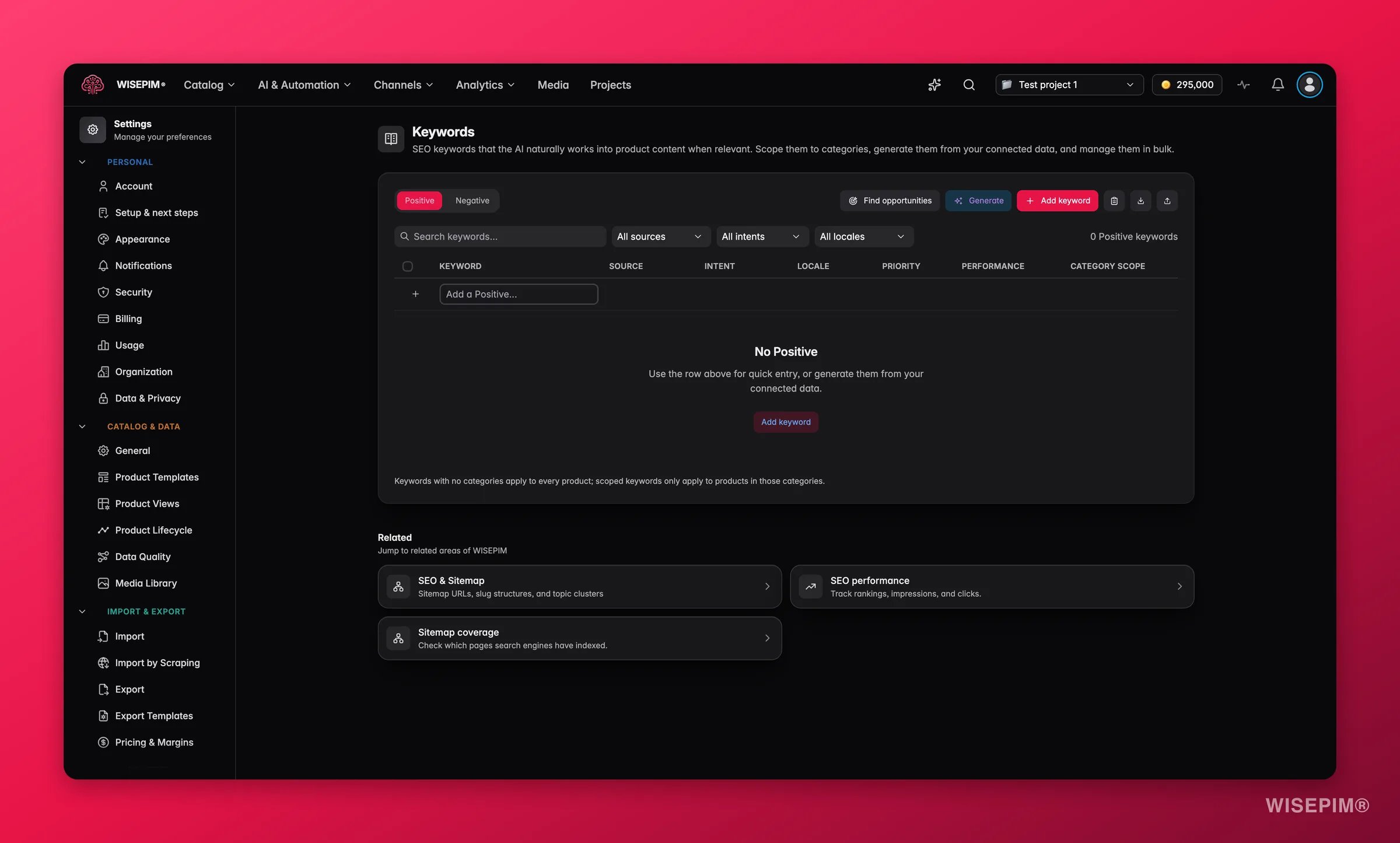
German shoppers do not search in translated English. Add the terms that market actually uses in Keywords and set each one’s locale scope so it only applies to German content.
2
Create one feed per language
In Feed Hub, click Create Feed and build a separate feed for the new market. One feed per language is the documented pattern for multilingual catalogs, and most channels expect a separate URL per market anyway.
3
Confirm hreflang is on
In SEO & Sitemap settings, check that Generate hreflang tags is enabled - it is by default - and that Default locale, which only appears once a project has more than one locale, points at the right language. This is what stops your two languages competing as duplicate content.
4
Handle Outdated fields as source content changes
When you edit or re-enrich source text, the matching translated field is flagged Outdated and re-translated on the next run. Filter for it periodically instead of assuming a translated catalog stays translated.
5
Turn on the auto-learn glossary once reviews look sensible
Back in Translation settings, Auto-learn glossary from reviews turns confident review findings into dictionary entries by itself. It is off by default on purpose - switch it on after your first reviews look right, not before.
The launch gate is simple: every product Fully translated, consistency issues resolved, and a Linguistic Review score comfortably above 4 for the locale.
You have no target language yet. Add one besides your primary language under Additional languages in General settings and the action appears.
I re-ran the translation and nothing changed
A language is skipped when it was already translated with the same settings from the same source text - that is what keeps re-runs from burning credits. Change the setting you meant to change, or edit the source field (which flags the translation Outdated), then run again.
The German reads like a translation, not like German
That is Locale Quality in the review, and it usually traces back to source text or settings rather than the model. Improve the primary-language content first, then check formality and tone for the language on the Languages tab of Translation settings, and re-translate the affected products.
The same product term is translated three different ways
Open Term Variants in Linguistic Review, apply the recommended variant, and toggle Add to dictionary in the same click so the next run cannot drift again.
Brand names and model codes got translated
Add them to the Dictionary tab in Translation settings as Keep as-is, and confirm Preserve brand names is still on under the General tab. Then re-translate the affected products.
Attribute values are still in the source language
That is expected. Translation covers the six content fields only; custom attributes are not translated. Handle spec values as a separate data job rather than waiting for a translation run to fix them.