

Before you start: you need default prompts set in Enrich Prompts and a filled Knowledge Library from part 1, and clean, categorized products from part 3.
Pick the right tool: fill gaps or start over
Both tools write the same fields with the same prompts, and they treat existing content in opposite ways. This is the one choice in the series that cannot be undone by running the other tool afterwards.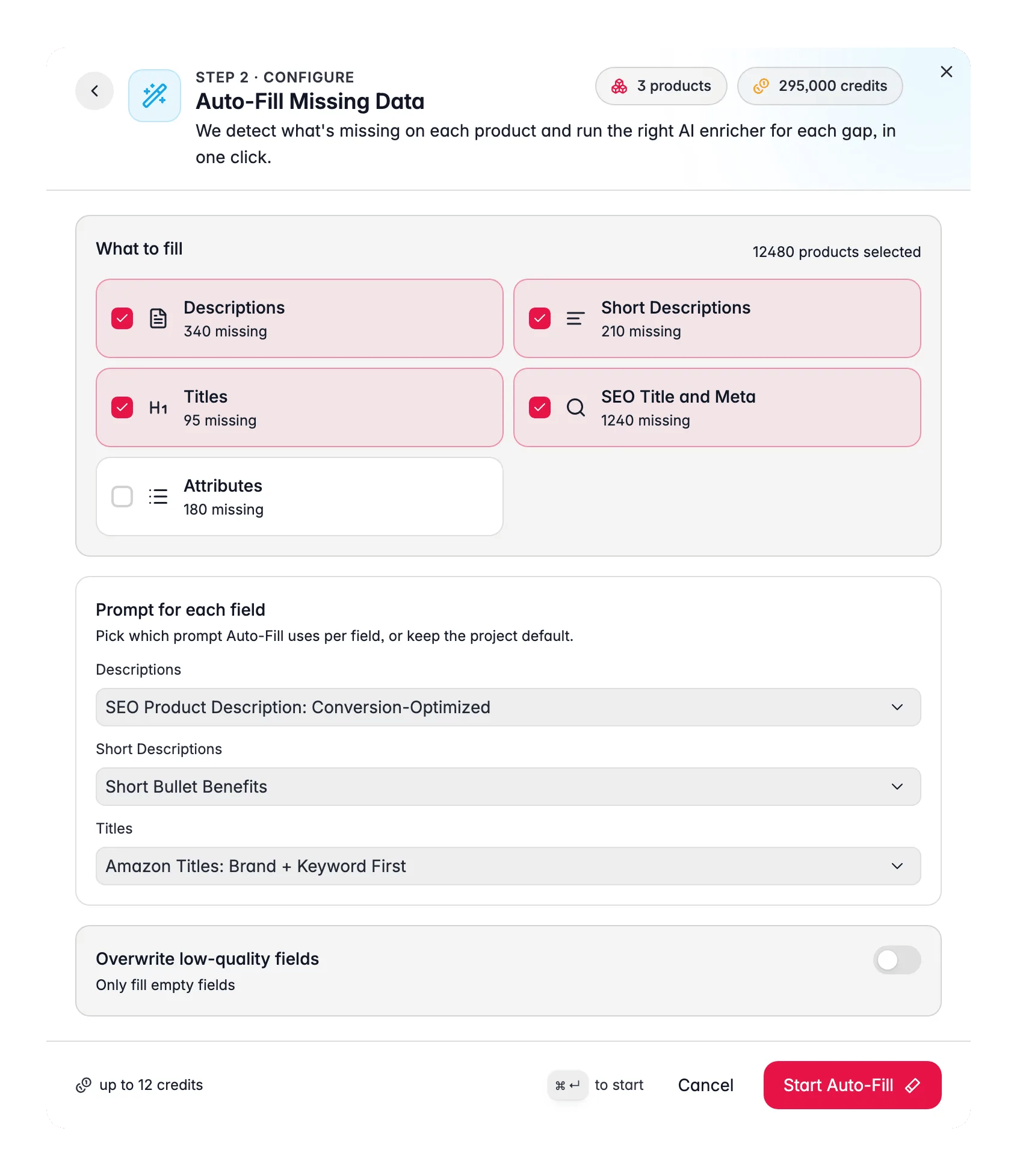
1
Confirm Auto-Fill is your tool
A first catalog is gap-filling by definition, so Auto-Fill is almost always right here. It costs one credit per product per field it actually generates, and fields that already have content are skipped, so they cost nothing.
2
Check which gap types are available
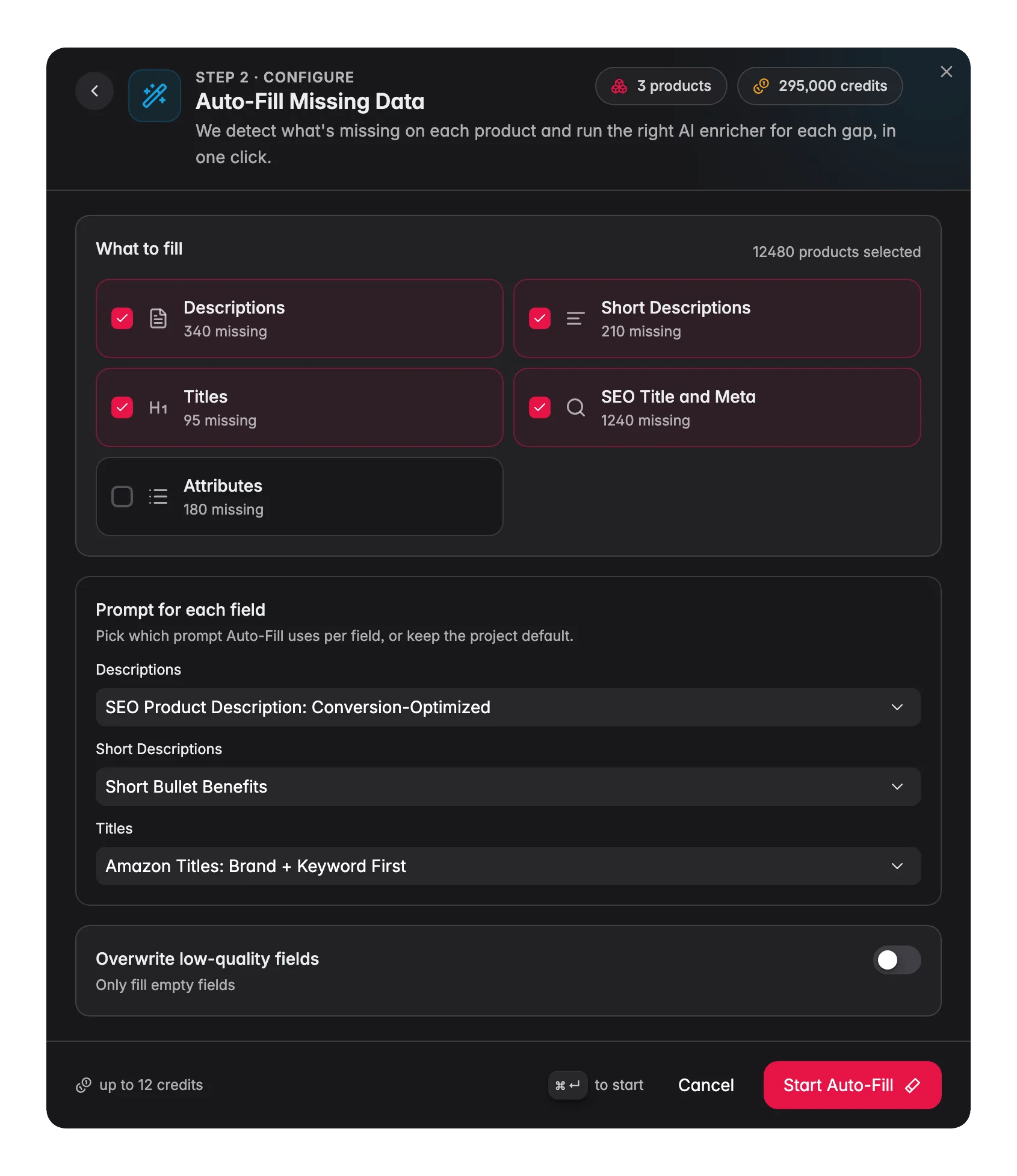
A gap type shows as greyed out when it has no default prompt and no override picked. Set the default in Enrich Prompts or choose an override in the panel, otherwise that content type is silently skipped.
3
Leave the overwrite threshold off for now
With it off, Auto-Fill only touches completely empty fields. Turn it on later, at a low threshold, once you trust the output enough to let it replace weak existing content too.
Test on ten products, and actually read the output
Ten products cost almost nothing and tell you everything, but only if you pick them badly on purpose.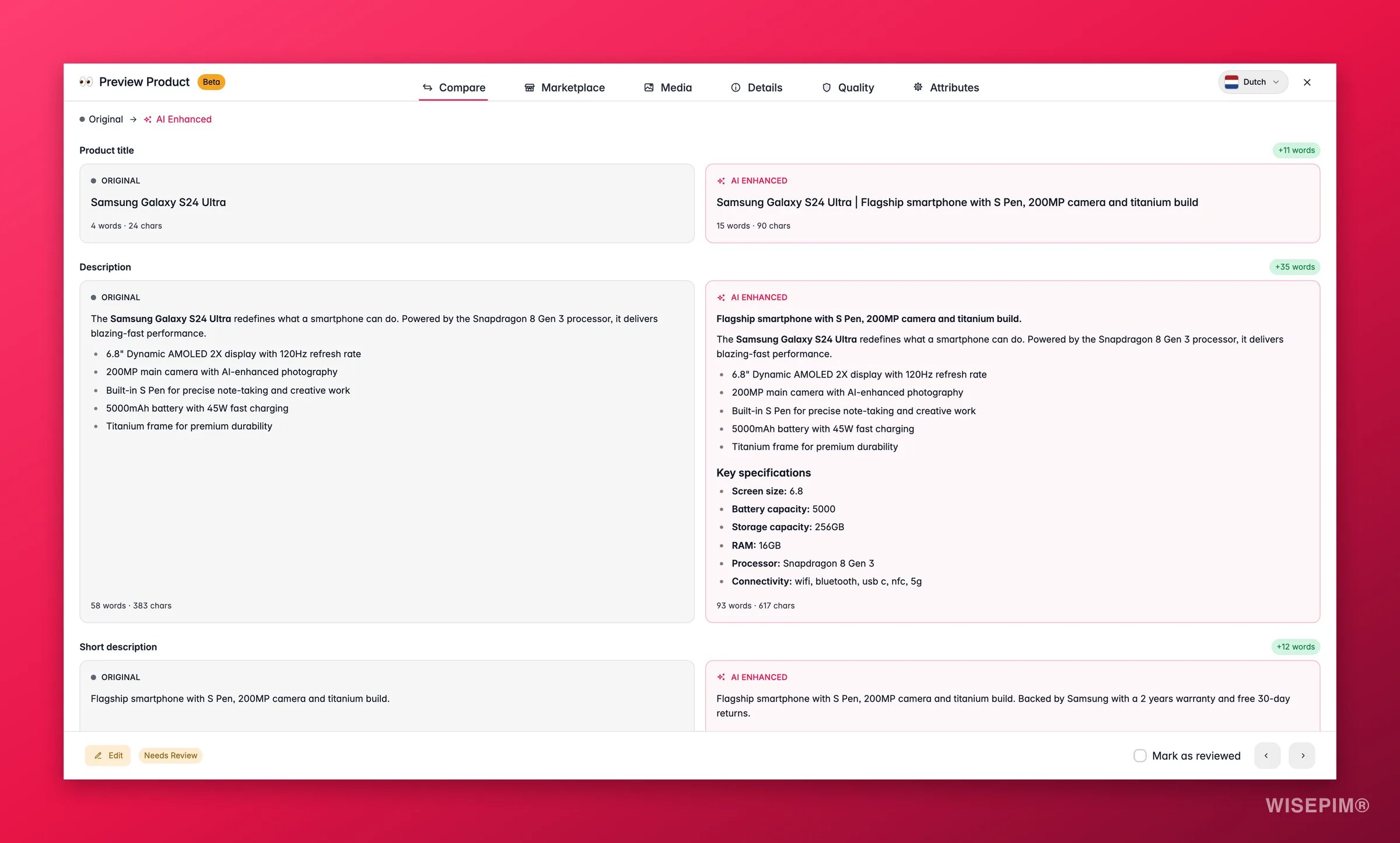
1
Choose a deliberately mixed sample
Take a few products with rich source data, a few with almost none, and one from each of your main categories. Auto-Fill writes from what is already in the record, so thin products are where output quality shows its floor.
2
Run Auto-Fill on just those ten
Tick the ten rows, click Enrich with AI in the toolbar, pick Auto-Fill Missing Data, and click Start Enrichment. Enriched content is stored in separate reviewed fields alongside your originals, so your source data stays as it was.
3
Read every generated field
Not skim: read. Open the products and check tone, length, and factual claims against the source data. This is the moment to catch a prompt that invents specifications, while it has only invented them ten times.
4
Fix the prompt, not the products
If something is off, adjust the prompt in the Prompt Lab against a real product, or add the missing context to your Knowledge Library, then re-test the same ten.
5
Repeat until boring
When two rounds in a row produce nothing you would edit, the prompt is ready for the catalog.
Run the catalog and manage the job, not the products
A 5,000-product run is a background job. Your work during it is watching for the one failure that repeats, not reading products.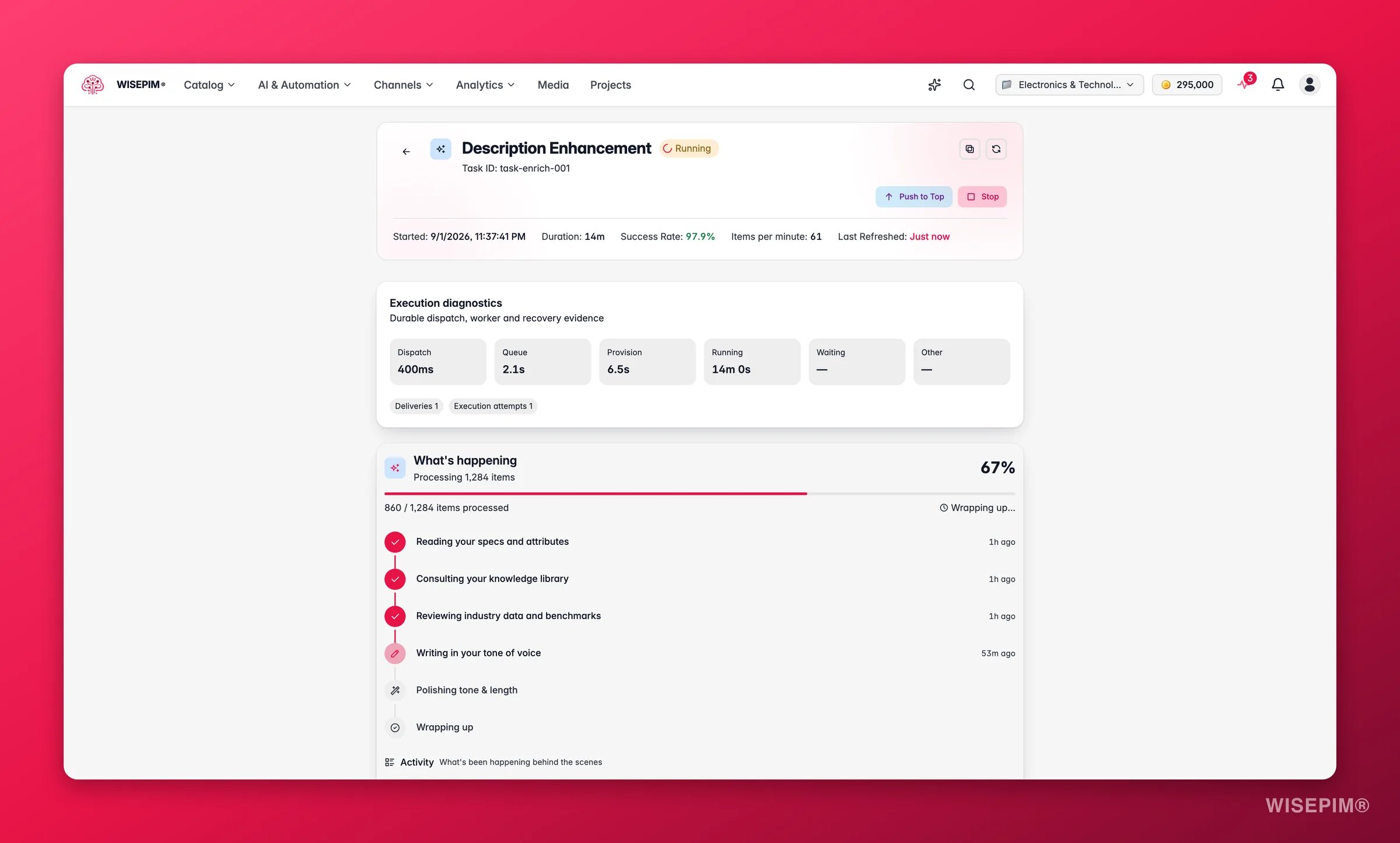
1
Filter, select all matching, and check the count in the modal header
Filter to the products that need work, use Apply to all to take every match across all pages, and read the product count before starting. This is your last chance to catch a filter that is wider than you thought.
2
Start the run and let it go
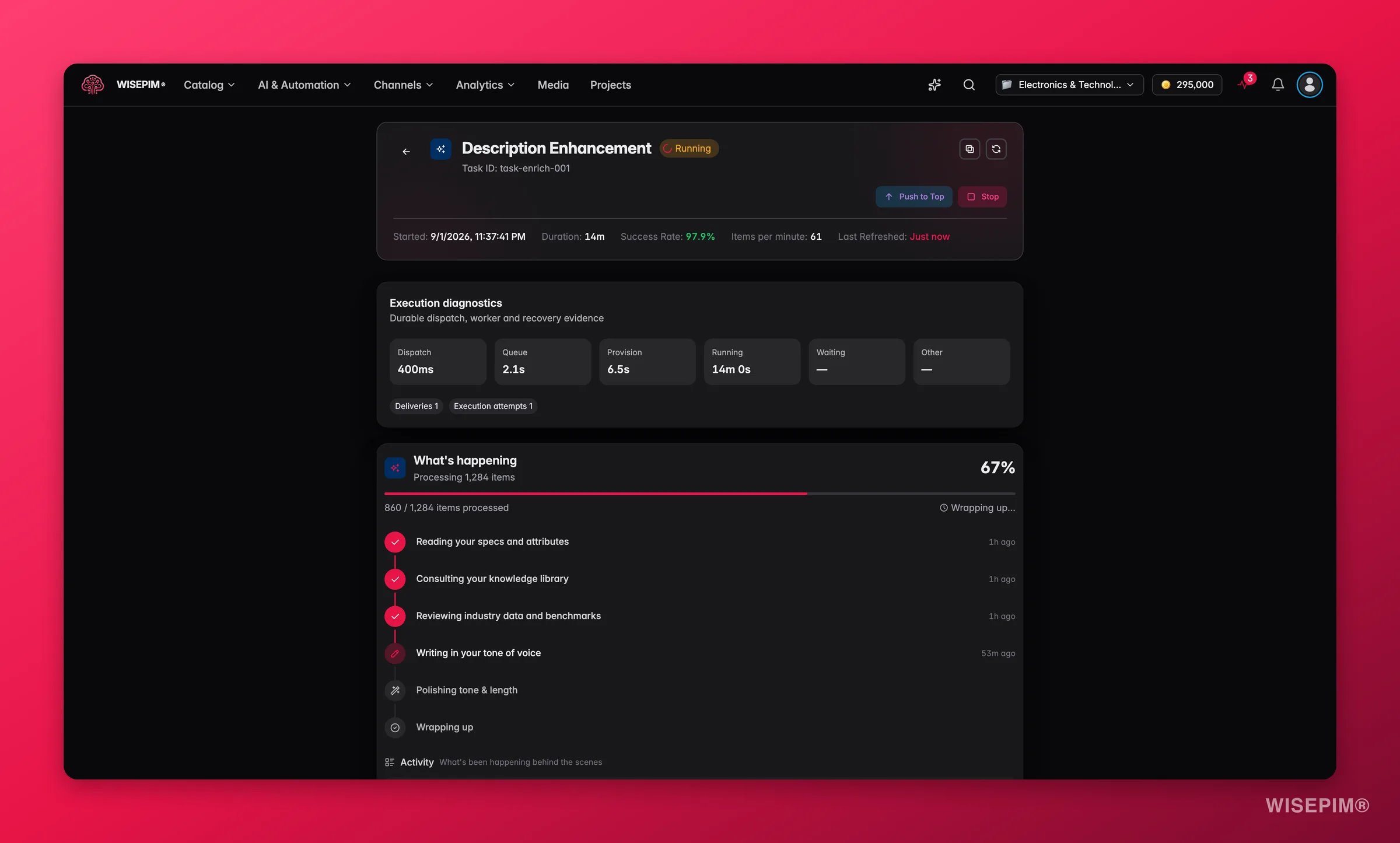
It appears in the Process Tracker as one parent task with a child task per product or field, with live progress.
3
Read the What's happening timeline
It narrates the run in plain language and shows what the AI drew on. If it never consulted your Knowledge Library, that explains an off-brand result better than any guesswork.
4
Resume, never restart
If the run stops, whether you stopped it or credits ran out, Resume processes only the remainder at no extra credit cost. Restart re-runs the full original selection and is charged as a new run.
5
Read the recap when it finishes
“Here is what WISEPIM did” sums up how many products were enriched, how long it took, and which of your rules and context it used.
How to tell it worked
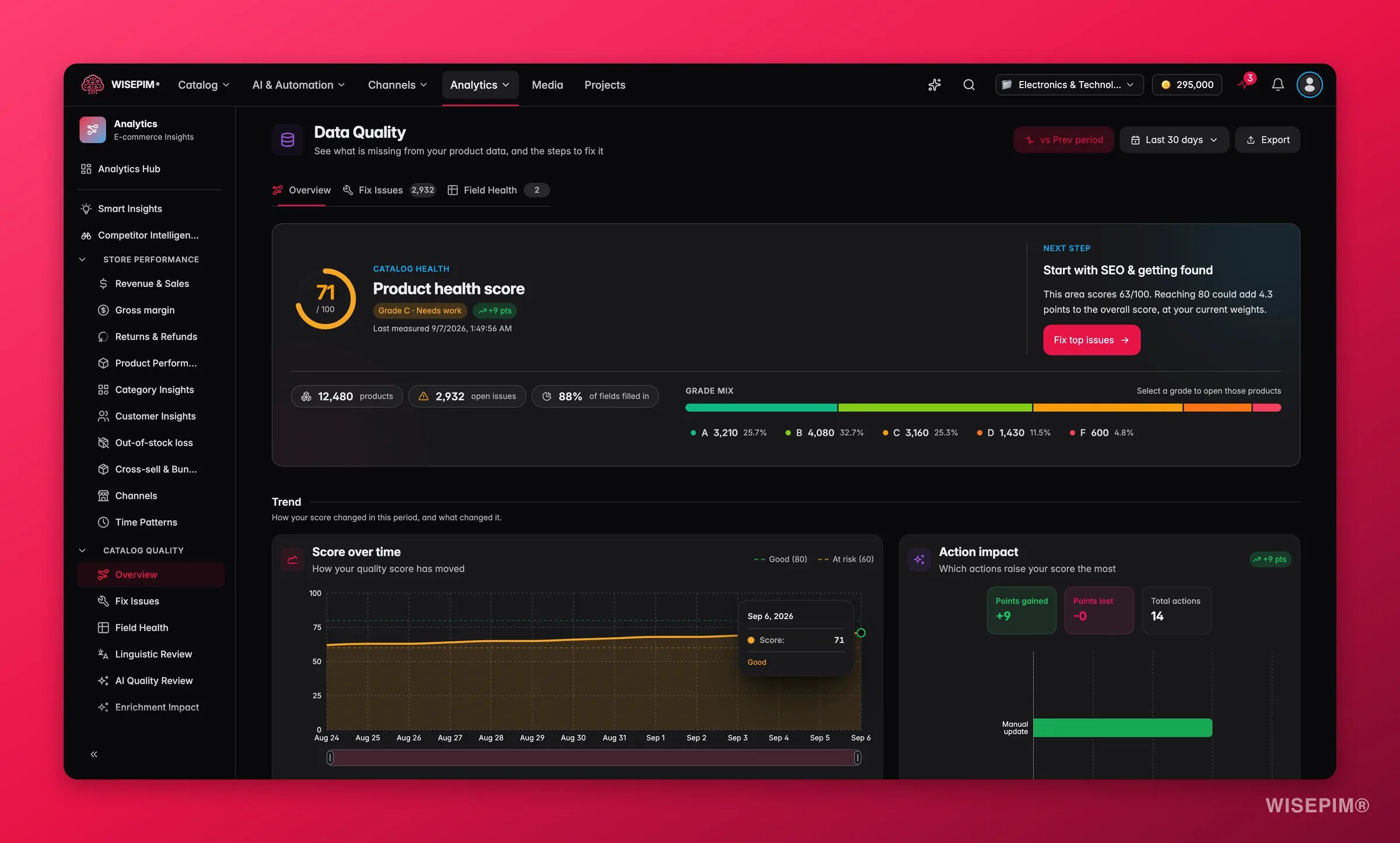
Open Data Quality and read the content coverage funnel: it shows the percentage of products carrying each key field, so a remaining gap is obvious rather than anecdotal. Aim for a B, 80 or above, before part 5.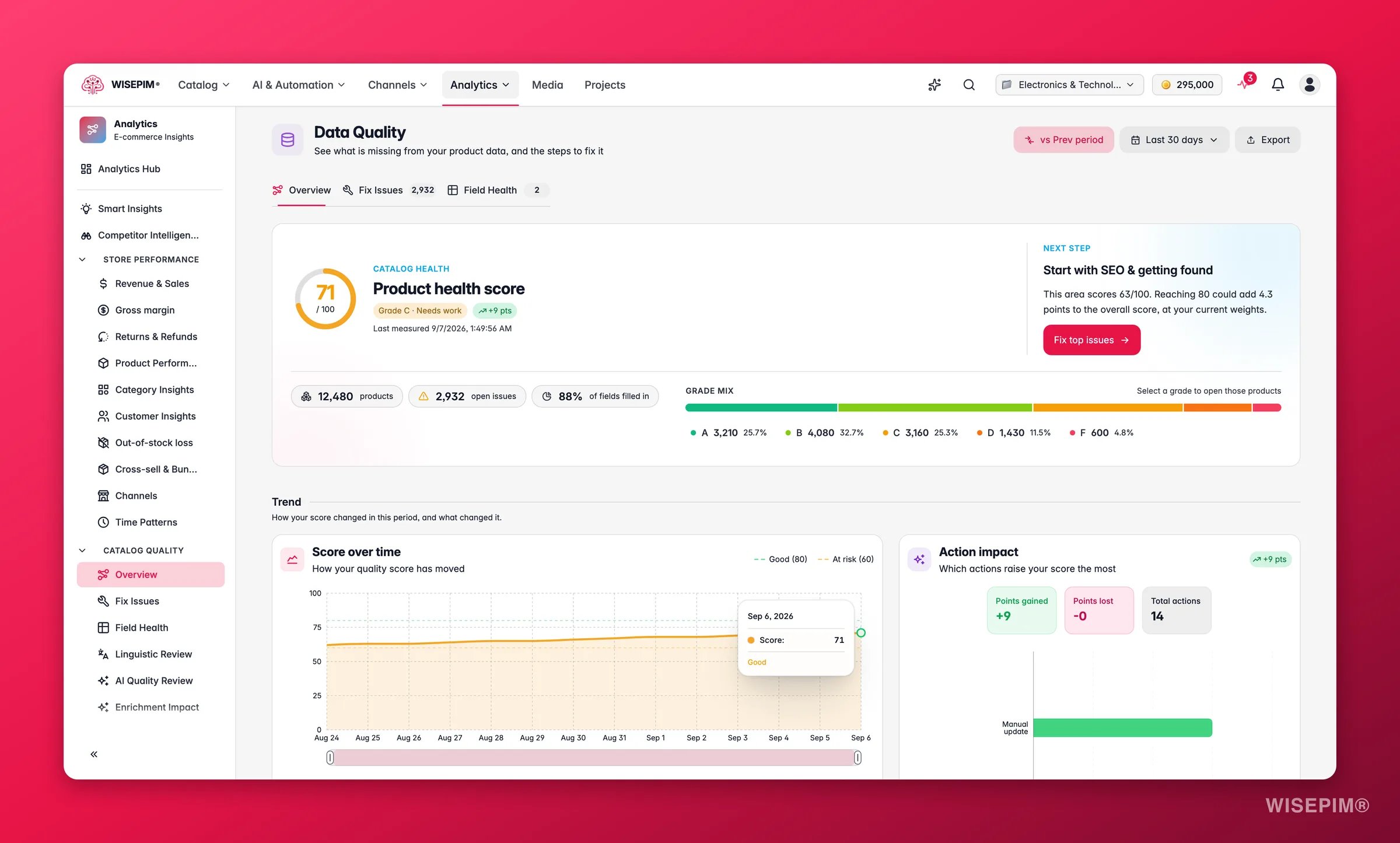
When it doesn’t work
It overwrote descriptions I wanted to keep
It overwrote descriptions I wanted to keep
That is Bulk Enrich behaving as designed: it always overwrites the fields you pick. For gap-filling, use Auto-Fill instead, which leaves existing content alone.
Some products came out far better than others
Some products came out far better than others
Compare the weak ones’ source data. Auto-Fill works from what is already in the product record, so shorter existing descriptions and fewer attributes produce weaker output. Improve the source data first, then run again.
The run stopped halfway through
The run stopped halfway through
Open the task and use Resume. It runs only the items that were never processed, with no extra credits, because the original run already paid for them.
A content type was skipped entirely
A content type was skipped entirely
It had no default prompt and no override, so it was greyed out in the panel. Set the default in Enrich Prompts and run again on the affected products.
The copy doesn't sound like our brand
The copy doesn't sound like our brand
Fill in brand voice and brand identity in the Knowledge Library with concrete tone adjectives and example phrasing, re-test in the Prompt Lab, then re-run on a sample before the full catalog.
Related
5. Publish your first enriched catalog
Next in the series: get the enriched data out to your store or channel without surprises.
Teach WISEPIM your house style
When the output is close but not yet yours.
Auto-Fill Missing Data
Gap types, prompt overrides, and the overwrite threshold.
Bulk Enrich
The rewrite tool: fields, prompts, and what a run costs.