> ## Documentation Index
> Fetch the complete documentation index at: https://docs.wisepim.com/llms.txt
> Use this file to discover all available pages before exploring further.
# Web Research Settings
> Control what web research focuses on, which sites it may use, which product fields it updates, and how market prices turn into a recommended price.
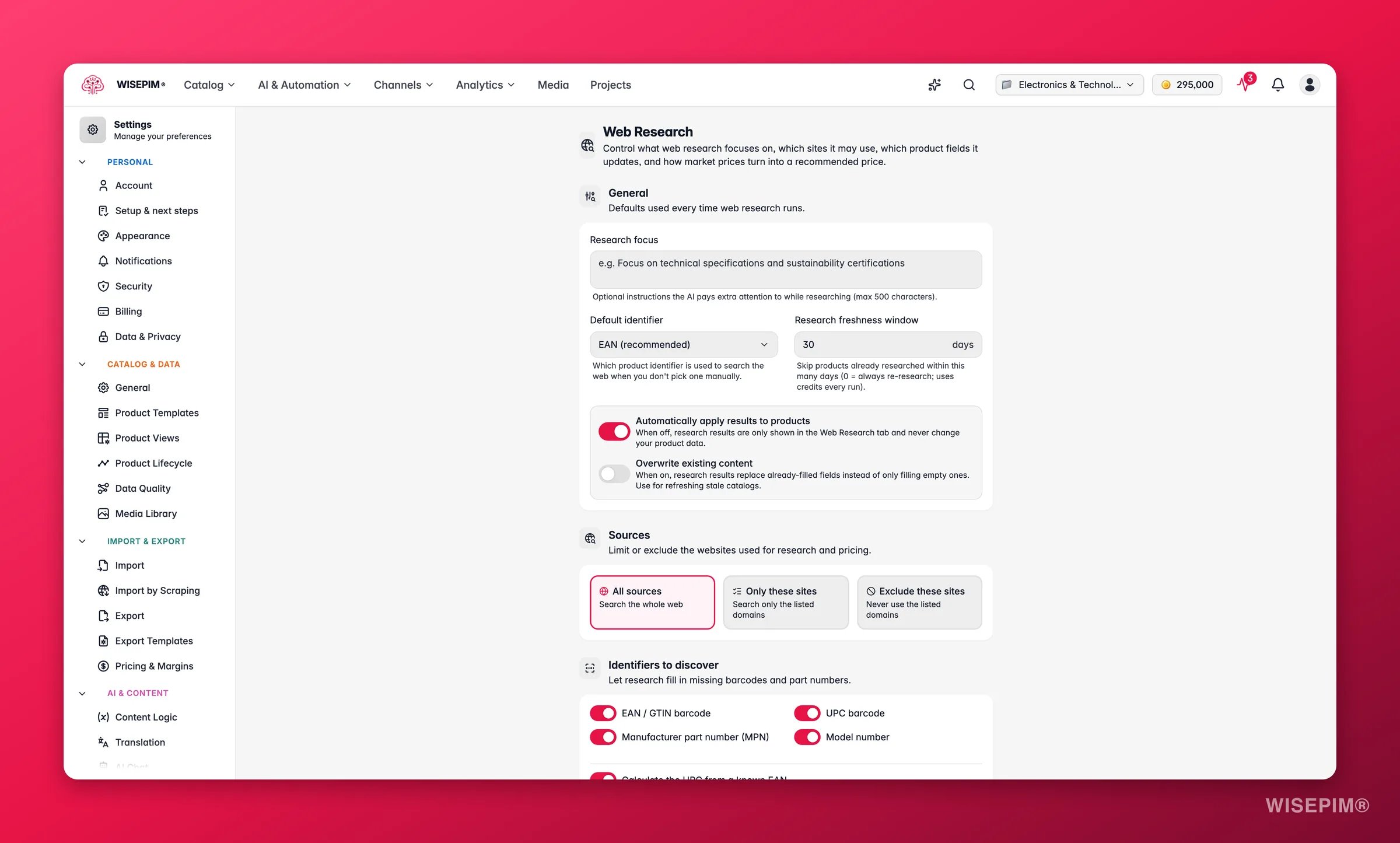
 Every [web research](/en/ai/web-research) run - started by hand from the products table, by an automation, or automatically [after a scraped import](/en/settings/import-by-scraping) - follows the rules on this page. Set them once and research behaves the same everywhere.
Web research needs the **Growth** plan or higher and costs **5 credits per product per run**. The settings page itself is free to configure.
## General
Defaults used every time web research runs:
* **Research focus**: optional instructions the AI pays extra attention to while researching, up to 500 characters - for example "Focus on technical specifications and sustainability certifications."
* **Default identifier**: which product identifier is used to search the web when you don't pick one manually. **EAN (recommended)** by default; UPC, model number, SKU, brand + product name, and brand + MPN are also available.
* **Research freshness window**: skip products already researched within this many days. Default **30**. Set it to 0 to always re-research - but that spends credits every run, so leave a window on unless you have a reason not to.
* **Automatically apply results to products**: on by default. Turn it off and research results are only shown in the product's Web Research tab, never written to your data - useful when you want a human to merge results by hand.
* **Overwrite existing content**: off by default. When on, research results replace already-filled fields instead of only filling empty ones. Use it for refreshing a stale catalog.
The freshness window is what makes automatic research affordable. Re-importing the same supplier feed won't re-spend credits on products researched last week - only genuinely new or stale products get a run.
## Sources
Limit or exclude the websites used for research and pricing:
* **All sources** (default): search the whole web.
* **Only these sites**: search only the listed domains - for example, just the manufacturer sites you trust.
* **Exclude these sites**: never use the listed domains - for example, a competitor whose specs you don't trust.
Both list modes take up to 10 domains (a search engine limit). WISEPIM strips `https://`, `www.`, and paths automatically, so pasting a full URL is fine.
## Identifiers to discover
Research can fill in missing barcodes and part numbers: **EAN/GTIN**, **UPC**, **MPN**, and **model number** are all on by default. Two extra toggles calculate the UPC from a known EAN and vice versa - a UPC is an EAN starting with a zero, so one can be derived from the other exactly, no research needed.
Identifiers are only ever written to empty fields. An existing barcode is never replaced - even with **Overwrite existing content** on. If research finds a different barcode than the one on the product, the mismatch is flagged instead.
## Fields to update
Choose exactly which product fields research may fill when applying results, with **All** / **None** shortcuts:
* **Content**: product name, long page title, description, short description, features, meta title, meta description, meta keywords
* **Product data**: brand, specifications (attributes), physical properties, category suggestions
* **Compliance & shipping**: country of origin, HS (customs) code, warranty, certifications, dangerous goods flag, fragile flag, handling instructions
Most content and product data fields are on by default. The warranty and certification fields (which create a project attribute on first use) and the shipping flags start off, so nothing appears in your data model until you opt in.
## Pricing strategy
Research also gathers competitor prices. This section turns those market prices into a **recommended selling price**:
| Strategy | What it recommends |
| ------------------------------- | ------------------------------------------------ |
| **No recommendation** (default) | Only show market statistics |
| **Match average** | Price at the market average |
| **Match lowest** | Price at the cheapest competitor |
| **Undercut lowest** | Go below the cheapest competitor by a percentage |
| **Undercut average** | Go below the market average by a percentage |
| **Premium** | Price above the market average by a percentage |
Supporting options:
* **VAT handling**: tell WISEPIM whether your prices include or exclude VAT, and the rate to assume when a shop doesn't state its own. Competitor prices are converted before they're compared, and prices that can't be converted are skipped rather than guessed.
* **Split prices per variant**: on by default. Variants of the same product often sell at different prices, so each variant gets its own market price instead of one blended average. This needs the parent's [product family](/en/products/product-families) to declare a variant axis (like size or color), so WISEPIM knows what distinguishes the variants; without one, you get a single blended price.
* **Adjustment and rounding**: the percentage for undercut/premium strategies, plus charm pricing (.99 / .95) or whole-number rounding. A live example shows the recommendation as you tune.
* **Guardrails**: a minimum margin over cost, and absolute minimum/maximum prices. The recommendation never crosses them.
### Writing the price back
By default the recommendation is just shown on the product. Turn on **Write recommended price to product** to apply it to the regular or sale price field on every research run.
Write-back overwrites the product's current price on every web research run, and scraped prices can be wrong. Double-check results on a few products before enabling this for bulk runs, and set the guardrails first.
## Related
What research gathers and how to run it on your products.
Chain research automatically onto every scraped import.
Pricing rules applied when products are exported.
Default prompts used by the enrichment that follows research.
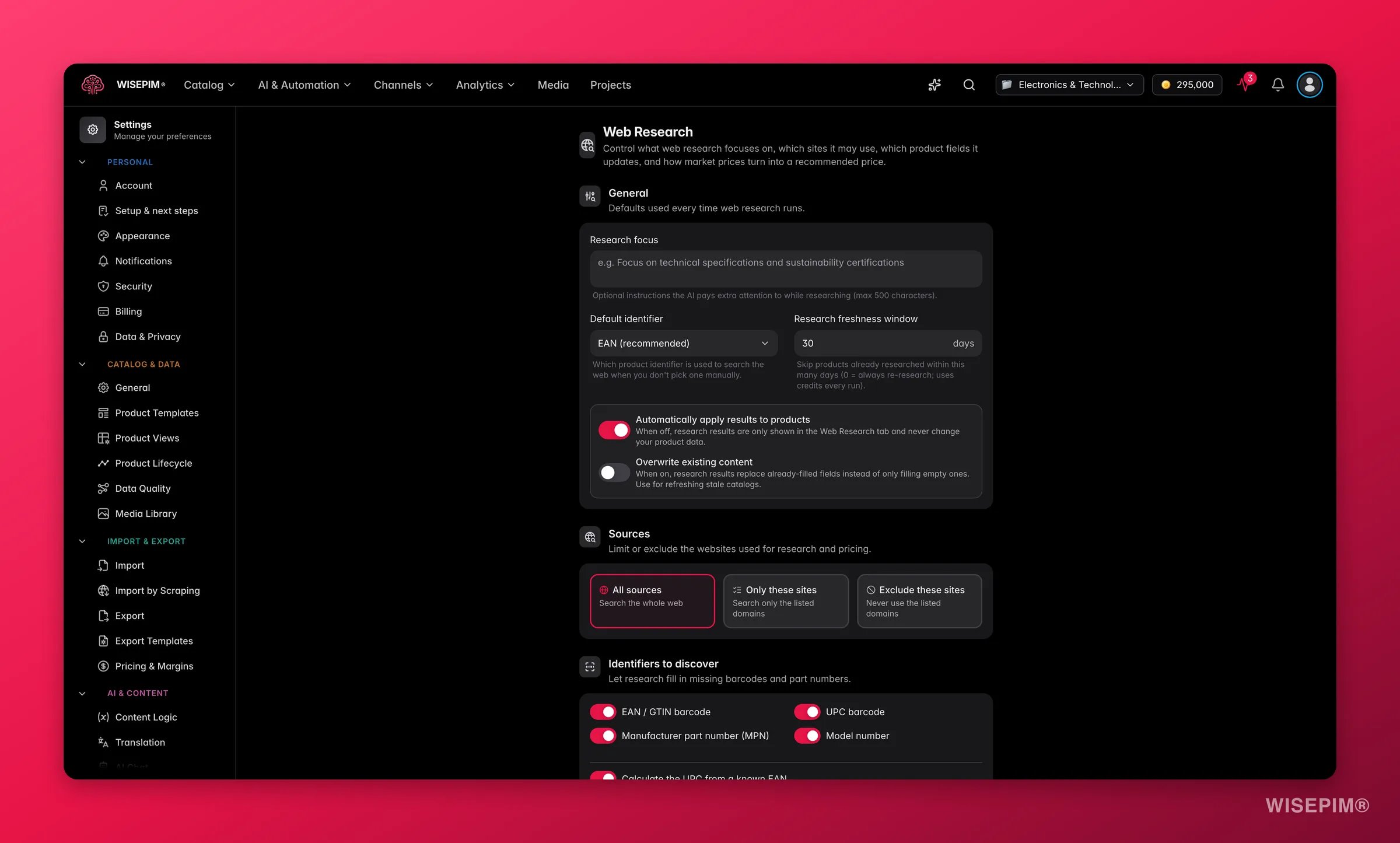
Every [web research](/en/ai/web-research) run - started by hand from the products table, by an automation, or automatically [after a scraped import](/en/settings/import-by-scraping) - follows the rules on this page. Set them once and research behaves the same everywhere.
Web research needs the **Growth** plan or higher and costs **5 credits per product per run**. The settings page itself is free to configure.
## General
Defaults used every time web research runs:
* **Research focus**: optional instructions the AI pays extra attention to while researching, up to 500 characters - for example "Focus on technical specifications and sustainability certifications."
* **Default identifier**: which product identifier is used to search the web when you don't pick one manually. **EAN (recommended)** by default; UPC, model number, SKU, brand + product name, and brand + MPN are also available.
* **Research freshness window**: skip products already researched within this many days. Default **30**. Set it to 0 to always re-research - but that spends credits every run, so leave a window on unless you have a reason not to.
* **Automatically apply results to products**: on by default. Turn it off and research results are only shown in the product's Web Research tab, never written to your data - useful when you want a human to merge results by hand.
* **Overwrite existing content**: off by default. When on, research results replace already-filled fields instead of only filling empty ones. Use it for refreshing a stale catalog.
The freshness window is what makes automatic research affordable. Re-importing the same supplier feed won't re-spend credits on products researched last week - only genuinely new or stale products get a run.
## Sources
Limit or exclude the websites used for research and pricing:
* **All sources** (default): search the whole web.
* **Only these sites**: search only the listed domains - for example, just the manufacturer sites you trust.
* **Exclude these sites**: never use the listed domains - for example, a competitor whose specs you don't trust.
Both list modes take up to 10 domains (a search engine limit). WISEPIM strips `https://`, `www.`, and paths automatically, so pasting a full URL is fine.
## Identifiers to discover
Research can fill in missing barcodes and part numbers: **EAN/GTIN**, **UPC**, **MPN**, and **model number** are all on by default. Two extra toggles calculate the UPC from a known EAN and vice versa - a UPC is an EAN starting with a zero, so one can be derived from the other exactly, no research needed.
Identifiers are only ever written to empty fields. An existing barcode is never replaced - even with **Overwrite existing content** on. If research finds a different barcode than the one on the product, the mismatch is flagged instead.
## Fields to update
Choose exactly which product fields research may fill when applying results, with **All** / **None** shortcuts:
* **Content**: product name, long page title, description, short description, features, meta title, meta description, meta keywords
* **Product data**: brand, specifications (attributes), physical properties, category suggestions
* **Compliance & shipping**: country of origin, HS (customs) code, warranty, certifications, dangerous goods flag, fragile flag, handling instructions
Most content and product data fields are on by default. The warranty and certification fields (which create a project attribute on first use) and the shipping flags start off, so nothing appears in your data model until you opt in.
## Pricing strategy
Research also gathers competitor prices. This section turns those market prices into a **recommended selling price**:
| Strategy | What it recommends |
| ------------------------------- | ------------------------------------------------ |
| **No recommendation** (default) | Only show market statistics |
| **Match average** | Price at the market average |
| **Match lowest** | Price at the cheapest competitor |
| **Undercut lowest** | Go below the cheapest competitor by a percentage |
| **Undercut average** | Go below the market average by a percentage |
| **Premium** | Price above the market average by a percentage |
Supporting options:
* **VAT handling**: tell WISEPIM whether your prices include or exclude VAT, and the rate to assume when a shop doesn't state its own. Competitor prices are converted before they're compared, and prices that can't be converted are skipped rather than guessed.
* **Split prices per variant**: on by default. Variants of the same product often sell at different prices, so each variant gets its own market price instead of one blended average. This needs the parent's [product family](/en/products/product-families) to declare a variant axis (like size or color), so WISEPIM knows what distinguishes the variants; without one, you get a single blended price.
* **Adjustment and rounding**: the percentage for undercut/premium strategies, plus charm pricing (.99 / .95) or whole-number rounding. A live example shows the recommendation as you tune.
* **Guardrails**: a minimum margin over cost, and absolute minimum/maximum prices. The recommendation never crosses them.
### Writing the price back
By default the recommendation is just shown on the product. Turn on **Write recommended price to product** to apply it to the regular or sale price field on every research run.
Write-back overwrites the product's current price on every web research run, and scraped prices can be wrong. Double-check results on a few products before enabling this for bulk runs, and set the guardrails first.
## Related
What research gathers and how to run it on your products.
Chain research automatically onto every scraped import.
Pricing rules applied when products are exported.
Default prompts used by the enrichment that follows research.