> ## Documentation Index
> Fetch the complete documentation index at: https://docs.wisepim.com/llms.txt
> Use this file to discover all available pages before exploring further.
# Usage Settings
> See where your AI credits go per project, team member and action, export the ledger as CSV, and set who may spend credits with monthly caps per member.
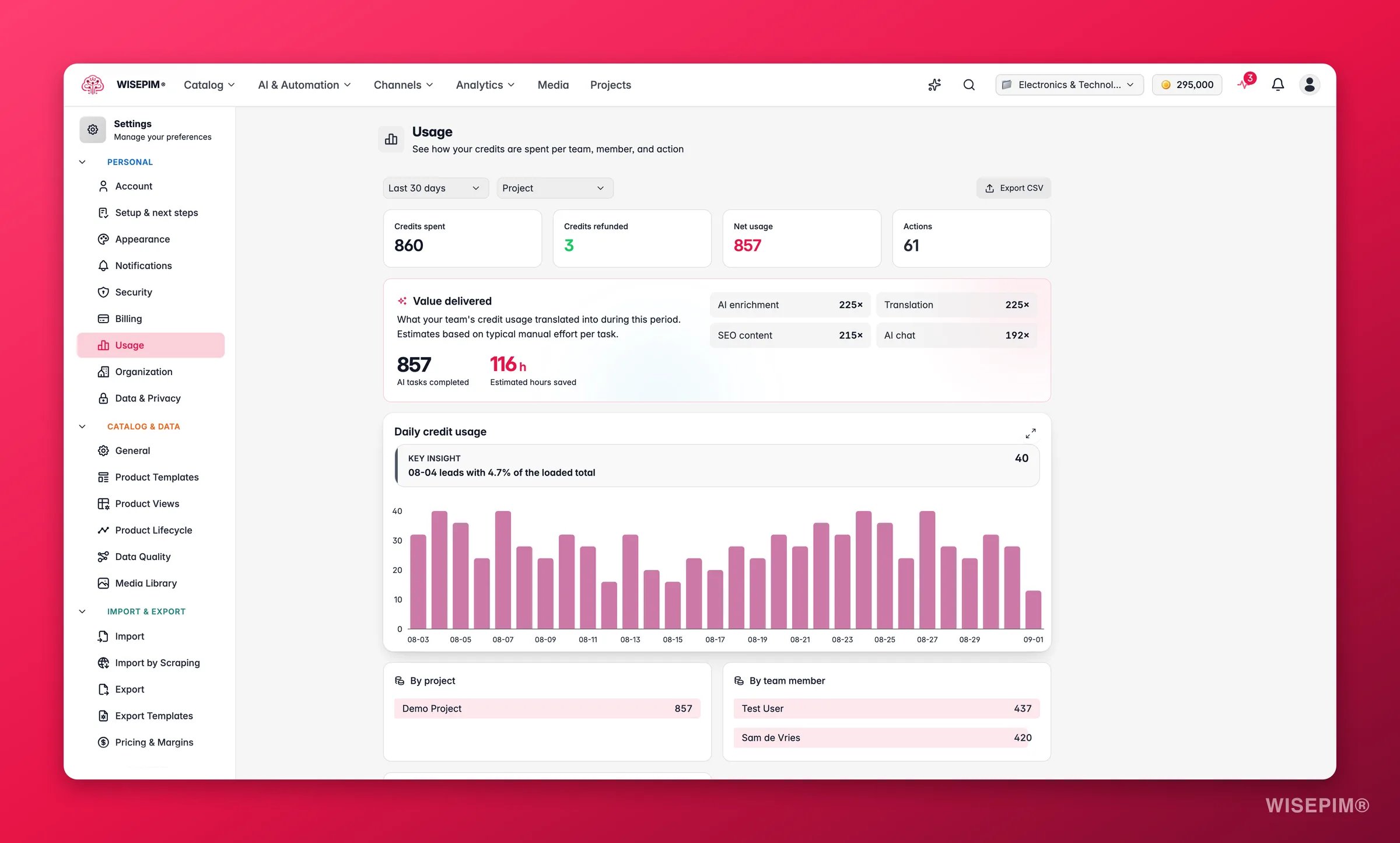
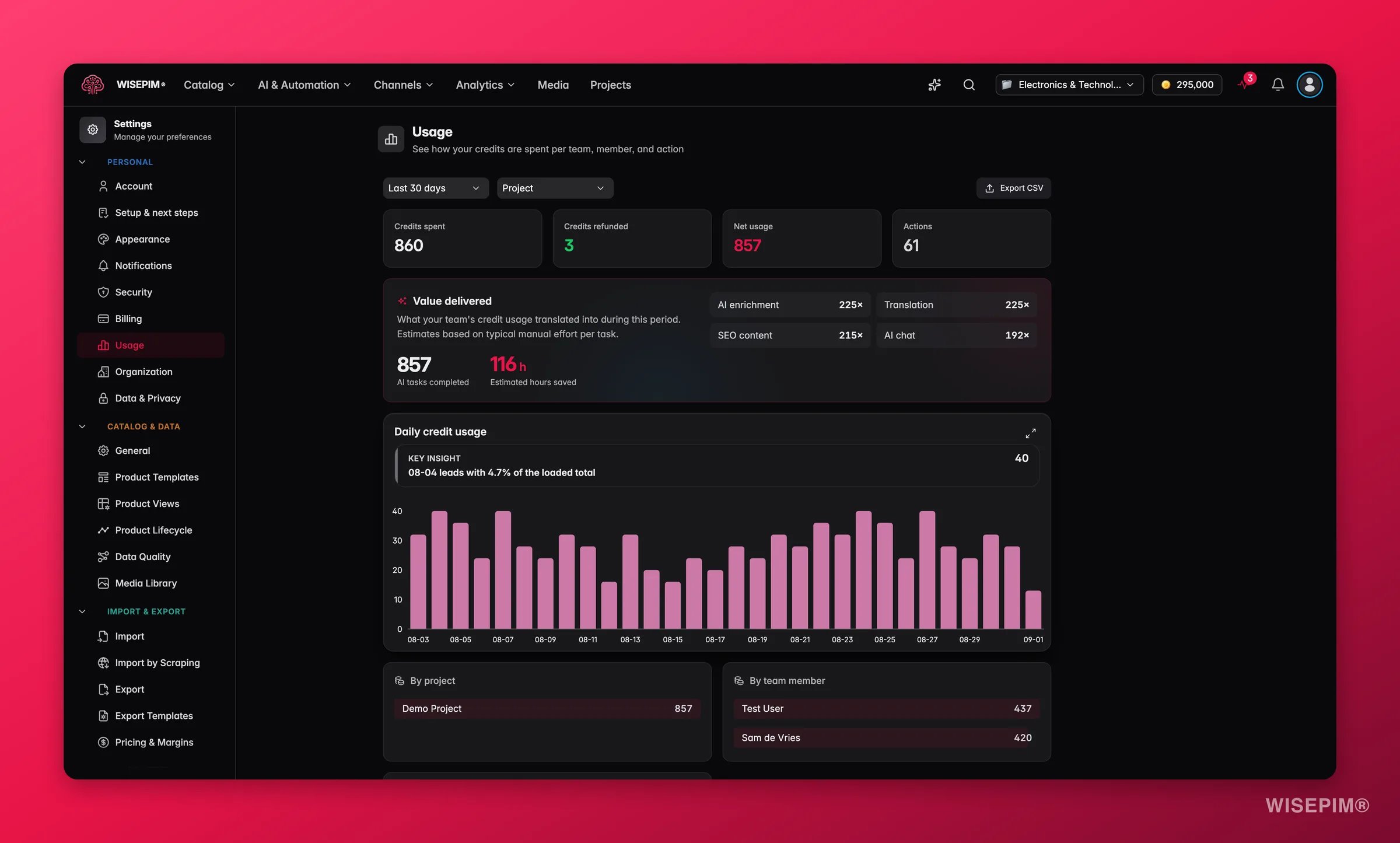 The Usage page shows how your AI credits are spent. Every paid action, from a single description to a bulk translation, lands in one ledger that you can slice by project, team member and action type.
**What this page enables:** you can answer "where did the credits go?" in seconds, spot a member or task that is burning through the budget, and put a cap on it before it becomes a problem.
**Where to find it:** go to **Settings** > **Usage** in the Personal group.
## Pick a period and a grouping
Two controls at the top drive everything below them:
* **Date range:** **Last 7 days**, **Last 30 days**, **Last 90 days** or **Last year**.
* **Group chart by:** **Project**, **Member**, **Action** or **Organization**. This decides how the daily chart is stacked.
Click **Export CSV** to download the filtered ledger for your own reporting.
The whole investigation lives in the page URL: range, grouping and any drill-down filters. Copy the link to share exactly what you are looking at with a teammate, or open two tabs to compare two ranges.
## Read the totals
Four tiles summarize the period:
| Tile | What it counts |
| -------------------- | ------------------------------------------------------------------------------------------------------ |
| **Credits spent** | Every credit deducted in the period. |
| **Credits refunded** | Credits returned for work that failed. WISEPIM refunds automatically, so a failed run never costs you. |
| **Net usage** | Spent minus refunded. This is what the period actually cost. |
| **Actions** | The number of paid actions behind those credits. |
### Value delivered
The **Value delivered** card turns the same numbers into work done: how many AI tasks completed and an estimate of the hours you did not spend doing them by hand. Each task type is weighted by the time it typically takes manually, such as writing a description or translating a product, so treat the hours as an estimate rather than a timesheet.
## Drill into the breakdowns
Below the **Daily credit usage** chart you get breakdown tables **By project**, **By team member** and **By action**, plus **By organization** when your projects belong to one. Click any row to apply it as a filter. Active filters show as chips above the chart; remove one with its close button or use **Clear all**.
The action types you will see include AI enrichment, Bulk enrich, Translation, SEO content, Titles, Internal linking, Image alt text, Categorization, Web research, Search intent, AI chat, ETIM enrichment, Image generation and Video generation.
### Recent activity
The **Recent activity** table is the raw ledger: date, action, member, project and credits for each event, paginated. Refunds are marked so you can tell a returned credit from a deduction.
## Spending controls
Spending controls are set per project by its owner. Change them in the project where the credits are spent.
The **Spending controls** section lets the project owner decide who can spend the project's credits and how much:
Under **Who can spend credits**, pick one of:
* **Owner, admins and editors** (default)
* **Owner and admins only**
* **Owner only**
The project owner can always spend credits. Members outside the chosen policy see their paid action refused with a message explaining the limit.
The table lists every team member with their role, what they spent this month and their **Monthly cap**. Leave it empty for **Unlimited**, or enter a number of credits. Once a member reaches the cap, further paid actions are refused until the next calendar month.
Click **Save**. Both the member and the project owner get a warning when a member crosses 80% of their cap.
A refused action because of a policy or cap is not the same as an empty credit balance. If a member reports "Monthly credit limit reached", raise their cap here; if the message is about credits running out, top up under [Billing](/en/settings/billing).
## Act on what you find
Set the range to **Last 30 days** and group by **Action**. A tall stack of one color usually points to a bulk run, such as Bulk enrich or Translation. Click that action to filter, then check **By team member** to see who started it.
Use the **Monthly cap** column in Spending controls. Start with a cap that covers a normal month plus some headroom. The 80% warning gives both of you time to talk before work stops.
Group by **Project**, set the range to the billing period and click **Export CSV**. The export carries project, member and action per event, which is enough for a chargeback line per client.
## Related
See your credit balance, what each action costs, and buy extra credits.
Share one credit pool across projects and allocate a budget to each.
Invite teammates and assign the roles that spending controls build on.
Watch the running tasks behind the credits being spent right now.
The Usage page shows how your AI credits are spent. Every paid action, from a single description to a bulk translation, lands in one ledger that you can slice by project, team member and action type.
**What this page enables:** you can answer "where did the credits go?" in seconds, spot a member or task that is burning through the budget, and put a cap on it before it becomes a problem.
**Where to find it:** go to **Settings** > **Usage** in the Personal group.
## Pick a period and a grouping
Two controls at the top drive everything below them:
* **Date range:** **Last 7 days**, **Last 30 days**, **Last 90 days** or **Last year**.
* **Group chart by:** **Project**, **Member**, **Action** or **Organization**. This decides how the daily chart is stacked.
Click **Export CSV** to download the filtered ledger for your own reporting.
The whole investigation lives in the page URL: range, grouping and any drill-down filters. Copy the link to share exactly what you are looking at with a teammate, or open two tabs to compare two ranges.
## Read the totals
Four tiles summarize the period:
| Tile | What it counts |
| -------------------- | ------------------------------------------------------------------------------------------------------ |
| **Credits spent** | Every credit deducted in the period. |
| **Credits refunded** | Credits returned for work that failed. WISEPIM refunds automatically, so a failed run never costs you. |
| **Net usage** | Spent minus refunded. This is what the period actually cost. |
| **Actions** | The number of paid actions behind those credits. |
### Value delivered
The **Value delivered** card turns the same numbers into work done: how many AI tasks completed and an estimate of the hours you did not spend doing them by hand. Each task type is weighted by the time it typically takes manually, such as writing a description or translating a product, so treat the hours as an estimate rather than a timesheet.
## Drill into the breakdowns
Below the **Daily credit usage** chart you get breakdown tables **By project**, **By team member** and **By action**, plus **By organization** when your projects belong to one. Click any row to apply it as a filter. Active filters show as chips above the chart; remove one with its close button or use **Clear all**.
The action types you will see include AI enrichment, Bulk enrich, Translation, SEO content, Titles, Internal linking, Image alt text, Categorization, Web research, Search intent, AI chat, ETIM enrichment, Image generation and Video generation.
### Recent activity
The **Recent activity** table is the raw ledger: date, action, member, project and credits for each event, paginated. Refunds are marked so you can tell a returned credit from a deduction.
## Spending controls
Spending controls are set per project by its owner. Change them in the project where the credits are spent.
The **Spending controls** section lets the project owner decide who can spend the project's credits and how much:
Under **Who can spend credits**, pick one of:
* **Owner, admins and editors** (default)
* **Owner and admins only**
* **Owner only**
The project owner can always spend credits. Members outside the chosen policy see their paid action refused with a message explaining the limit.
The table lists every team member with their role, what they spent this month and their **Monthly cap**. Leave it empty for **Unlimited**, or enter a number of credits. Once a member reaches the cap, further paid actions are refused until the next calendar month.
Click **Save**. Both the member and the project owner get a warning when a member crosses 80% of their cap.
A refused action because of a policy or cap is not the same as an empty credit balance. If a member reports "Monthly credit limit reached", raise their cap here; if the message is about credits running out, top up under [Billing](/en/settings/billing).
## Act on what you find
Set the range to **Last 30 days** and group by **Action**. A tall stack of one color usually points to a bulk run, such as Bulk enrich or Translation. Click that action to filter, then check **By team member** to see who started it.
Use the **Monthly cap** column in Spending controls. Start with a cap that covers a normal month plus some headroom. The 80% warning gives both of you time to talk before work stops.
Group by **Project**, set the range to the billing period and click **Export CSV**. The export carries project, member and action per event, which is enough for a chargeback line per client.
## Related
See your credit balance, what each action costs, and buy extra credits.
Share one credit pool across projects and allocate a budget to each.
Invite teammates and assign the roles that spending controls build on.
Watch the running tasks behind the credits being spent right now.