> ## Documentation Index
> Fetch the complete documentation index at: https://docs.wisepim.com/llms.txt
> Use this file to discover all available pages before exploring further.
# Product Templates
> Set the defaults every new product starts with: status, pricing, inventory, shipping, and SEO patterns. Save time and keep your catalog consistent.
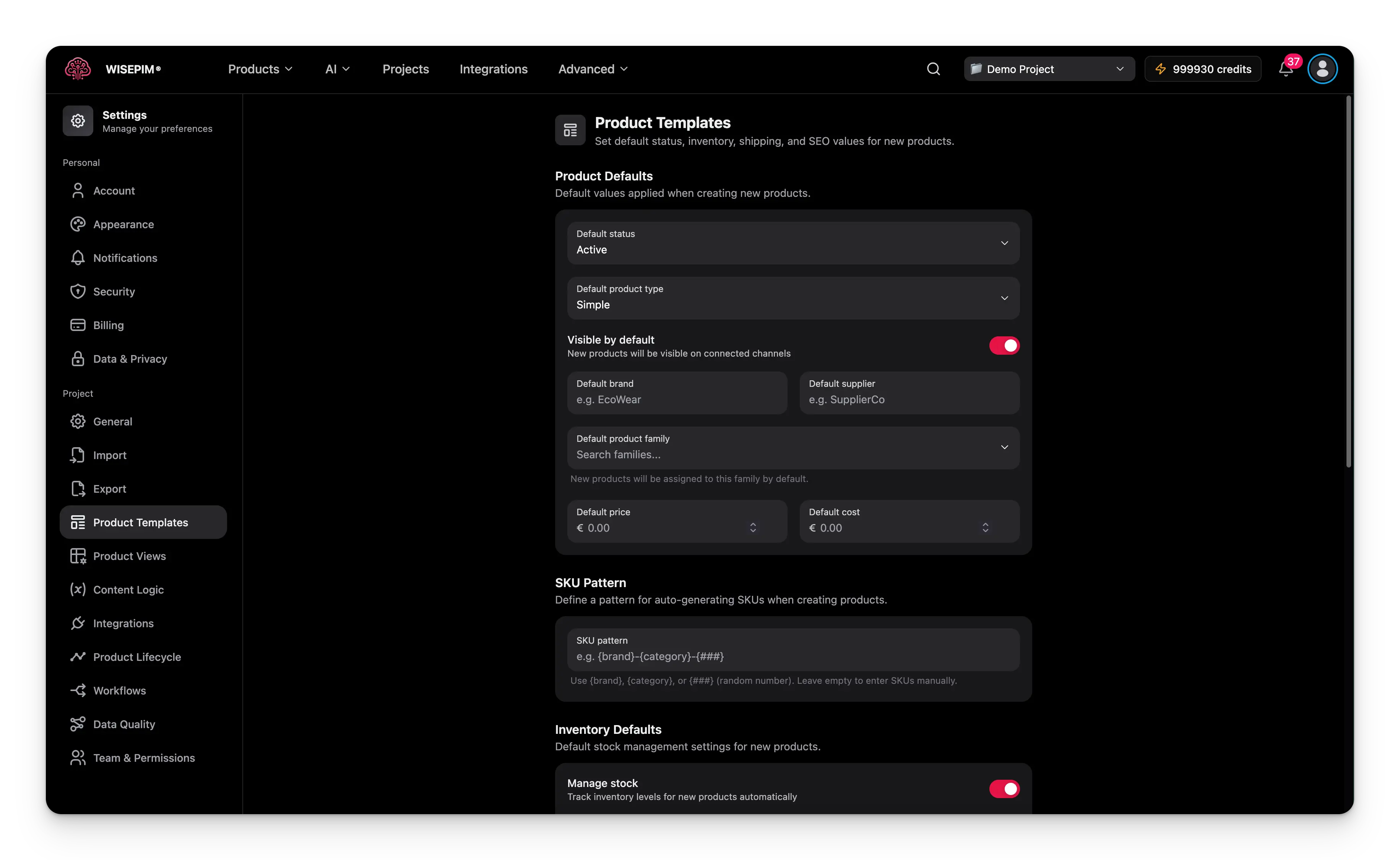 Product templates pre-fill fields whenever someone creates a new product. Set them once and every new product starts with the same baseline. This saves time, keeps your catalog consistent, and cuts repetitive data entry for your team.
Templates only apply to products created **after** you save them. Existing products do not change.
## Set product defaults
These are the baseline values every new product starts with. You can override any of them on a product later.
### Status and type
* **Default status**: where new products begin.
* **Draft**: hidden from channels.
* **Active**: published.
* **Archived**: hidden but kept.
* **Default product type**: the kind of product to create.
* **Simple**: a standalone product.
* **Configurable**: has variants like size or color.
* **Bundle**: groups several products together.
* **Virtual**: non-physical, such as a service.
### Visibility
Choose whether new products are **visible on connected channels** by default. When this is off, new products stay hidden until you publish them yourself.
### Brand and supplier
Pre-fill a default brand and supplier. They appear on every new product, and you can change them per product.
### Family and category
If your account has product families and categories set up, pick a default for each. New products are placed there automatically.
### Pricing
Set a default **price** and **cost**. Leave them blank to enter pricing by hand for each product.
Defaults pay off most when your project covers a single product line. One brand and one category means far less repeat typing.
## Auto-generate SKUs
Build a pattern and WISEPIM creates a SKU for every new product. A live preview below the field shows how generated SKUs will look.
Use these variables in your pattern:
| Variable | Becomes |
| ------------ | ------------------------- |
| `{brand}` | The product's brand name. |
| `{category}` | The product's category. |
| `{###}` | A random number. |
**Example**: the pattern `{brand}-{category}-{###}` with brand "EcoWear" produces SKUs like `EcoWear-TSHIRTS-4821`.
Leave the SKU pattern blank to assign SKUs by hand.
## Set inventory defaults
Control how stock works for new products:
* **Manage stock**: turn automatic inventory tracking on or off.
* **Default stock status**: choose **In Stock**, **Out of Stock**, or **On Backorder**.
* **Low stock threshold**: the quantity that triggers a low-stock alert.
## Set shipping defaults
Define default shipping and measurement settings:
* **Requires shipping**: turn off for digital products or services that do not ship.
* **Weight unit**: grams, kilograms, ounces, or pounds.
* **Dimension unit**: centimeters, meters, inches, or feet.
* **Country of origin**: the default manufacturing or origin country.
## Auto-generate SEO fields
Create patterns that fill the meta title and meta description for every new product. Patterns support dynamic variables, so each product gets unique, relevant text.
Use `{name}`, `{brand}`, `{sku}`, or `{category}` as placeholders. If you have content logic variables set up, you can also use the `{{product.field}}` syntax, with autocomplete to help.
| Field | Pattern | Generated output |
| ---------------- | ------------------------------------------------------------------ | -------------------------------------------------------------------------------- |
| Meta title | `{name} - {brand} \| Your Store` | `Organic Cotton T-Shirt - EcoWear \| Your Store` |
| Meta description | `Shop {name} from {brand}. High quality {category} available now.` | `Shop Organic Cotton T-Shirt from EcoWear. High quality T-Shirts available now.` |
For best results, keep meta titles under 60 characters and meta descriptions between 140 and 160 characters.
## Save your changes
When you change any setting, a save bar appears at the bottom of the page:
* **Save**: stores your template settings for this project.
* **Undo**: reverts everything to the last saved state.
## Related
Add products that start with your template defaults.
Bring in products in bulk from a file or integration.
Build the `{{product.field}}` variables used in SEO patterns.
Check that products meet your quality standards.
Product templates pre-fill fields whenever someone creates a new product. Set them once and every new product starts with the same baseline. This saves time, keeps your catalog consistent, and cuts repetitive data entry for your team.
Templates only apply to products created **after** you save them. Existing products do not change.
## Set product defaults
These are the baseline values every new product starts with. You can override any of them on a product later.
### Status and type
* **Default status**: where new products begin.
* **Draft**: hidden from channels.
* **Active**: published.
* **Archived**: hidden but kept.
* **Default product type**: the kind of product to create.
* **Simple**: a standalone product.
* **Configurable**: has variants like size or color.
* **Bundle**: groups several products together.
* **Virtual**: non-physical, such as a service.
### Visibility
Choose whether new products are **visible on connected channels** by default. When this is off, new products stay hidden until you publish them yourself.
### Brand and supplier
Pre-fill a default brand and supplier. They appear on every new product, and you can change them per product.
### Family and category
If your account has product families and categories set up, pick a default for each. New products are placed there automatically.
### Pricing
Set a default **price** and **cost**. Leave them blank to enter pricing by hand for each product.
Defaults pay off most when your project covers a single product line. One brand and one category means far less repeat typing.
## Auto-generate SKUs
Build a pattern and WISEPIM creates a SKU for every new product. A live preview below the field shows how generated SKUs will look.
Use these variables in your pattern:
| Variable | Becomes |
| ------------ | ------------------------- |
| `{brand}` | The product's brand name. |
| `{category}` | The product's category. |
| `{###}` | A random number. |
**Example**: the pattern `{brand}-{category}-{###}` with brand "EcoWear" produces SKUs like `EcoWear-TSHIRTS-4821`.
Leave the SKU pattern blank to assign SKUs by hand.
## Set inventory defaults
Control how stock works for new products:
* **Manage stock**: turn automatic inventory tracking on or off.
* **Default stock status**: choose **In Stock**, **Out of Stock**, or **On Backorder**.
* **Low stock threshold**: the quantity that triggers a low-stock alert.
## Set shipping defaults
Define default shipping and measurement settings:
* **Requires shipping**: turn off for digital products or services that do not ship.
* **Weight unit**: grams, kilograms, ounces, or pounds.
* **Dimension unit**: centimeters, meters, inches, or feet.
* **Country of origin**: the default manufacturing or origin country.
## Auto-generate SEO fields
Create patterns that fill the meta title and meta description for every new product. Patterns support dynamic variables, so each product gets unique, relevant text.
Use `{name}`, `{brand}`, `{sku}`, or `{category}` as placeholders. If you have content logic variables set up, you can also use the `{{product.field}}` syntax, with autocomplete to help.
| Field | Pattern | Generated output |
| ---------------- | ------------------------------------------------------------------ | -------------------------------------------------------------------------------- |
| Meta title | `{name} - {brand} \| Your Store` | `Organic Cotton T-Shirt - EcoWear \| Your Store` |
| Meta description | `Shop {name} from {brand}. High quality {category} available now.` | `Shop Organic Cotton T-Shirt from EcoWear. High quality T-Shirts available now.` |
For best results, keep meta titles under 60 characters and meta descriptions between 140 and 160 characters.
## Save your changes
When you change any setting, a save bar appears at the bottom of the page:
* **Save**: stores your template settings for this project.
* **Undo**: reverts everything to the last saved state.
## Related
Add products that start with your template defaults.
Bring in products in bulk from a file or integration.
Build the `{{product.field}}` variables used in SEO patterns.
Check that products meet your quality standards.