> ## Documentation Index
> Fetch the complete documentation index at: https://docs.wisepim.com/llms.txt
> Use this file to discover all available pages before exploring further.
# Send a different price per channel
> A marketplace fee is eating your margin. Add a per-channel markup at export time, with safeguards, and never change the prices you have stored.
A marketplace takes 15% of every order and your margin on that channel no longer works. The obvious move - raise the price - breaks everything else, because that same price goes to your webshop, your comparison feeds, and your partners. So people end up maintaining a second price list in a spreadsheet, and it's out of date within a month.
You don't need a second price list. WISEPIM can add the fee to the price *at the moment products leave for that one channel*, and leave the price stored on your product exactly as it is. Budget about 30 minutes.
**Before you start:** [Pricing & Margins](/en/settings/pricing) needs the **Scale** plan or higher - you can read the page and browse the recipes on any plan, but the master switch, **New rule**, and saving are locked. Cost prices on your products make the safeguards far more useful.
**What you'll get:** the marketplace receives a price that absorbs its fee, every other channel keeps the price you stored, and one switch reverts all of it instantly.
## Three things are called pricing. Pick the right one.
Picking the wrong one is the most expensive mistake in this flow, because one of the three rewrites the prices stored on your products and syncs them onward. Check this table before you build anything.
| Tool | What it does | Reach for it when |
| ----------------------------------------------------------- | ------------------------------------------------------------------------------------ | ------------------------------------------------------------------------------ |
| **[Pricing & Margins](/en/settings/pricing)** | Transforms the price **on export**, per channel. Your stored price is never touched. | A channel needs a different number than the one you keep. |
| **[Discounts & Pricing](/en/products/discounts)** | Changes the prices **stored** on your products, and syncs them to your stores. | You want the price to actually be lower: promotions, volume tiers, B2B groups. |
| **Pricing strategy** in [Web Research](/en/ai/web-research) | Reads competitor prices and **recommends** a number. Nothing is written anywhere. | You don't know what to charge yet. |
This guide is entirely about the first row. If your reaction is "but I do want the price to change", stop here and go to [Discounts & Pricing](/en/products/discounts) instead.
## Build the marketplace-fee rule
The whole mechanism in one line: the rule only fires on the channel you scope it to, and everything else leaves with the price you stored.
```mermaid theme={null}
flowchart LR
A[Stored price] --> B[Channel-scoped rule]
B --> C[Safeguards]
C --> D[Marketplace price]
A --> E[Every other channel]
```
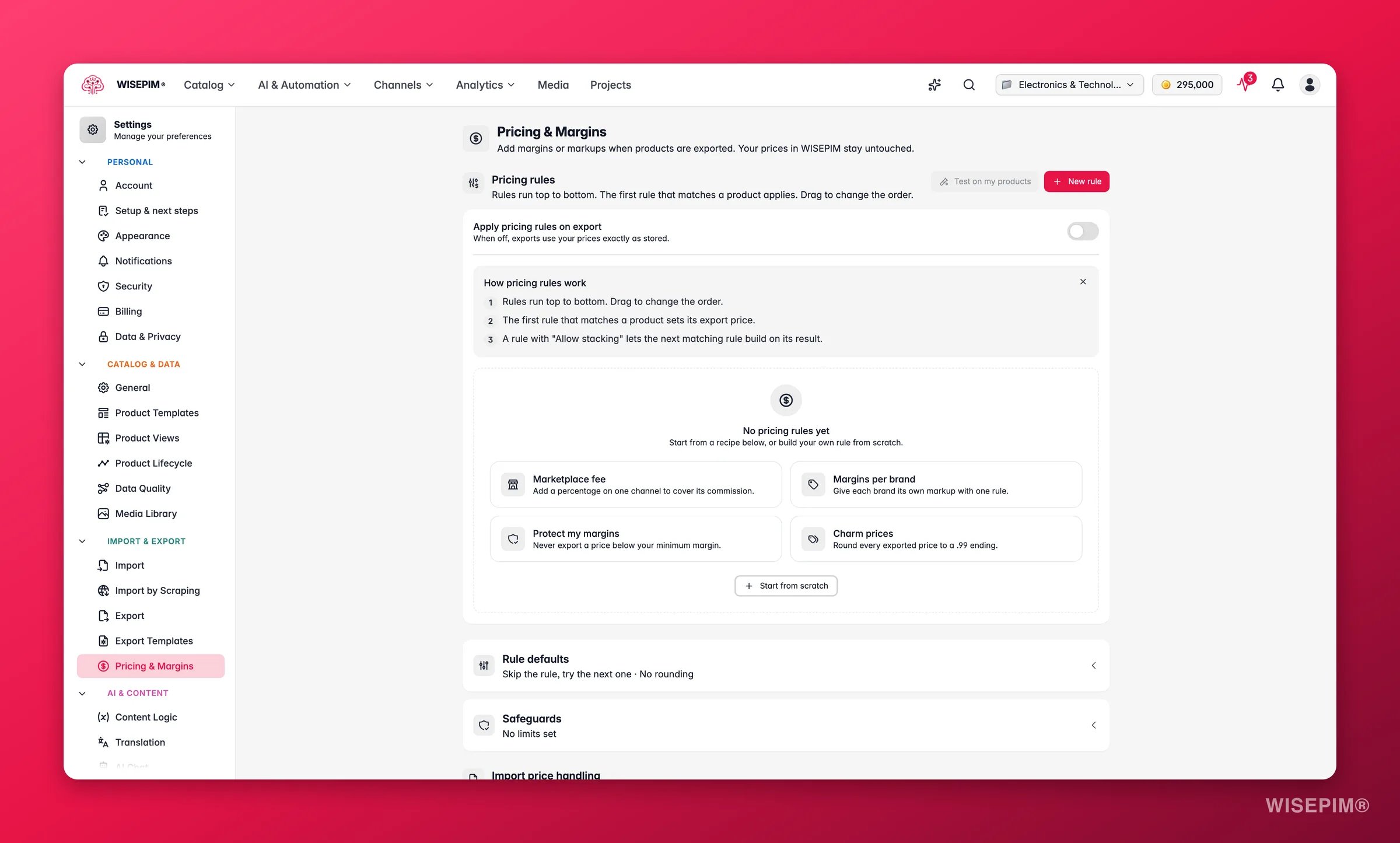
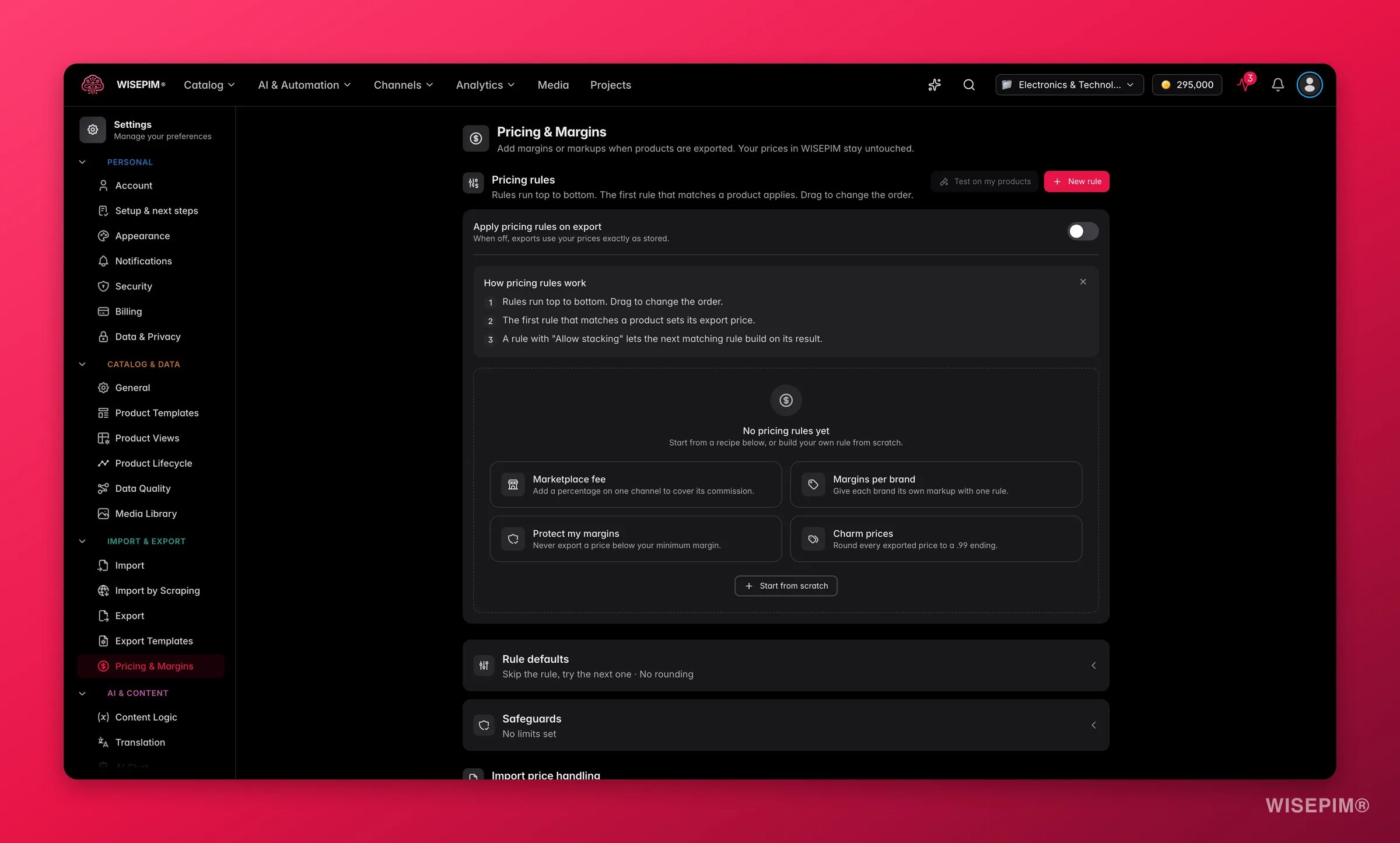 You'll find it in **Settings**, under Import & Export. Click **New rule** and pick the **Marketplace fee** recipe. Recipes only pre-fill the form - everything stays editable, but starting from one means you don't have to remember which calculation type you meant.
"Kaufland +15%" beats "Rule 3" in six months, when someone else is reading your rule list trying to work out why a price looks odd.
This is the step that makes it per-channel. Under **Channels**, choose the marketplace instead of leaving it on **All channels** - a rule with no channel restriction applies everywhere prices go out, including your own shop. You can scope to connected platforms, file exports, a specific [feed](/en/essentials/feed-hub), or a specific [brand portal](/en/other-features/brand-portals).
For a blanket marketplace fee, every product in the channel is usually right. If only part of your assortment sells there, use **Quick add** for brand, supplier, category, or family, and watch the live "≈ N products" chip.
**Percentage markup** is the one that covers a commission. Then set rounding - **Charm .99** or whole numbers keep marketplace prices looking deliberate rather than computed.
The editor keeps a live **In plain words** summary of the rule. If that sentence doesn't describe what you meant, the rule is wrong, and no amount of previewing later will fix it.
Rules run top to bottom and the **first rule that matches a product wins** - everything below it is skipped for that product. If you already have a catch-all rule for this marketplace, drag your specific rule above it, or turn on **Allow stacking**.
## Set the safeguards that stop a bad day
Safeguards are the part people skip and later wish they hadn't. They're optional limits that override the calculation when it goes somewhere you didn't intend, and an empty field simply means "no limit". Set them now, before the preview, so the preview shows you the rule you'll actually ship.
Still in the rule editor, open the **Safeguards** step. **Minimum margin (%)** is the single most valuable one: it stops the rule leaving you below the margin you actually need after the calculation runs, however strange the underlying cost data turns out to be.
Put this on any rule that touches cost price. It's the cheapest protection against one supplier file with a decimal in the wrong place - a price that suddenly moves 400% gets capped instead of shipped.
**Minimum price** and **Maximum price** are for hard limits: a marketplace band you must stay inside, or a psychological ceiling you never want to cross.
This one is project-wide, not per rule: back on the main Pricing & Margins page, open the **Rule defaults** accordion. Cost-based calculations can't run without a cost, so choose whether such a product skips to the next rule, keeps its current price, or keeps it **and gets flagged**. The flag option turns a silent gap into a to-do list.
When a safeguard changes the outcome, the result is labelled - **Margin floor applied**, **Change limited**, **Capped at maximum price**, **No cost price**, **Below cost**. You'll read these in the previews next, so it's worth knowing they exist.
## Preview it, then turn it on
The master switch comes last on purpose. Three previews sit between you and it, each answering a question the previous one can't - the maths, then one real product, then the whole rule set. Work them in that order and the switch is a formality rather than a gamble.
Inside the rule editor, type a price and a cost and read the resulting **Export price** plus the **How it's calculated** trail. It's a sandbox - no real data, and it's where you catch having confused a 40% markup with a 40% margin. They are not the same number.
Still in the editor, but this one runs an actual product through the actual engine. You get the old price struck through, the new price beside it, and the margin and safeguard chips that fired. Do this before you save.
From the main page, **Test on my products** runs a 25-product sample through your whole rule set. Set the channel picker to the marketplace you just scoped rather than leaving it on **All rules, any channel**, or you're testing a different question. **Read the safeguard column, not just the after column** - a lot of safeguard hits usually means a rule is aimed at products it was never meant to touch. **Run again** draws a fresh sample.
**Apply pricing rules on export**, at the top of the page, is what makes any of this real. It's also your escape hatch: switch it off and every export reverts to your stored prices immediately, with nothing to undo, because nothing was ever written to your products.
Prices can come back in from a channel. **Smart** works out whether an incoming price is genuinely new or just your own marked-up price coming home, and only stores the real changes. It exists precisely to stop your exported price becoming your new cost base.
Once rules are active, the price in your product list will differ from the price the marketplace receives. That's the feature working correctly - but say it out loud, or somebody spends an afternoon hunting a mismatch that's by design.
## How to tell it worked
You'll find it in **Settings**, under Import & Export. Click **New rule** and pick the **Marketplace fee** recipe. Recipes only pre-fill the form - everything stays editable, but starting from one means you don't have to remember which calculation type you meant.
"Kaufland +15%" beats "Rule 3" in six months, when someone else is reading your rule list trying to work out why a price looks odd.
This is the step that makes it per-channel. Under **Channels**, choose the marketplace instead of leaving it on **All channels** - a rule with no channel restriction applies everywhere prices go out, including your own shop. You can scope to connected platforms, file exports, a specific [feed](/en/essentials/feed-hub), or a specific [brand portal](/en/other-features/brand-portals).
For a blanket marketplace fee, every product in the channel is usually right. If only part of your assortment sells there, use **Quick add** for brand, supplier, category, or family, and watch the live "≈ N products" chip.
**Percentage markup** is the one that covers a commission. Then set rounding - **Charm .99** or whole numbers keep marketplace prices looking deliberate rather than computed.
The editor keeps a live **In plain words** summary of the rule. If that sentence doesn't describe what you meant, the rule is wrong, and no amount of previewing later will fix it.
Rules run top to bottom and the **first rule that matches a product wins** - everything below it is skipped for that product. If you already have a catch-all rule for this marketplace, drag your specific rule above it, or turn on **Allow stacking**.
## Set the safeguards that stop a bad day
Safeguards are the part people skip and later wish they hadn't. They're optional limits that override the calculation when it goes somewhere you didn't intend, and an empty field simply means "no limit". Set them now, before the preview, so the preview shows you the rule you'll actually ship.
Still in the rule editor, open the **Safeguards** step. **Minimum margin (%)** is the single most valuable one: it stops the rule leaving you below the margin you actually need after the calculation runs, however strange the underlying cost data turns out to be.
Put this on any rule that touches cost price. It's the cheapest protection against one supplier file with a decimal in the wrong place - a price that suddenly moves 400% gets capped instead of shipped.
**Minimum price** and **Maximum price** are for hard limits: a marketplace band you must stay inside, or a psychological ceiling you never want to cross.
This one is project-wide, not per rule: back on the main Pricing & Margins page, open the **Rule defaults** accordion. Cost-based calculations can't run without a cost, so choose whether such a product skips to the next rule, keeps its current price, or keeps it **and gets flagged**. The flag option turns a silent gap into a to-do list.
When a safeguard changes the outcome, the result is labelled - **Margin floor applied**, **Change limited**, **Capped at maximum price**, **No cost price**, **Below cost**. You'll read these in the previews next, so it's worth knowing they exist.
## Preview it, then turn it on
The master switch comes last on purpose. Three previews sit between you and it, each answering a question the previous one can't - the maths, then one real product, then the whole rule set. Work them in that order and the switch is a formality rather than a gamble.
Inside the rule editor, type a price and a cost and read the resulting **Export price** plus the **How it's calculated** trail. It's a sandbox - no real data, and it's where you catch having confused a 40% markup with a 40% margin. They are not the same number.
Still in the editor, but this one runs an actual product through the actual engine. You get the old price struck through, the new price beside it, and the margin and safeguard chips that fired. Do this before you save.
From the main page, **Test on my products** runs a 25-product sample through your whole rule set. Set the channel picker to the marketplace you just scoped rather than leaving it on **All rules, any channel**, or you're testing a different question. **Read the safeguard column, not just the after column** - a lot of safeguard hits usually means a rule is aimed at products it was never meant to touch. **Run again** draws a fresh sample.
**Apply pricing rules on export**, at the top of the page, is what makes any of this real. It's also your escape hatch: switch it off and every export reverts to your stored prices immediately, with nothing to undo, because nothing was ever written to your products.
Prices can come back in from a channel. **Smart** works out whether an incoming price is genuinely new or just your own marked-up price coming home, and only stores the real changes. It exists precisely to stop your exported price becoming your new cost base.
Once rules are active, the price in your product list will differ from the price the marketplace receives. That's the feature working correctly - but say it out loud, or somebody spends an afternoon hunting a mismatch that's by design.
## How to tell it worked
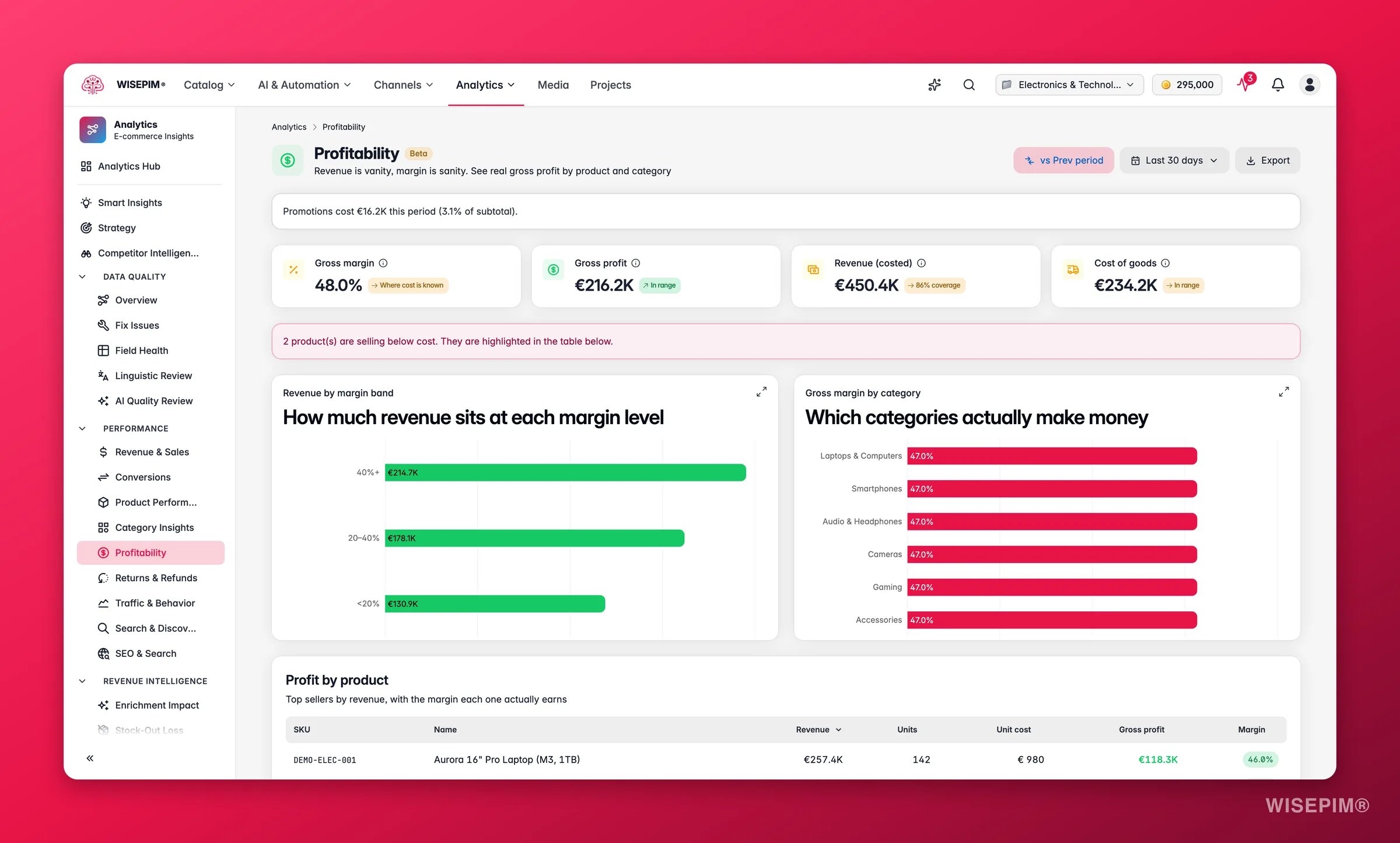
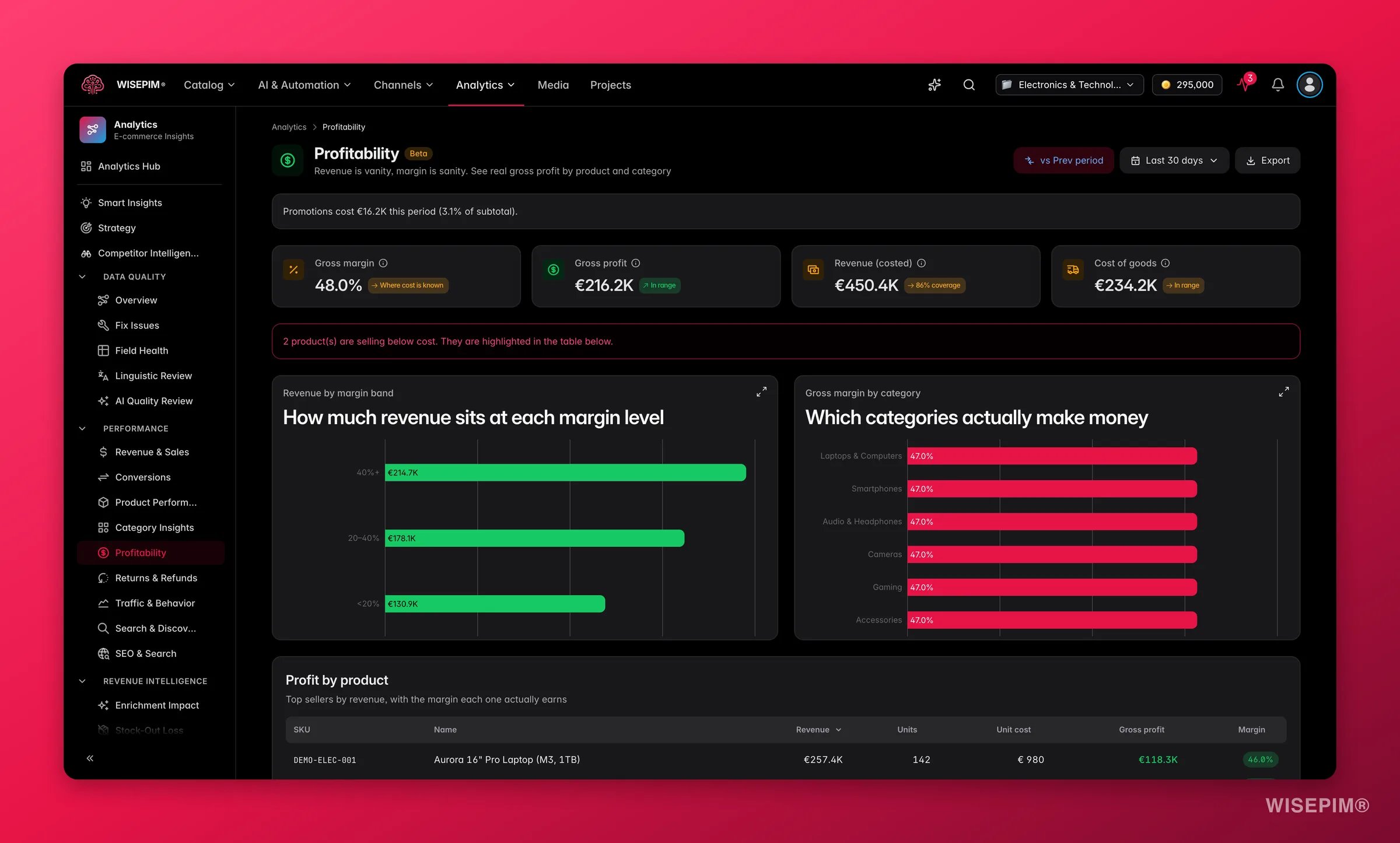 | Signal | Where to look | When it moves |
| ------------------------------- | -------------------------------------------------------------------------------- | ------------------------------------------------------------------- |
| Products evaluated vs adjusted | **Test on my products** chips | Same session, on a 25-product sample |
| Safeguard hits, and which ones | The safeguard column in the same test | Same session - a high count means re-scope the rule |
| Export price ≠ stored price | The exported file, or the [feed](/en/essentials/feed-hub) row for a SKU you know | On the very next export or feed generation |
| Gross margin % for that channel | [Profitability](/en/analytics/profitability) | Only once orders arrive, and only if costs are set on your products |
| Products selling below cost | The red-flagged rows in Profitability | Same reporting period - treat these as same-day work |
Pricing rules use **no AI credits**, so previewing and re-testing costs you nothing but time. Test more than feels necessary.
## When it doesn't work
Work down the list in this order: is **Apply pricing rules on export** on, is the rule itself **Active**, does its **Channels** scope actually include the destination you exported to, and is there a rule above it that matched the product first? Rules stop at the first match, so a catch-all sitting above your specific rule will swallow it - drag the specific one higher, or switch on **Allow stacking**. The "≈ N products" chip on the rule tells you straight away if the product scope is wrong.
That's almost always cost data rather than the rule. Run **Test on my products** and read the safeguard chips: **No cost price** and **Below cost** point straight at the products with bad or missing costs. Add a **Maximum change (%)** so the next bad supplier file gets capped instead of exported.
Check **Import price handling**. **Smart** is the recommended default because it recognises your own exported price returning; **Reverse the markup** runs an incoming price backwards through the rule before storing it, and **Never import prices** makes your stored price the only truth.
Pricing rules need the **Scale** plan or higher. The page stays readable on any plan - you can browse the recipes and the safeguards, but saving is gated with a note pointing at the upgrade.
Turn off **Apply pricing rules on export**. Every export reverts to your stored prices on the spot. Nothing needs undoing, because nothing was ever written to your products. Stop the bleeding first, debug afterwards.
## Related
Every calculation type, safeguard, and import option in full.
Scope a rule to a portal so each partner sees their own price level.
Get the channel accepting your feed before you worry about its fee.
The B2B catalog these partner price levels usually go with.
| Signal | Where to look | When it moves |
| ------------------------------- | -------------------------------------------------------------------------------- | ------------------------------------------------------------------- |
| Products evaluated vs adjusted | **Test on my products** chips | Same session, on a 25-product sample |
| Safeguard hits, and which ones | The safeguard column in the same test | Same session - a high count means re-scope the rule |
| Export price ≠ stored price | The exported file, or the [feed](/en/essentials/feed-hub) row for a SKU you know | On the very next export or feed generation |
| Gross margin % for that channel | [Profitability](/en/analytics/profitability) | Only once orders arrive, and only if costs are set on your products |
| Products selling below cost | The red-flagged rows in Profitability | Same reporting period - treat these as same-day work |
Pricing rules use **no AI credits**, so previewing and re-testing costs you nothing but time. Test more than feels necessary.
## When it doesn't work
Work down the list in this order: is **Apply pricing rules on export** on, is the rule itself **Active**, does its **Channels** scope actually include the destination you exported to, and is there a rule above it that matched the product first? Rules stop at the first match, so a catch-all sitting above your specific rule will swallow it - drag the specific one higher, or switch on **Allow stacking**. The "≈ N products" chip on the rule tells you straight away if the product scope is wrong.
That's almost always cost data rather than the rule. Run **Test on my products** and read the safeguard chips: **No cost price** and **Below cost** point straight at the products with bad or missing costs. Add a **Maximum change (%)** so the next bad supplier file gets capped instead of exported.
Check **Import price handling**. **Smart** is the recommended default because it recognises your own exported price returning; **Reverse the markup** runs an incoming price backwards through the rule before storing it, and **Never import prices** makes your stored price the only truth.
Pricing rules need the **Scale** plan or higher. The page stays readable on any plan - you can browse the recipes and the safeguards, but saving is gated with a note pointing at the upgrade.
Turn off **Apply pricing rules on export**. Every export reverts to your stored prices on the spot. Nothing needs undoing, because nothing was ever written to your products. Stop the bleeding first, debug afterwards.
## Related
Every calculation type, safeguard, and import option in full.
Scope a rule to a portal so each partner sees their own price level.
Get the channel accepting your feed before you worry about its fee.
The B2B catalog these partner price levels usually go with.